

Johnston voters reject expanded eminent domain power; Santoros’ battle continues
“Johnston voters sent a clear message: they do not want to give the Town broader power to take private property,” said Kady Valois, an attorney with Pacific Legal Foundation.
Eco-friendly entrepreneur fights to sell biodegradable boat wrap in Minnesota
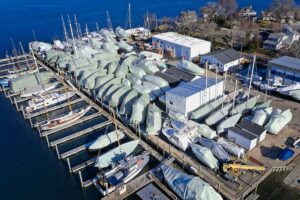
Every spring in Jamestown, Rhode Island, boat owners tear off the plastic coverings that sheltered their vessels through the winter and toss them into dumpsters. Within weeks, the boats are back on the water. The plastic heads to a landfill, where it will sit for centuries. Simon Milne, an entrepreneur and sailor himself, watched the waste pile ...

Georgia nurse practitioner sues to stop medical board from rewriting law
Georgia nurse practitioner Erin Patel challenges a medical board policy that treats paid collaborating physicians as employees, blocking her practice.
Erin Patel v. State of Georgia
Georgia nurse practitioner Erin Patel challenges a medical board policy that treats paid collaborating physicians as employees, blocking her practice.

National Review: Congress Seeks a Shot Clock on the Permitting Fast Lane
Congress is on the verge of fixing one of the strangest defects in federal permitting: an environmental review designed to be fast that has no time limitation. Introduced on September 30, the Senate's new Bipartisan American Affordability and Jobs Act (BAAJA) would, among many other permitting changes, impose a one-year deadline on federal permi ...

Real Clear Energy: Permitting Reform Could Be a Victory for the Environment
America has the seventh-largest known unmined copper reserves in the world. Those reserves alone could meet current U.S. demand for more than two decades, supplying the copper needed for electricity, buildings, and other critical infrastructure. Yet we still import 57% of the copper we use—much of it from Chile. American environmentalism often ...

PLF joins new challenges to Clean Water Act citizen suits in California, Pennsylvania, and Tennessee
PLF has joined three citizen suits in defense of a family-owned California business, a Pennsylvania manufacturer, and a Tennessee town. In each case, PLF asks the court to hold that the Clean Water Act’s 1972 “citizen suit” provision violates the Constitution by handing the executive branch’s prosecutorial power to unaccountable private actors.

Tennessee Riverkeeper, Inc. v. Town of Alexandria, Tennessee
Represented at no cost by Pacific Legal Foundation, the Town of Alexandria asks the court to dismiss the citizen suit filed against it and find the CWA’s citizen suit provision unconstitutional.

Friends of the Delaware River, LLC v. Martelli’s Metal Fabrication, Inc.
Martelli’s argues that citizen suits threaten Americans’ rights by allowing private actors, who cannot be held accountable by the voting public, to exercise government authority.

Inland Empire Waterkeeper, et al. v. Corona Clay Company
Corona Clay argues that the CWA’s citizen suit provision should be struck down because it violates the Constitution’s nondelegation doctrine and the separation of powers by allowing private plaintiffs to wield the executive branch’s prosecutorial powers.