Unconstitutional Accreditation Pressures Force Law Schools to Discriminate against Faculty and Students
By Caitlin Styrsky and Alison Somin
Table of Contents
Discrimination on the basis of race or sex in law school hiring and admissions is illegal, but the American Bar Association (ABA), the only federally approved accreditor of JD programs in the United States, has pushed law schools to discriminate anyway. This research in brief reports the results of a Pacific Legal Foundation survey conducted via public records requests of the 50 best public law schools (as ranked by U.S. News & World Report). Forty-five schools responded. The results indicate that law schools often face pressure from the ABA to adopt racial preferences in their admissions and hiring practices to meet the ABA’s preferred demographics. 1 This research in brief uses “ABA” to refer to the American Bar Association, as well as to the Council of the Section of Legal Education and Admissions to the Bar, which is the ABA’s accreditation arm.
Law schools generally cannot discriminate in these areas without violating the Constitution, Title VI of the 1964 Civil Rights Act, Title IX of the Education Amendments of 1972, and state laws and constitutional provisions prohibiting race and sex discrimination. Furthermore, as a monopoly accreditor that can control access to federal student aid (FSA) programs and state licensure of attorneys, the ABA may be enough of a state actor that its requirements and pressures are especially invidious. Legislation is necessary to address the ABA’s unlawful pressure on law schools.
Why Study Racial Preferences in Accreditation?
Accreditors, including law school accreditors, have long pushed colleges and universities toward the increased use of racial preferences. In 1988, the Western Association of Schools and Colleges (WASC) began requiring accredited schools to make “positive efforts to foster . . . diversity.” 2 By 1994, conflict over WASC’s diversity standards had heated up. Fourteen schools (including Caltech, Stanford, and USC) objected to the WASC requirement that they promulgate official diversity statements. However, the objections of these wealthy and prominent institutions were insufficient to convince WASC to halt what Berkeley sociology professor Martin Trow described as a “fiercely evangelical movement.” Trow is quoted in Gail L. Heriot and Peter Kirsanow, “Letter on Need for Legislation on Accreditation Abuses Submitted to Bill Cassidy, Chair of the Senate Committee on Health, Education, Labor & Pensions by Two Members of the United States Commission on Civil Rights” (San Diego Legal Studies Paper No. 25-007, University of San Diego, San Diego, CA, last revised April 9, 2025), 7. The Rand Graduate School of Policy Studies was the first school to be sanctioned under this standard, 3 While Rand had met all other requirements for reaccreditation, WASC found it was “missing an opportunity to take leadership and responsibility” with regard to race, sex, and ethnic diversity. followed by Thomas Aquinas College. 4 Unlike Rand, Thomas Aquinas fought back, claiming that it preferred a policy of nondiscrimination in admissions. In 1990, the Middle States Association of Colleges and Schools sanctioned Baruch College (part of the City University of New York) for failing to meet the association’s diversity standards. 5 Baruch College was criticized in 1990 by the Middle States Association of Colleges and Schools for failure to hire enough minority faculty members and to retain enough Black and Latino students. Eventually, then–Secretary of Education Lamar Alexander saved Baruch by deferring the renewal of the accreditor’s federal recognition. By the late 1990s, 31 percent of law schools and 24 percent of medical schools reported that they “felt pressure” from accreditation agencies to “take race into account when making admissions decisions.” 6 Susan Welch and John Gruhl, Affirmative Action in Minority Enrollments and Law School (Ann Arbor, MI: University of Michigan Press, 1998), 80.
Although traditionally the goal of accreditation has been to ensure a minimum level of educational quality for all students, recent accreditors have been forthright that diversity standards are actually intended to achieve broader social goals. When the Council on Postsecondary Accreditation (COPA) defended such rules promulgated by the Middle States Association of Colleges and Schools, COPA “pointed out that accrediting agencies had adopted ‘diversity’ rules for different reasons . . . less to do with an assessment of educational quality than with the agency’s desire to promote its conception of the larger public good.” 7 Matthew W. Finkin, “The Unfolding Tendency in the Federal Relationship to Private Accreditation in Higher Education,” Law and Contemporary Problems 57, no. 4 (1994), 89–120.
Law school accreditation follows this pattern. The ABA promulgates rules and standards with which law schools must comply. 8 For the 2024–2025 standards, see American Bar Association Section of Legal Education and Admissions to the Bar, Standards and Rules of Procedure for Approval of Law Schools 2024–2025 (Chicago, IL: American Bar Association, 2024). These standards are intended to establish requirements for ensuring “a sound program of legal education” and, since 2006, they have included standards concerning student body and faculty diversity. 9 American Bar Association Section of Legal Education and Admissions to the Bar, Standards and Rules , 105. Since ABA accreditation triggers access to FSA programs and state-level prerogatives for JD graduates, the ABA functions as a quasi-governmental entity. Moreover, unlike the variety of institutional accreditors for programs other than the JD, the ABA currently holds a monopoly for JD accreditation. In his 1972 annual address, ABA President Leon Jaworski observed that “the [ABA]—now and for some time past unmistakably the organization of the legal profession in this country—has become what amounts to a quasi-public institution.” 10 Leon Jaworski, “The American Bar Association: A Quasi-Public Institution,” American Bar Association Journal 58, no. 9 (1972): 917–19. Since most states require bar exam candidates to have graduated from an ABA-accredited law school, the accreditation process has become a powerful tool through which the ABA can compel law schools to adopt its preferred policies on hiring and admissions.
The ABA has vigorously enforced its diversity standards. It investigated George Mason University School of Law extensively starting in 2000 for supposed violations of its diversity standards and only gave up after the school quietly lowered its admissions standards to satisfy the ABA’s demands. 11 The ABA took a hard line against George Mason University School of Law following a site evaluation in early 2000. A report summarizing the site evaluation notes that “the Law School has not been very successful in recruiting minority students and the number has actually declined recently.” The report was clear that the problem was not insufficient outreach from Mason to minority students. Mason’s outreach efforts were strong, but they didn’t matter to the ABA unless the law school achieved certain demographic quotas. After several years of action letters and back-and-forth with the ABA, Mason quietly gave up and shifted its admissions strategy to achieve the racial numbers the ABA wanted. For additional details, see Heriot and Kirsanow, “Letter on Need for Legislation,” 9–15. In 2006, the newly established Charleston School of Law failed to gain ABA accreditation over concern about insufficient racial diversity. The ABA accredited Charleston Law only after the school agreed to appoint a director of diversity. 12 Gail L. Heriot, “Affirmative Action in American Law Schools,” Journal of Contemporary Legal Issues 17 (2008), 237–280. In 2006, professor David Barnhizer of the Cleveland-Marshall College of Law wrote about a similar instance:
Not long ago, I was asked to be a candidate for dean at another law school. . . . I asked the chair of the dean search committee to send me some background materials. The materials were sent and included the most recent ABA and AALS accreditation reports and follow-ups relating to the law school. . . . 13 The Association of American Law Schools (AALS) maintains membership standards but is not a federally recognized accreditor.
After reading the reports, I withdrew my name from their search. The reason I withdrew had nothing to do with the law school but with the AALS/ABA accreditation report and the degree to which the culture of soft repression had reached inside the accreditation mechanisms of those two institutions. . . . Two main criticisms were voiced as serious concerns by the AALS/ABA report to the extent that immediate action was needed to avoid a negative final accreditation report. One criticism was that of twenty-three faculty members, only eight were women. It was expected that something must be done immediately to fix this problem. . . .
[B]ecause the law school was eager to solidify its status with the AALS/ABA, it was particularly vulnerable to the pressure. The result was that it hired a woman only one year out of law school who would otherwise probably not have been hired at that point in her legal career. 14 David Barnhizer, “A Chilling Discourse,” Saint Louis Law Journal 50, no. 2 (2006): 361–424.
Such practices have come to the attention of legislators, civil rights commissioners, and the president of the United States. In 2024, Iowa legislator Henry Stone argued that accreditation requirements undermined a state law banning diversity, equity, and inclusion (DEI) training that he had cosponsored. Under the legislation, Iowa’s Carver College of Medicine should have been required to close its Office of Health Parity, but the office remained open because the university’s board of regents said “its hand was forced by accreditors,” even though the accreditors claimed that discriminatory activities were not technically required. 15 Henry Stone, “How Colleges and Universities Get Around State DEI Bans,” Wall Street Journal, December 20, 2024. Stone called upon Congress to prohibit accreditors from imposing diversity requirements.
In March 2025, two members of the US Commission on Civil Rights also surveyed the available evidence and called for Congress to pass legislation prohibiting accreditors from taking diversity policies into account when making accreditation decisions. 16 Heriot and Kirsanow, “Letter on Need for Legislation.” In April, President Donald J. Trump issued Executive Order 14279 to end racial preferences as a condition of accreditation. 17 Reforming Accreditation to Strengthen Higher Education, Executive Order 14279, 90 Fed. Reg. 17529 (April 23, 2025). The order states that “accreditors have remained improperly focused on compelling adoption of discriminatory ideology” and that “some accreditors make the adoption of unlawfully discriminatory practices a formal standard of accreditation, and therefore a condition of accessing Federal aid.” 18 Executive Order 14279, 90 Fed. Reg. 17529. The order requires the Department of Education to “hold accountable” accreditors that violate federal law by requiring institutions to engage in unlawful discrimination. 19 Executive Order 14279, 90 Fed. Reg. 17530. The order also requires the attorney general and secretary of education to “take appropriate action to terminate unlawful discrimination by American law schools that is advanced” by accreditors, and the Secretary of Education “shall also assess whether to suspend or terminate the [ABA’s] status as an accrediting agency under Federal law.” 20 Executive Order 14279, 90 Fed. Reg. 17530.
In 2023, the Supreme Court’s opinion in Students for Fair Admissions v. Harvard made clear that race preferences in admissions in higher education are generally constitutionally prohibited: “Eliminating racial discrimination means eliminating all of it.” 21 Students for Fair Admissions, Inc. v. President and Fellows of Harvard College, 600 U.S. 181, 206 (2023). Yet, for nearly two years, the ABA did nothing to amend its diversity standards. Finally, in 2025, after the Trump administration announced its plans to enforce Students for Fair Admissions, the ABA announced it would temporarily “suspend” enforcement of its diversity standards under Standard 206 and would “take a new look” at Standard 205. 22 Julianne Hill, “ABA Legal Ed Council Suspends Accreditation Standard Focused on Diversity,” ABA Journal, February 21, 2025. In May 2025, the ABA extended its suspension of Standard 206 through August 31, 2026. 23 American Bar Association, “Council of the ABA Section of Legal Education Extends Standard 206 Suspension to 2026,” news release, May 9, 2025, https://www.americanbar.org/news/abanews/aba-news-archives/2025/05/aba-council-extends-206-suspension.
How the ABA Evaluates Law Schools’ Compliance
Although the ABA provisionally accredits new law schools, most of its accreditation activities involve fully accredited law schools, which undergo a full site evaluation in the third year after full approval and every 10 years thereafter. This process includes an in-person visit from accreditors and a self-study, in which law school officials provide and evaluate information about their own compliance with each standard. Typically, the site visit includes a team of six or seven faculty or staff from peer schools—or even judges or others with relevant professional backgrounds—headed by an experienced team captain (often a past or present law school dean). The team compiles a report and sends it to the ABA.
The ABA typically follows one of three paths after receiving a site report. If the ABA concludes that the law school fully complies with all the ABA’s standards, it informs the law school that the school remains fully approved, with no corrective action necessary. Following the second path, the ABA may conclude that the school does not appear to comply with one or more standards or that the ABA lacks sufficient information to determine compliance. In such scenarios, the ABA will issue a letter that requires the school, by a specific date, to indicate the steps it has taken to bring itself into compliance or to provide the needed information.
Finally, following the third path, if the ABA finds noncompliance, the law school must appear at a hearing to determine whether sanctions should be imposed. The law school must comply within the time specified by the ABA, which may not exceed two years except for good cause. If the law school does not come into compliance in time, the ABA will begin to take action to withdraw provisional or full approval.
Law School Accreditation Standards Mandating Diversity
In 2006, the ABA significantly ramped up its standards concerning diversity with the issuance of Standard 212. The changes were widely debated and discussed, with critics charging that the new standards would lead schools to discriminate on the basis of race and sex. Since then, the ABA has made modest changes: Standard 212 has been renumbered to Standard 206, retitled “Diversity and Inclusion,” and revised to require law schools to demonstrate a commitment to “diversity and inclusion” instead of simply “diversity” (see appendix A for the full text of Standard 206). The ABA also deleted a sentence about Grutter v. Bollinger, which had upheld a law school’s racial preferences in admissions but which was superseded by Students for Fair Admissions.
Although some states—notably California and Florida—have prohibited race-preferential admissions, Standard 206 does not recognize these state requirements as justification for avoiding compliance with the ABA’s diversity standard. Interpretation 206-1 states that a constitutional provision or statute that “purports” to prohibit consideration of gender, race, ethnicity, or national origin is not a justification for a school’s noncompliance with Standard 206. “Purports” is a strange term to use, given that laws like California’s Civil Rights Initiative are straightforward about the nature of their prohibition. Law professor David Bernstein has suggested that the ABA’s reinterpretation of Article I, Section 31 of the California Constitution (also known as the California Civil Rights Initiative, or Proposition 209) meant that the ABA was “implicitly adopting the somewhat wacky view that a constitutional provision or statute that prohibits racial preferences or consideration of race, gender, etc. in admissions is somehow unconstitutional itself.” 24 US Commission on Civil Rights, Affirmative Action in American Law Schools, 2006. In 2014, however, the Supreme Court rejected a similar claim in Schuette v. BAMN, holding that Michigan’s ban on race-preferential admissions did not violate the US Constitution’s Equal Protection Clause. Nevertheless, the ABA kept its interpretation on the books for years afterward.
Accreditation teams also have used Standard 205, which concerns law school nondiscrimination policies, to press for discriminatory admissions and hiring practices (see appendix A for the full text of Standard 205). While the text may seem innocuous—calling for nondiscrimination and equality of opportunity in law school admissions and student retention—accreditation teams have used Standard 205 to claim discrimination if a favored group is underrepresented among a law school’s faculty, applicant pool, or student body. A team assessing the Antonin Scalia Law School at George Mason University in 2022, 25 Antonin Scalia Law School is the new name of George Mason University School of Law. for example, cited Standard 205 when addressing a single student’s opinion that the school “would benefit from a more diverse student body.” 26 George Mason University, Office of the Dean, Antonin Scalia Law School, “Response of the Antonin Scalia Law School, George Mason University, to the Site Visit Report Dated February 14, 2023” (unpublished manuscript, March 15, 2023), 35. Available from author upon request. The accreditor contended that the school’s nondiscrimination policy did not specifically “apply to applicants or to the retention of students based on race and other characteristics as specified in [Standard] 205(a).” In response, the school asserted that “all faculty staff are bound to adhere to this policy . . . including in the recruitment and admission of applicants and the education and retention of students.” 27 George Mason University, Office of the Dean, Antonin Scalia Law School, “Response of the Antonin Scalia Law School,” 35.
Survey of Law School Accreditation Reports
Pacific Legal Foundation (PLF) researchers sent Freedom of Information Act requests to the 50 best public law schools, as ranked by U.S. News & World Report, requesting copies of the most recent accreditation visit report from the ABA’s peer review team. Forty-five responded with copies of reports dated from 2014 to 2023.
Some reports are structured to follow the ABA standards, whereas other reports take a more narrative approach. Some reports use checked boxes to signify compliance with various subsections, whereas others provide qualitative evaluations.
PLF researchers evaluated accreditation teams’ assessments of law school admissions and faculty hiring practices under standards 205 and 206 to understand how the accreditation process forces law schools to modify their hiring and admissions practices to satisfy the ABA’s standards, even when doing so might violate state or federal civil rights guarantees.
On the one hand, 20 law schools received accreditation reports indicating failure to meet the ABA’s diversity standards. Common points of failure included not having enough minority faculty, not having enough women faculty, not having enough student diversity, failing to follow through with diversity plans, concerns about the treatment of minority faculty, having limited DEI curriculum integration, not having enough LGBTQ+ support groups, and attrition concerns for minority students. On the other hand, 25 law schools received accreditation reports acknowledging or praising the schools’ compliance with the ABA’s diversity standards. Common commendations included having a strong commitment to hiring diverse faculty, having diversity-focused scholarships and fellowships, having pipeline programs for minority students, having active DEI committees and task forces, having diversity recruitment strategies, having inclusive classroom initiatives, having a presence of DEI leadership positions, and having faculty diversity training.
Figure 1 displays the number of law schools that received qualitative evaluations of a variety of accreditation diversity standards. Each category aligns with a question in the accreditation report. No more than 15 of the 50 law schools received qualitative evaluations in any particular category.
Figure 1. Number of Law Schools that Received Qualitative Evaluations of Diversity Standards
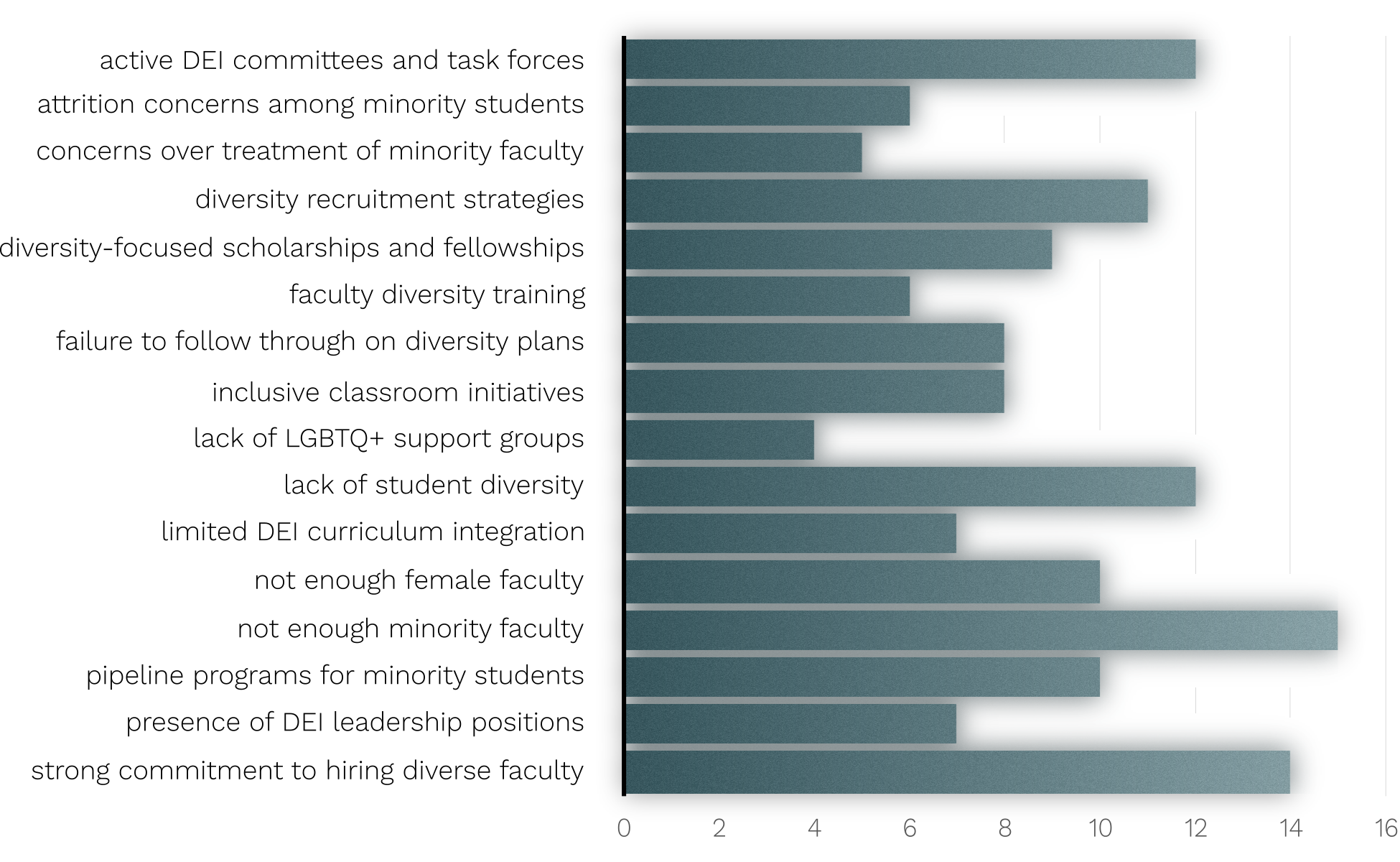
Note: Not all law schools received qualitative evaluations in every category.
Legislative Reform
Although Executive Order 14279 is a step toward ending unlawful discrimination compelled by accreditors, enforcement of civil rights laws can change from one administration to the next. Legislation is necessary to permanently stop illegal discrimination pushed by accreditors.
Currently, 20 U.S.C. 1099b(a) provides that “No accrediting agency or association may be determined by the Secretary [of Education] to be a reliable agency as to the quality of education or training offered for the purposes of this chapter or for other Federal purposes, unless the agency or accreditation meets criteria established by the Secretary pursuant to this section.” The provisions of 20 U.S.C. 1099b(a)(5) set forth the minimum criteria an accrediting agency must use for it to be considered such a reliable authority.
Pursuant to 20 U.S.C. 1099b(g), however, the secretary may not add any criteria, and pursuant to paragraph (o), “the Secretary shall not promulgate any regulation with respect to the standards of an accreditation agency or association described in subsection (a)(5).” This means that the Department of Education faces extreme challenges in regulating accreditation standards. Although the department can probably prevent accreditors from forcing institutions and law schools to discriminate unlawfully, legislation is a much stronger and surer way to do so. Therefore, lawmakers and policymakers should focus on improvements to section 1099b. The following language, which would create a new subsection (a)(9), is one option that would prohibit the race- and sex-based preferences imposed by accrediting agencies:
[Accreditation criteria shall require that—] (9)(A) The standards for accreditation of the agency or association do not impose any requirement concerning student body, faculty, or staff diversity on the basis of race, sex, or national origin;
(B) The agency or association does not conduct investigations into student body, faculty, or staff diversity on the basis of race, sex, or national origin;
(C) The agency or association makes no recommendations regarding student body, faculty, or staff diversity on the basis of race, sex, or national origin; and
(D) The agency or association permits each entity that it accredits to adopt any lawful policy on student body, faculty, or staff diversity that concerns race, sex, or national origin. 28 This proposed language is nearly identical to that used in in Heriot and Kirsanow, “Letter on Need for Legislation,” 5.
Conclusion
Law school accreditation reports demonstrate how the ABA, as the sole federally recognized accreditor of JD programs, has abused its monopoly power as a quasi-governmental regulator to push law schools to adopt race and sex preferences in admissions and hiring. Dozens of law schools have been praised or blamed, have faced adverse action from the ABA, or have even been required to use race and sex preferences to meet ABA’s idea of diversity requirements. This evidence validates media reports and academic articles describing instances of such pressure. Narrowly amending the Higher Education Act would prevent this unlawful pressure and safeguard state and federal civil rights.
Appendix: ABA Standards 205 and 206
Standard 206 reads as follows:
(a) Consistent with sound legal education policy and the Standards, a law school shall demonstrate by concrete action a commitment to diversity and inclusion by providing full opportunities for the study of law and entry into the profession by members of underrepresented groups, particularly racial and ethnic minorities, and a commitment to having a student body that is diverse with respect to gender, race, and ethnicity.
(b) Consistent with sound educational policy and the Standards, a law school shall demonstrate by concrete action a commitment to diversity and inclusion by having a faculty and staff that are diverse with respect to gender, race, and ethnicity.
Interpretation 206-1 reads as follows:
The requirement of a constitutional provision or statute that purports to prohibit consideration of gender, race, ethnicity, or national origin in admissions or employment decisions is not a justification for a school’s non-compliance with Standard 206. A law school that is subject to such constitutional or statutory provisions would have to demonstrate the commitment required by Standard 206 by means other than those prohibited by the applicable constitutional or statutory provisions.
Interpretation 206-2 reads as follows:
In addition to providing full opportunities for the study of law and the entry into the legal profession by members of underrepresented groups, the enrollment of a diverse student body promotes cross-cultural understanding, helps break down racial, ethnic, and gender stereotypes, and enables students to better understand persons of different backgrounds. The forms of concrete action required by a law school to satisfy the obligations of this Standard are not specified. If consistent with applicable law, a law school may use race and ethnicity in its admissions process to promote diversity and inclusion. The determination of a law school’s satisfaction of such obligations is based on the totality of the law school’s actions and the results achieved. The commitment to providing full educational opportunities for members of underrepresented groups typically includes a special concern for determining the potential of these applicants through the admission process, special recruitment efforts, and programs that assist in meeting the academic and financial needs of many of these students and that create a favorable environment for students from underrepresented groups.
Standard 205 reads as follows:
(a) A law school shall adopt, publish, and adhere to a policy of non-discrimination that prohibits the use of admission policies or other actions to preclude admission of applicants or retention of students on the basis of race, color, ethnicity, religion, national origin, gender, gender identity or expression, sexual orientation, age, disability, or military status.
(b) A law school shall adopt, publish, and adhere to policies that foster and maintain equality of opportunity for students, faculty, and staff, without discrimination or segregation on the basis of race, color, ethnicity, religion, national origin, gender, gender identity or expression, sexual orientation, age, disability, or military status.
(c) This Standard does not prevent a law school from having a religious affiliation or purpose and adopting and applying policies of admission of students and employment of faculty and staff that directly relate to this affiliation or purpose so long as
(1) notice of these policies has been given to applicants, students, faculty, and staff before their affiliation with the law school, and
(2) the religious affiliation, purpose, or policies do not contravene any other Standard, including Standard 405(b) concerning academic freedom. These policies may provide a preference for persons adhering to the religious affiliation or purpose of the law school, but may not be applied to use admission policies or take other action to preclude admission of applicants or retention of students on the basis of race, color, ethnicity, religion, national origin, gender, gender identity or expression, sexual orientation, age, disability, or military status. This Standard permits religious affiliation or purpose policies as to admission, retention, and employment only to the extent that these policies are protected by the United States Constitution. It is administered as though the First Amendment of the United States Constitution governs its application.
(d) Non-discrimination and equality of opportunity in legal education includes equal employment opportunity. A law school shall communicate to every employer to whom it furnishes assistance and facilities for interviewing and other placement services the school’s firm expectation that the employer will observe the principles of non-discrimination and equality of opportunity on the basis of race, color, ethnicity, religion, national origin, gender, gender identity or expression, sexual orientation, age, disability, or military status in regard to hiring, promotion, retention, and conditions of employment.
Interpretation 205-1 reads as follows:
A law school may not require applicants, students, faculty, or employees to disclose their sexual orientation, although it may provide opportunities for them to do so voluntarily.
Interpretation 205-2 reads as follows:
So long as a school complies with Standard 205(c), the prohibition concerning sexual orientation and gender identity or expression does not require a religiously affiliated school to act inconsistently with the essential elements of its religious values and beliefs. For example, Standard 205(c) does not require a school to recognize or support organizations whose purposes or objectives with respect to sexual orientation or gender identity or expression conflict with the essential elements of the religious values and beliefs held by the school.
Interpretation 205-3 reads as follows:
Standard 205(d) applies to all employers, including government agencies and religiously affiliated organizations, to which a school furnishes assistance and facilities for interviewing and other placement services. However, this Standard does not require a law school to implement its terms by excluding any employer unless that employer discriminates unlawfully.
Interpretation 205-4 reads as follows:
The denial by a law school of admission to a qualified applicant is treated as made upon the basis of race, color, ethnicity, religion, national origin, gender, gender identity or expression, sexual orientation, age, disability, or military status if the basis of denial relied upon is an admission qualification of the school that is intended to prevent the admission of applicants on the basis of race, color, ethnicity, religion, national origin, gender, gender identity or expression, sexual orientation, age, disability, or military status though not purporting to do so.
Interpretation 205-5 reads as follows:
The denial by a law school of employment to a qualified individual is treated as made upon the basis of race, color, ethnicity, religion, national origin, gender, gender identity or expression, sexual orientation, age, disability, or military status if the basis of denial relied upon is an employment policy of the school that is intended to prevent the employment of individuals on the basis of race, color, ethnicity, religion, national origin, gender, gender identity or expression, sexual orientation, age, disability, or military status though not purporting to do so.
Interpretation 205-6 reads as follows:
The requirements stated in Standards 205(a) and 205(b) that a law school adopt, publish, and adhere to policies regarding non-discrimination and equality of opportunity may be satisfied by adopting, publishing, and adhering to policies of a parent institution that comply with this Standard.
Acknowledgments
The authors thank Duncan Schroeder, Olivia Hodge, and Elizabeth Williams for their contributions to the research and data presented in this brief.
Sources
[1] This research in brief uses “ABA” to refer to the American Bar Association, as well as to the Council of the Section of Legal Education and Admissions to the Bar, which is the ABA’s accreditation arm.
[2] By 1994, conflict over WASC’s diversity standards had heated up. Fourteen schools (including Caltech, Stanford, and USC) objected to the WASC requirement that they promulgate official diversity statements. However, the objections of these wealthy and prominent institutions were insufficient to convince WASC to halt what Berkeley sociology professor Martin Trow described as a “fiercely evangelical movement.” Trow is quoted in Gail L. Heriot and Peter Kirsanow, “Letter on Need for Legislation on Accreditation Abuses Submitted to Bill Cassidy, Chair of the Senate Committee on Health, Education, Labor & Pensions by Two Members of the United States Commission on Civil Rights” (San Diego Legal Studies Paper No. 25-007, University of San Diego, San Diego, CA, last revised April 9, 2025), 7.
[3] While Rand had met all other requirements for reaccreditation, WASC found it was “missing an opportunity to take leadership and responsibility” with regard to race, sex, and ethnic diversity.
[4] Unlike Rand, Thomas Aquinas fought back, claiming that it preferred a policy of nondiscrimination in admissions.
[5] Baruch College was criticized in 1990 by the Middle States Association of Colleges and Schools for failure to hire enough minority faculty members and to retain enough Black and Latino students. Eventually, then–Secretary of Education Lamar Alexander saved Baruch by deferring the renewal of the accreditor’s federal recognition.
[6] Susan Welch and John Gruhl, Affirmative Action in Minority Enrollments and Law School (Ann Arbor, MI: University of Michigan Press, 1998), 80.
[7] Matthew W. Finkin, “The Unfolding Tendency in the Federal Relationship to Private Accreditation in Higher Education,” Law and Contemporary Problems 57, no. 4 (1994), 89–120.
[8] For the 2024–2025 standards, see American Bar Association Section of Legal Education and Admissions to the Bar, Standards and Rules of Procedure for Approval of Law Schools 2024–2025 (Chicago, IL: American Bar Association, 2024).
[9] American Bar Association Section of Legal Education and Admissions to the Bar, Standards and Rules , 105.
[10] Leon Jaworski, “The American Bar Association: A Quasi-Public Institution,” American Bar Association Journal 58, no. 9 (1972): 917–19.
[11] The ABA took a hard line against George Mason University School of Law following a site evaluation in early 2000. A report summarizing the site evaluation notes that “the Law School has not been very successful in recruiting minority students and the number has actually declined recently.” The report was clear that the problem was not insufficient outreach from Mason to minority students. Mason’s outreach efforts were strong, but they didn’t matter to the ABA unless the law school achieved certain demographic quotas. After several years of action letters and back-and-forth with the ABA, Mason quietly gave up and shifted its admissions strategy to achieve the racial numbers the ABA wanted. For additional details, see Heriot and Kirsanow, “Letter on Need for Legislation,” 9–15.
[12] Gail L. Heriot, “Affirmative Action in American Law Schools,” Journal of Contemporary Legal Issues 17 (2008), 237–280.
[13] The Association of American Law Schools (AALS) maintains membership standards but is not a federally recognized accreditor.
[14] David Barnhizer, “A Chilling Discourse,” Saint Louis Law Journal 50, no. 2 (2006): 361–424.
[15] Henry Stone, “How Colleges and Universities Get Around State DEI Bans,” Wall Street Journal, December 20, 2024.
[16] Heriot and Kirsanow, “Letter on Need for Legislation.”
[17] Reforming Accreditation to Strengthen Higher Education, Executive Order 14279, 90 Fed. Reg. 17529 (April 23, 2025).
[18] Executive Order 14279, 90 Fed. Reg. 17529.
[19] Executive Order 14279, 90 Fed. Reg. 17530.
[20] Executive Order 14279, 90 Fed. Reg. 17530.
[21] Students for Fair Admissions, Inc. v. President and Fellows of Harvard College, 600 U.S. 181, 206 (2023).
[22] Julianne Hill, “ABA Legal Ed Council Suspends Accreditation Standard Focused on Diversity,” ABA Journal, February 21, 2025.
[23] American Bar Association, “Council of the ABA Section of Legal Education Extends Standard 206 Suspension to 2026,” news release, May 9, 2025, https://www.americanbar.org/news/abanews/aba-news-archives/2025/05/aba-council-extends-206-suspension.
[24] US Commission on Civil Rights, Affirmative Action in American Law Schools, 2006.
[25] Antonin Scalia Law School is the new name of George Mason University School of Law.
[26] George Mason University, Office of the Dean, Antonin Scalia Law School, “Response of the Antonin Scalia Law School, George Mason University, to the Site Visit Report Dated February 14, 2023” (unpublished manuscript, March 15, 2023), 35. Available from author upon request.
[27] George Mason University, Office of the Dean, Antonin Scalia Law School, “Response of the Antonin Scalia Law School,” 35.
[28] This proposed language is nearly identical to that used in in Heriot and Kirsanow, “Letter on Need for Legislation,” 5.

PLF is a national nonprofit legal organization that defends Americans’ liberties when threatened by government overreach and abuse. We sue the government in court when our clients’ rights protected by the Constitution are violated, and advocate for legislative and regulatory reforms in the other branches of government. Started in 1973 in California, PLF now seeks reform across the country, including suits filed nationwide, scoring precedent-setting victories for our clients, with an unmatched track record at the United States Supreme Court.