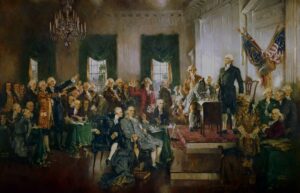


The Articles of Confederation were defective. The Constitution solved the problem and better embodied the Declaration of Independence.
Within months of the Declaration of Independence, the new states created a shell of a government, shaped by their experience under British tyranny. But the Articles of Confederation were weak and defective: The primary problem was a powerless federal authority, a government that was more like a union of independent nations than a single, unified country. Instead of a strong, peaceful country, the states fought one another with limited respect for the rule of law.
The Articles, however, could not be fixed by amendment. The newly founded states needed a different system—one that had enough energy and authority to preserve individual liberty, general welfare, and peace. “The inefficacy of our government becomes daily more and more apparent,” John Jay wrote in a letter to Thomas Jefferson. The structure was broken and beyond repair. Because its fundamental structure and main pillars could not be fixed, a new system had to be created.
Although Publius, the author of The Federalist Papers, described a dissonance between the first principles of the Articles and the Constitution, there is none between the first principles of the Declaration and the Constitution. The enduring tenets of life, liberty, property, and limited government are consistent in both the Declaration and the Constitution, which is why we cannot celebrate one without the other.
The constitutional framework stands out as unique and superior to those of other nations, whether ancient or modern. It is founded on historical experience and the core principles of the Declaration of Independence, notably the ideas of popular sovereignty and natural rights. As we approach the 250th anniversary of the Declaration, it is essential to remember these fundamental principles and their enduring impact on the preservation of liberty and equality for all.
Faulty fabric and sour structures
As early as 1780, Alexander Hamilton wrote that “the confederation itself is defective and requires to be altered.” Seven years later, shortly after the Constitutional Convention, Hamilton gathered James Madison and John Jay to write a series of essays in favor of the Constitution in New York newspapers. The seriousness of the situation demanded reflection—and while the first national government failed under the Articles, the maintenance of the Union primarily depended not on the delegates to the Constitutional Convention but on the people themselves.
The people had to “deliberate” and “decide” whether maintaining the Union was worth it. If not, the states would succumb to civil war fueled by passion and self-interest.
Because there were fundamental structural errors that could be corrected only by changing the system’s core principles, the states needed a completely new approach: out with the old and in with the new.
One month before the Constitutional Convention of 1787, James Madison compiled a list of flaws he identified in the Articles of Confederation, which he had considered for years. Many of the men involved in the Convention sent letters expressing their concerns about the failing system. Shortly after the Convention concluded in September 1787, Madison began publishing his arguments in The Federalist Papers, alongside Hamilton and Jay. Madison’s critique of the Articles appeared in Essays 15–22, including a comparative analysis of historical confederacies. Of the twelve flaws Madison identified, four stand out: a lack of enforcement power, a lack of judicial authority, an absence of separation of powers, and a deficiency in popular sovereignty.
Who has the power?
Under the Articles of Confederation, Congress could pass resolutions and make requests, but the federal government lacked enforcement power, leaving the states to their own devices. States began printing their own currency and refused to pay off the war debt Congress had incurred during the revolution. Resolutions and requests were directed at state legislatures, not individuals, allowing the legislatures to decide whether to comply. Congress also lacked the means to quell Shays’s Rebellion, an armed uprising of farmers in Massachusetts in opposition to the state’s efforts to collect more taxes.
In practice, the lack of executive force led to disastrous effects: chronic financial weakness, military impotence, commercial chaos, and diplomatic embarrassment. Congress was powerless to pay off debts, quell rebellions, regulate trade, and protect citizens.
The government, Hamilton wrote, “must, in short, possess all the means, and have a right to resort to all the methods, of executing the powers with which it is intrusted that are possessed and exercised by the government of the particular States.” To solve these problems, the delegates proposed a federal system—dividing and balancing power between the national and state governments, as well as between three branches of government—a topic that will be addressed in later posts of this Federalist Papers series.
To provide a proper remedy to the pending legal crisis, the delegates and the people needed to understand “the extent and malignity of the disease,” Hamilton said. This is why Hamilton and Madison went to great lengths when explaining the flaws of the Articles of Confederation. If the people didn’t understand, they couldn’t adequately choose whether the Constitution was worth ratifying.
The delegates did not want a single, consolidated body of power. The Founders considered the national legislature dangerous, which is why the national government needed effective and enforceable checks against a muscular legislative power. To prevent the concentration of power, the Framers suggested several guardrails—including three branches of government (legislative, executive, and judicial), the consent of the governed, and a bicameral legislature, with the House and the Senate serving as checks on each other.
Separation and subsidiarity
The delegates carefully considered how best to distribute power under the new Constitution. Hamilton recognized that conspiracies among the branches could threaten the Union’s security. Although no government can completely prevent internal conflicts, the Constitution offers the best solution by allowing states to handle local issues while the federal government manages national ones.
Ironically, Hamilton described the “inherent and intrinsic weakness in all federal constitutions” when he predicted that the state governments would be more likely “to encroach upon the national authorities than for the national government to encroach upon the State authorities.”
Hamilton was wrong: Over time, the federal government has encroached upon the states’ powers, mainly through the all-encompassing view of Congress’s enumerated powers, such as the commerce clause, the spending clause, and the necessary and proper clause. Acting upon these plenary powers, Congress has delegated its authority to federal agencies, creating a rogue fourth branch of government.
In Federalist No. 17, Hamilton highlighted how the “administration of private justice between the citizens of the same State, the supervision of agriculture and of other concerns of a similar nature, all those things, in short, which are proper to be provided for by local legislation, can never be desirable cares of a general jurisdiction.” Each state should be responsible for making laws that meet its own needs, rather than the federal government prescribing what is best for every state. Maybe the Supreme Court and Congress could learn a thing or two from this essay.
Congress has amassed more power than is constitutionally permissible, thanks to several Supreme Court cases from the New Deal era, which allowed Congress to legislate on state matters, create agencies, and delegate consolidated power to them.
In recent years, many federal agencies, such as the Federal Trade Commission (FTC), the Department of Agriculture (USDA), and the Consumer Product Safety Commission (CPSC), often serve as judge, jury, and executioner for in-house legal proceedings. These agencies strip American citizens of their right to a jury trial and punish them for alleged violations of rules and regulations. Rather than actually doing its job, or leaving these policy questions to the states, Congress has given agencies broad authority to violate the rights of American citizens.
As Alexis de Tocqueville observed in Democracy in America, people tend to feel more connected to their local community than to the federal government. When power is left closest to the people, communities flourish. But when power is consolidated in the federal government or unregulated agencies, like the Financial Industry Regulatory Authority (FINRA) and the Horse Integrity and Safety Authority (HISA), people suffer harm at the hands of unelected bureaucrats.
Where’s the judiciary?
One of the grievances listed in the Declaration of Independence included the lack of an independent judiciary: The King of Great Britain “made Judges dependent on his Will alone, for the tenure of their offices, and the amount and payment of their salaries.” The Founders shared similar fears, which led them to institute life tenure, salary protections, and a separation of powers.
The Founders also considered disagreements among different types of courts, such as courts of law, equity, admiralty, and maritime. If judges proposed differing opinions within various types of courts or the same court, who was the final arbiter? As a solution, Hamilton proposed a Supreme Court in Federalist No. 22 :
There are endless diversities in the opinions of men. We often see not only different courts but the judges of the same court differing from each other. To avoid the confusion which would unavoidably result from the contradictory decisions of a number of independent judicatories, all nations have found it necessary to establish one court paramount to the rest, possessing a general superintendence, and authorized to settle and declare in the last resort a uniform rule of civil justice.
To prevent disagreements among various types of courts, Article III gave federal courts jurisdiction over law, equity, admiralty, and maritime cases so that there would be one court that is supreme over all types of cases. Because federal courts are the supreme authority on matters of law and fact, they are responsible for determining what the law is.
The consent of the governed
But more than all these improvements, the states needed a government that derived its power from the consent of the governed.
“The fabric of American empire ought to rest on the solid basis of THE CONSENT OF THE PEOPLE. The streams of national power ought to flow immediately from that pure, original fountain of all legitimate authority,” Hamilton argued in Federalist No. 22.
Eventually, the states ratified the Constitution. While the Bill of Rights and additional amendments were added along the way, we would not have this structure if it weren’t for the enduring principles of the Declaration of Independence and the persistence of the Federalists and Anti-Federalists. Their commitment to popular sovereignty, life, liberty, and property is why our structure has endured this long. And here at Pacific Legal Foundation, we are actively working in courts and legislatures to ensure that the structure remains as the vibrant, first protector of individual rights for future generations.