

Guns, drugs, and ghosts of doctrines past
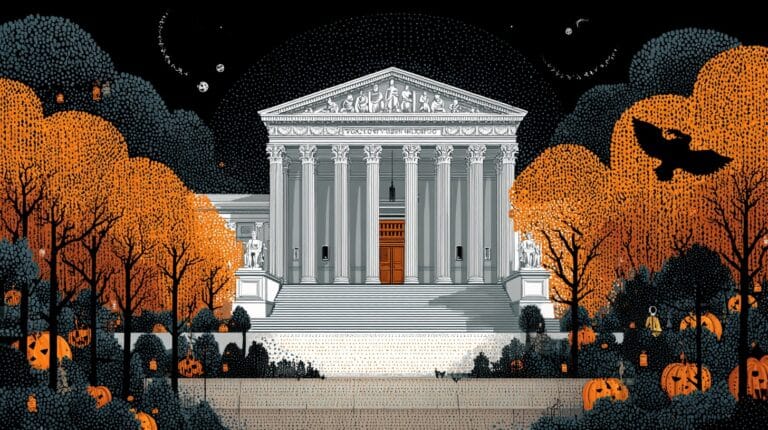
Happy Halloween, SCOTUS lovers. Need a last-minute costume? Don’t want to be Taylor “Swift Justice?” Go as “The Dissenter.” All black robe, dramatic lace jabot à la RBG, and add fake blood on a scroll for Halloween flair. You are now: “When your dissent was so good, it came back to haunt the majority.”
Alternatively: Lochner-era Bakery Owner. Apron, rolling pin, fake Supreme Court opinion in your pocket. Zombie makeup. I can see the tweet now: “Baking liberty into every contract since 1905.” Or “Economic liberty is not dead!”
Or, the Privileges or Immunities Clause. Roman goddess aesthetic, gold laurel crown with the Roman numeral XIV, and a sash reading “Written Out of the Constitution, But Still Shining.”
Honorable mention: Pride and Precedent. Regency gown + pocket Constitution (two things we all have in our closet, amirite?).
But back to the Court…
SCOTUS takes a doubly controversial case: guns + drugs
The Supreme Court just granted its second gun rights case of the term, and this one’s doubly controversial: guns + drugs.
Ali Danial Hemani, a dual U.S.-Pakistan citizen the government says has terrorism ties, was charged under a federal law banning users of illegal drugs from possessing firearms. Agents searched his home and found marijuana, cocaine, and a gun. Hemani admitted to using drugs and was indicted under the challenged statute.
In a separate case, the Fifth Circuit ruled that the same law was unconstitutional where there was no finding the person was presently or recently using drugs while possessing the firearm. Relying on that opinion, Hemani’s indictment was dismissed—and now the United States has appealed.
While the DOJ goes out of its way to say that Second Amendment rights are important, its brief insists that it’s only targeting habitual users and calls the restriction a “temporary” ban that can be lifted once the person quits. Under New York State Rifle & Pistol Association v. Bruen, any firearm restriction must be consistent with the nation’s history and tradition. The U.S. therefore analogizes this law to founding-era bans on “drunkards” carrying weapons, arguing that both practice and common sense show habitual drug users pose a risk of misusing a gun.
Last Term, in United States v. Rahimi, the Court upheld a law temporarily disarming people subject to domestic-violence protective orders. Justice Thomas was the lone dissenter. Thus, even in a Court that’s robustly protective of gun rights, there are still limits.
This makes Hemani the second major gun case of the term. The first challenges Hawaii’s law that bans guns on private property (stores, hotels) unless the owner posts or verbally permits carry. The challengers say that flips the constitutional presumption: Carry should be the default, not the exception.
The militia isn’t just a thing from the 1800s
After a district court blocked President Trump from deploying the National Guard to Chicago, Solicitor General John Sauer rushed to the Supreme Court asking it to pause that ruling—yes, on the dreaded “shadow docket” (should we call it the “spooky docket”?). So what’s the background?
Under the Constitution’s “Call Forth” Clause, Congress may summon the militia to “execute the Laws, suppress Insurrections, and repel Invasions.” When federalized, the president becomes commander-in-chief. Congress has also empowered the president to call forth the militia under the Insurrection Act when a governor requests it or when there’s an invasion or rebellion or the president cannot “with the regular forces … execute the laws of the United States.”
President Trump has recently cited crime and protecting federal immigration officials as reason to invoke the Insurrection Act and to send the National Guard to cities across the U.S. But cities like Chicago, Los Angeles, and Portland have resisted. The lower courts are now split:
The Seventh Circuit said Chicago’s protests weren’t a “rebellion” and federal officials weren’t obstructed, so Trump lacked authority.
With regard to Portland, a three-judge panel out of the Ninth Circuit said the opposite—calling Trump’s decision a “colorable assessment of facts within a range of honest judgment.” (Although the full court will now rehear the case.)
Two other cases remain pending regarding DC and Los Angeles.
The question in these cases is whether courts even have authority to review the president’s decision to call forth the National Guard under the Insurrection Act and, if so, whether the circumstances justify his decision.
This week the Supreme Court ordered supplemental briefing on the question of whether the Insurrection Act allows the president to call up the militia to augment civilian forces (like ICE) or merely the armed forces.
She dissents
The Supreme Court turned down an Alabama inmate’s request to block his execution by nitrogen hypoxia and to be executed by firing squad instead.
Justice Sotomayor, joined by Justices Kagan and Jackson, dissented:
“Boyd asks for the barest form of mercy: to die by firing squad, which would kill him in seconds, rather than by a torturous suffocation lasting up to four minutes. The Constitution would grant him that grace. My colleagues do not.”
Shameless self-promotion: For some background on the time the Supreme Court temporarily ruled the death penalty unconstitutional and then swiftly reversed itself just a few years later, check out this episode of Dissed.
Oral argument recap: Voting rights back at the Court
The Court recently heard arguments on Section 2 of the Voting Rights Act. But what’s that, you ask?
In the 1960s, amid suppression of black voter registration drives (think Selma, Alabama), Congress passed the Voting Rights Act of 1965 to enforce the Fifteenth Amendment’s promise that no citizen would be denied the right to vote based on race.
Sections 4 and 5 of the Act created a coverage formula and “preclearance” regime, requiring certain jurisdictions (those with histories of racial discrimination) to get federal approval before changing voting laws. Section 4 was recently struck down on the theory that the formula was based on “decades-old data” that no longer reflected contemporary conditions. Since then, Section 2 has become the predominant tool for voting rights litigation.
Section 2 has been interpreted as prohibiting practices that not only outright deny the right to vote, but also those that result in “vote dilution”—diminishing the ability of minority voters to elect candidates “of their choice.” That’s in tension with Equal Protection, because it rests on the stereotype that racial blocs vote alike and because it can require explicit race-conscious redistricting.
So what happened here? Louisiana’s new congressional map gave black voters, who made up one-third of the population, just one majority-black district out of six districts total. A group of plaintiffs sued, arguing that politicians had deliberately fragmented black voters across several districts to dilute their influence statewide. A district court found that the plan likely violated Section 2, and so the legislature redrew its lines again and added another minority-majority district.
Then, new plaintiffs sued on the theory that the second map was an unconstitutional racial gerrymander. That case is now before the Supreme Court.
At oral argument, three themes dominated:
- Race vs. Politics: Justice Alito pressed whether the first map reflected politics, not race. If politicians are drawing lines based on political affiliation rather than membership in a racial group, then there’s no basis for a race-conscious remedy.
- Congressional Power: Several justices asked whether Section 2, as applied here, exceeds Congress’s Fifteenth Amendment authority—especially absent any finding of intentional discrimination.
- Last, much of argument time was spent with justices asking softball questions—effectively engaging in monologues and then asking the advocate whether they were right—which is not really a question at all. (One question of Justice Jackson’s spanned two transcript pages.) Justice Kagan’s softball asked what would happen if Section 2 were invalidated. The attorney defending it said the results would be “catastrophic.” In response, counsel for the plaintiffs said the “sky-is-falling rhetoric” is overstated. After all, there are over one hundred minority members of Congress, many from districts not drawn to remedy VRA violations.
Next up:
Next week the Court will hear arguments about President Trump’s tariffs. He claims the longstanding trade deficit and opioid crisis are now emergencies warranting action under the International Emergency Economic Powers Act. Challengers say those aren’t emergencies and the president doesn’t have the power to impose tariffs under that statute anyway. Plus, the tariffs are ruining their businesses. It’s a big separation of powers case, and we love when the Major Questions Doctrine enters the chat.
What have I been up to, you ask?
Writing this op-ed with Chef Andrew Gruel on California craziness.
Appearing on Political Orphanage to talk about parents’ right to opt out of schooling they say contradicts their beliefs.
Talking about the dissent everybody knows was right. Have you heard of The Slaughter-House Cases? One of the biggest disappointments in constitutional law!
Until next time… don’t be afraid to hand out pocket Constitutions instead of candy tomorrow.