


Continuing to Lock Squatters Out: How States Have Protected Property Rights from Squatters

Squatting is the act of occupying someone else’s property without any legal claim or title to it and without consent from the property owner. Removing squatters is difficult in most states, keeping property owners from occupying their homes for a long time. However, states are starting to see the need for protecting property rights.
Civil Eviction Processes Harm Homeowners and Help Squatters
When property owners call police to their home after discovering squatters, squatters often falsely claim to have a lease, and police cannot verify these claims. Although trespassing is a criminal offense, property owners are told by police to file a civil court case traditionally designed for landlord-tenant disputes. Unfortunately, doing so results in a host of problems for property owners, who must wait months or years to legally regain full possession of their home and pay thousands of dollars in legal bills, increased utility bills, and property repairs.1 For further details on the cost of squatting to property owners, see Kyle Sweetland and Mark Miller, Locking Squatters Out: How States Can Protect Property Owners (Sacramento, CA: July 2024). Meanwhile, squatters get to live in the home without fear of being removed quickly.
How States are Responding
As figure 1 shows, as of May 2024, 8 states (Alabama, California, Florida, Georgia, Nevada, Tennessee, Washington, and West Virginia) had laws that criminalized squatting, while 11 other states had introduced bills to do so.2 Sweetland and Miller, Locking Squatters Out, 4, figure 2. Most states had not yet addressed the issue legislatively, leaving property owners’ doors wide open to squatters and requiring the civil court system to resolve the issue through the much-slower eviction process.
This landscape changed significantly in just more than a year. As of July 2025, an additional 15 states (Arkansas, Illinois, Indiana, Kentucky, Louisiana, Maryland, Mississippi, Montana, Nevada, New Hampshire, North Dakota, Oklahoma, Pennsylvania, Texas, and Wyoming) had criminalized squatting, bringing the total to 23 states. Additionally, a couple of states introduced bills to criminalize squatting.3 Bills pending criminalizing squatting: S.B. 725, 221st Leg., 2024 Sess. (N.J. 2024); H.B. 984, 2023 Sess. (N.C. 2024).
Figure 1. Legal Status of Squatting (May 2024 to July 2025)
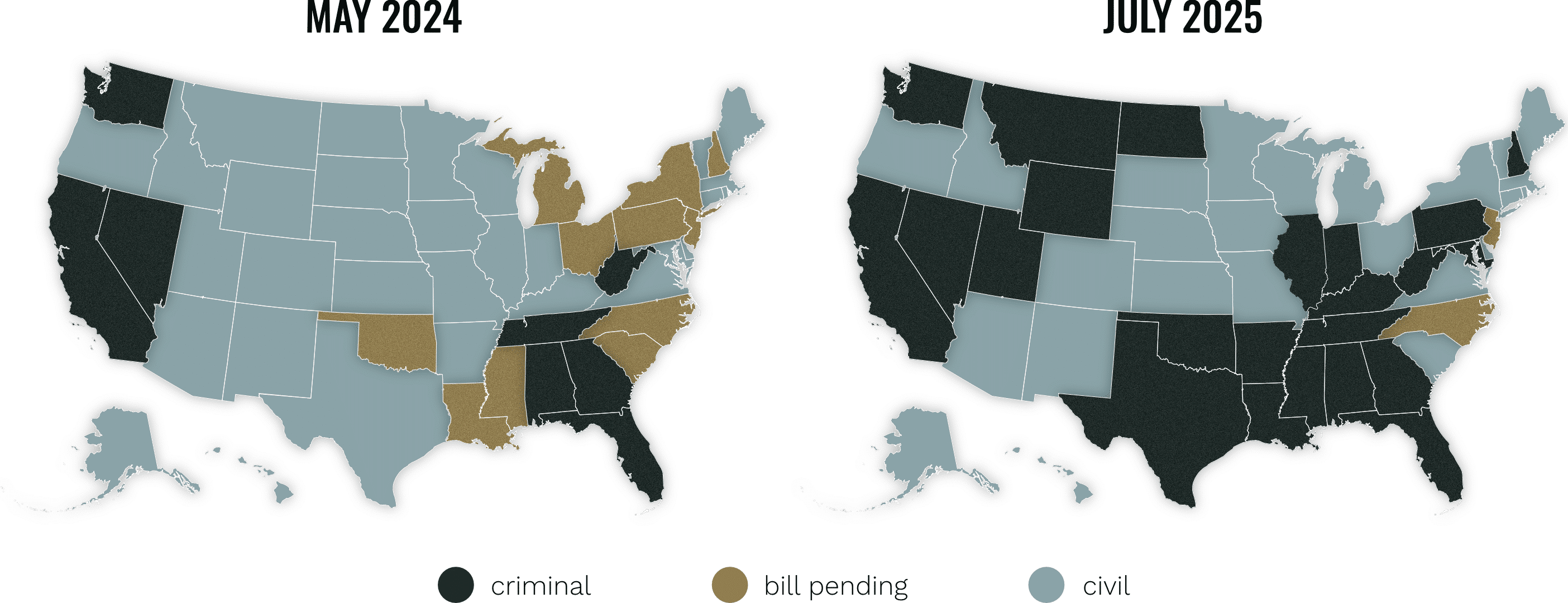
Note: The author thanks Brooks Ball for his research assistance.
Source: Kyle Sweetland and Mark Miller, Locking Squatters Out: How States Can Protect Property Owners (Sacramento, CA: July 2024). Bills passed criminalizing squatting: H.B. 1049, 95th Gen. Assemb., Reg. Sess. (Ark. 2025); S.B. 1563, 104th Gen. Assemb. (Ill. 2025), 124th Gen. Assemb., 1st Reg. Sess. (Ind. 2025); H.B. 10, 2025 Reg. Sess. (Ky. 2025); S.B. 466, 2024 Reg. Sess. (La. 2024); S.B. 46, 2025 Reg. Sess. (Md. 2025); H.B. 1200, 2025 Reg. Sess. (Miss. 2025); S.B. 101, 69th Leg. (Mont.); H.B. 1400, 2024 Sess. (N.H. 2024); H.B. 1305, 69th Leg. Assemb., Reg. Sess. (N.D. 2025); S.B. 1994, 59th Leg., 2nd Sess. (Okla. 2024); S.B. 1236, 2024 Reg. Sess. (Pa. 2024); S.B. 1333, 89th Leg., Reg. Sess. (Tex. 2025); S.B. 55, 2025 Gen. Sess. (Utah 2025); S.F. 0006, 68th Leg., 2025 Gen. Sess. (Wyo. 2025).
Next Steps
Although many states have taken steps to protect property rights, about half of the states in the country have not done so. One of the most effective ways states can protect property rights against squatters is by reforming the law to make it easier and faster for property owners to remove squatters from their property.
For example, in Georgia, property owners used to spend eight months on average waiting for squatters to be removed through eviction. But with the passage of the Squatter Reform Act in April 2024, police can serve criminal notice to squatters, allowing property owners to regain possession of their home in less than two weeks.4 Dana Fowle, “Georgia Squatter Reform Act Passes, Awaits Governor’s Signature,” FOX 5 Atlanta, March 29, 2024.
Pacific Legal Foundation’s model bill, the Stop Squatters Act, is a template for legislators to craft laws that would better protect property rights, give owners remedies against squatting, and penalize squatters as criminals. In fact, five states used the model bill in drafting their own legislation: Arkansas, Kentucky, Montana, West Virginia, and Wyoming.
-
Sources
[1]
For further details on the cost of squatting to property owners, see Kyle Sweetland and Mark Miller, Locking Squatters Out: How States Can Protect Property Owners (Sacramento, CA: July 2024).
[2]Sweetland and Miller, Locking Squatters Out, 4, figure 2.
[3]Bills pending criminalizing squatting: S.B. 725, 221st Leg., 2024 Sess. (N.J. 2024); H.B. 984, 2023 Sess. (N.C. 2024).
[4]Dana Fowle, “Georgia Squatter Reform Act Passes, Awaits Governor’s Signature,” FOX 5 Atlanta, March 29, 2024.