


How States Have Unlocked Housing by Protecting the Right to Have Roommates
July 10, 2026

, Jameson Huang
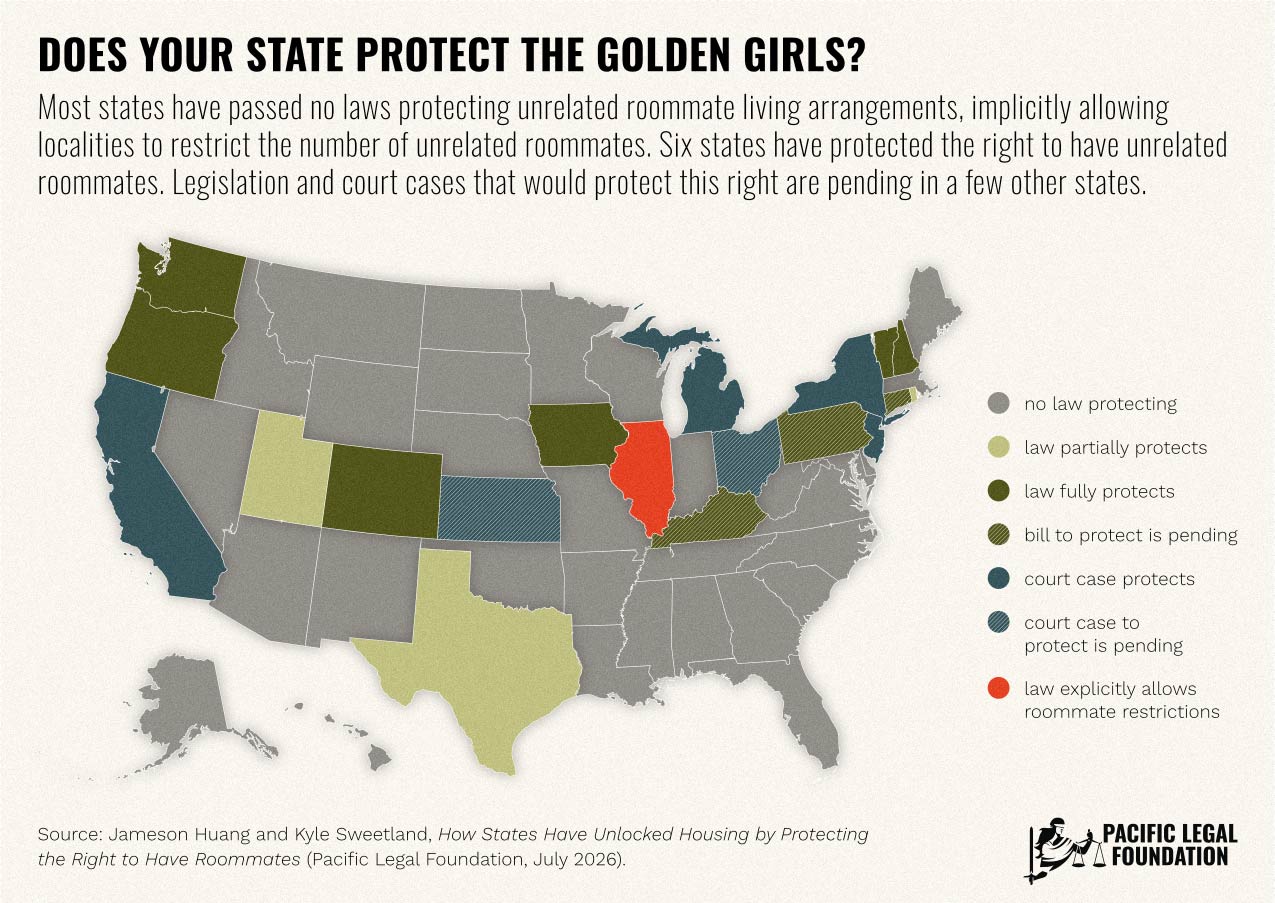
Housing affordability remains a major concern for many Americans, and one way to reduce housing costs is to allow more people to share existing homes through roommate living arrangements. This policy explainer examines state laws governing local limits on unrelated roommates, finding that most states permit municipalities to restrict these arrangements, even though such rules can leave housing underutilized and have faced constitutional challenges in some courts. The explainer reports the legal protections each state provides to roommate households and highlights recent state reforms.
Key Findings:
- Thirty-two states have enacted no laws protecting unrelated roommate living arrangements, effectively allowing local governments to impose occupancy limits based on family relationships.
- Localities in all 32 of those states have adopted unrelated roommate occupancy restrictions.
- Illinois explicitly authorizes local governments to enact unrelated roommate limits, providing stronger state support for such restrictions than mere state silence.
- Courts in four states have protected unrelated roommate living arrangements on constitutional grounds, including privacy, due process, and property rights protections.
- Six states have enacted laws protecting unrelated roommate living arrangements by preventing localities from imposing relationship-based occupancy limits, whereas three additional states have introduced similar reforms.
- Three other states have adopted narrower measures that protect unrelated roommate living arrangements in at least some jurisdictions.
Policy Implications:
- State legislation that protects unrelated roommate living arrangements can expand access to lower-cost shared housing within the existing housing stock while preserving local authority to enforce occupancy, nuisance, building-code, and safety standards.
Download the PDF here.
How States Have Unlocked Housing by Protecting the Right to Have Roommates
July 10, 2026
Jameson Huang