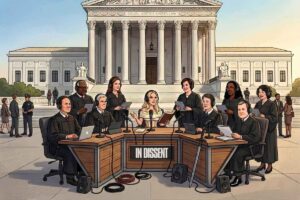


Supreme Court rules for presidential removal power in Trump v. Slaughter

For nearly a century, federal law barred the president from firing members of the Federal Trade Commission unless they could be shown to have committed “inefficiency, neglect of duty, or malfeasance in office.” The goal of this congressionally imposed restriction was to give agencies like the FTC some measure of independence from politics. But the practical result was a class of federal officials who could set policy, bring enforcement actions, and adjudicate disputes affecting millions of Americans, with no meaningful check on their power.
In Trump v. Slaughter, the Court confronted the question of whether the heads of federal agencies like the FTC should be insulated from presidential removal—and on June 29, the Supreme Court struck down that restriction in a 6-3 decision, giving the president authority to remove the leaders of roughly two dozen “independent” agencies at will.
The firing that reached the Supreme Court
The case began when President Donald Trump fired Rebecca Slaughter, a member of the Federal Trade Commission, claiming her “service on the FTC [was] inconsistent with [his] Administration’s priorities.” Slaughter went to federal court to challenge her firing, relying on Humphrey’s Executor v. United States—a 1935 decision that upheld Congress’ authority to restrict the president’s ability to fire certain agency officials. The lower courts sided with Slaughter, and the case went to the Supreme Court.
Pacific Legal Foundation filed an amicus brief urging the Court to restore the president’s removal authority, arguing that accountability requires the power to remove.
PLF’s case for accountability
In its brief, Pacific Legal Foundation explained that the Constitution vests all executive power in the president, who is obligated to “take Care that the Laws be faithfully executed.” That duty requires control over the officials who execute the laws on his behalf.
The FTC has authority over consumer protection, antitrust enforcement, and large segments of the economy—and it exercises that authority through actions the Constitution has assigned to other branches. It writes rules that function like laws, a power the Constitution gives to Congress. It adjudicates disputes, a power the Constitution gives to independent judges. When its commissioners are also shielded from removal, there is no meaningful check on their power.
In its brief, PLF traced the administrative state to its Progressive-era roots. Progressives expressly lamented the Constitution’s separation of powers, arguing, in the words of James Landis, that government needed to escape the “inadequacy of a simple tripartite form of government to deal with modern problems.” Woodrow Wilson complained that divided government left things without “definite order, showing a confused interplay of forces”—a system in which “no man stands at the helm to steer.” Justice Neil Gorsuch’s concurrence drew on the same history, citing Wilson’s vision of agencies run by politically insulated experts as a promise the administrative state never kept.
Finally, PLF drew on its own clients’ experiences to illustrate the cost of unaccountable agency power. The Consumer Product Safety Commission pursued a small Oklahoma company called Leachco for four years over a product hazard claim so weak that, after a full administrative trial, the administrative law judge sided with Leachco. The CPSC ultimately dropped the case, but not before vacating the ALJ’s ruling so future defendants could not use it as a shield.
Based on these arguments and experiences, PLF argued, “Affirming the President’s authority to remove the heads of the agencies is not a panacea, [but] it will at the very least restore a measure of control and oversight to the President and, through him, to the People.”
The Court rules
Writing for the majority, Chief Justice John Roberts argued that presidential oversight is meaningless if the president cannot remove the officials who exercise executive power on his behalf.
“The President must have the assistance of officers he can trust,” Roberts wrote. “Although it is up to the Senate to decide whether to confirm those with whom the President would prefer to work, neither Congress nor the courts may saddle him with those with whom he cannot work. Subordinates who exercise the President’s power are subject to removal by him. Then, and only then, can they remain accountable to the President, and the President to the people.”
The decision overruled Humphrey’s Executor v. United States, the 1935 precedent that had enabled for-cause removal protections for certain agency officials, dismissing it as “a result in search of a rationale.”
In a concurrence, Justice Gorsuch agreed—and went further. He wrote that “the notion that the FTC and agencies like it would be led by technical experts who would neutrally and scientifically chart the Nation’s path soon began to look a bit ‘quaint’” and that “the term ‘independent’ was always a bit of a misnomer.”
The same day, the Court decided Trump v. Cook, making clear that Slaughter’s rule has at least one exception: the Federal Reserve. In a 5-4 decision, the Court held that the Fed was a thoroughly unique entity in American history and that its governors retain their for-cause removal protections, concluding that stripping them away without notice or an opportunity to respond violated the statute Congress enacted to protect the central bank’s independence.
The bigger picture
The Supreme Court’s Slaughter ruling arrives as a victory in PLF’s broader effort to restore constitutional limits on the administrative state, at a time when federal agency power is at an all-time high.
“Today’s decision confirms a basic constitutional principle: The American people deserve a government that is accountable to them,” said Oliver Dunford, a senior attorney at PLF. “By restoring the president’s removal authority, the Court has reinforced the separation of powers and ensured that no executive officials operate beyond democratic oversight.”