

The Dispatch: Florence Allen Was More Than a First
Florence Allen’s decision to become a lawyer came to her “like a flash out of the blue,” a “revelation on high.” It was an inconvenient one. When Allen entered law school in 1909, women could not vote, many schools would not admit them, and only about 1 percent of American lawyers were women.
Her own undergraduate alma mater, Case Western University, was closed to women who wanted to study law. But Allen’s persistence would eventually make her a first in several senses, including the first woman judge, the first woman state Supreme Court justice, and the first woman federal appellate judge. Tracy Thomas’ The First Woman Judge details Allen’s important journey. And it’s worth reading to learn more about a fascinating figure that few know about. But in emphasizing Allen’s first-ness, the book sometimes loses her singularity.
Born in Utah in 1884 and raised in Ohio, Allen was an achiever. She was elected president of her freshman class, edited her college’s literary magazine, and took leading roles in theater productions—her classmates even nicknamed her “Cousin Jo,” after the individualistic character in Little Women. She studied law first at the University of Chicago, where she was one of four women in her class, and then moved to New York University, where she was more comfortably one of 82 women in the school, and graduated second overall. After encountering difficulty finding a job because of her sex, she simply opened her own practice, eventually trying cases in family law, criminal defense, and constitutional law, and she later became one of the first female prosecutors, where she reported winning 3 out of every 4 cases.
Allen was a dedicated suffragist, once marching 250 miles from New York to Washington in brutal winter weather for the cause. When the 19th Amendment was ratified in 1920, she promptly ran for judicial office. The author attributes her victory to a rare alignment: She was a highly qualified candidate riding the wave of recent enfranchisement in a bellwether state (Ohio) consistently on the leading edge of political change. Allen was not only the first woman elected to a court of general jurisdiction; she would go on to become the first woman elected to a state Supreme Court. And on Allen’s 50th birthday, President Franklin Delano Roosevelt would make her the first woman federal appellate judge by appointing her to the 6th Circuit Court of Appeals. Later, she was the first woman shortlisted for the Supreme Court, though that nomination would elude her.
None of this happened because her colleagues suddenly welcomed women as equals. To the contrary, four justices declined to attend her welcome reception on the Ohio Supreme Court. Newspapers made cruel remarks about her appearance. She was excluded from professional gatherings and paid less than her male colleagues until she negotiated equal pay. Potter Stewart, who served with her on the 6th Circuit before joining the Supreme Court, recalled advocates addressing the bench with, “May it please the court and Miss Allen.”
One of the book’s best stories captures Allen’s response to that world. Early in her time on the 6th Circuit, she fell down a courthouse staircase, broke several teeth, and badly injured her face. The presiding judge offered to postpone the next day’s argument in a major bank case. But lawyers were already traveling to Cincinnati, and it was the Depression. Allen insisted that the case proceed. She appeared with her face wrapped in adhesive tape. Even some detractors were won over by her grit.
Allen deserves recognition for each barrier she broke. Yet as the book accumulates firsts—the first woman attorney to appear before the National War Labor Board, the first woman to preside over juries with female jurors, the first woman to impose a death sentence—the list invites a question: What makes a “first” worth mentioning? Being the first woman judge mattered because discrimination had kept women from the bench and her election marked a meaningful step toward equality before the law. But as the catalog of firsts expands, we risk making categories more memorable than the person.
The tendency to categorize shapes the book’s treatment of Allen’s politics, too. The author measures Allen’s actions by their alignment with progressive politics. Her decisions favoring labor are described as progressive, any departures from the Democratic platform are dubbed “conservative,” and her decisions to defend these deviations are called “stubborn[ness].” Why should agreement with her party be the measure of her judgment?
Allen’s views often had their own history. She favored Prohibition after seeing the damage caused by drinking as a judge. She kept a gun in her car after receiving threats for ruling against organized crime. She personally opposed a peacetime draft and supported “Outlawry,” a movement to outlaw war, after one brother was killed and another was seriously injured in World War I. (As a judge, she nevertheless upheld the draft.) It feels simplistic to cast each of her actions as “progressive” or “conservative.” A contemporary observer said Allen’s following rested on the belief that no one could “own” her. No political movement needs to own her now.
Focusing on political labels can oversimplify. The book briefly notes, for example, that when “conservative” courts struck down laws that purported to help women—like maximum hours laws or minimum wages laws—they sometimes did so in the name of equality and respecting women’s autonomy. The progressive dissenters, meanwhile, advocated for upholding protective regulations because they paternalistically assumed women’s inferiority and inability to work for long hours. That is a fascinating tension that defies the ordinary narrative about what it means to be feminist or “progressive.”
Similarly, the book describes the Supreme Court’s shift from invalidating economic regulations to deferring to FDR’s economic agenda as one from conservative to liberal, and attributes some of this shift to the supposed “switch in time to save nine,” whereby the justices supposedly changed their stance on New Deal legislation to stave off FDR’s court-packing plan. But historians have shown that the shift may have started before the court-packing plan was even introduced. And in modern times, “judicial restraint” and deference has been championed by judicial conservatives. In short, slapping political labels on these events tells us little about what was going on underneath.
Allen, the book says, sought to exemplify the “masculine qualities of objectivity, formal reasoning, rationality, and linear logic” rather than the “feminine traits of informality, emotion, and subjectivity.” Elsewhere, her hard work, stoicism, determination, and grit are called “valued masculine traits.” Law schools, it says, “systematically inculcate[d] the ‘profession’s orthodox masculine ideals,’” by introducing things like the Socratic method, which “required a competitive, individualistic dialogue” and utilized a “machismo view of the case method.” These labels obscure complexity.
Perhaps Allen was not performing masculinity. Perhaps she was hardworking, rational, and tough. Allen herself said that, “Many people think that we must be masculine in order to be doing such work, that we must have ‘the masculine mind.’ As I view it, our ‘masculine mind’ is just hard work, and women[,] a lot of them[,] have always worked hard.” And given that women today make up more than half of law students, perhaps “competitive, individualistic” tools like the Socratic method are well-suited to women as well. While the author describes Allen as not having adopted “a feminine approach to judging based on mercy or problem solving,” Allen herself resisted having her achievements viewed “from a feminine angle alone.” After suffrage, she said, “the work of men and women is blended, as it should be, into a human whole.” That may have been shrewd campaign rhetoric, but it also offers a way to read her life.
Reading Allen’s life through a lens of firsts, feminism, and progressivism hides some of its richness. For example, the book recounts many possible reasons Allen never reached the Supreme Court: Some saw her as too moderate, others suspected she was a communist, she wrote judicial opinions that offended powerful groups like labor and the NAACP, and there were whispers about her sexual orientation. But ultimately it concludes that “at the end of the day, she was not appointed because she was a woman.” Sexism surely shaped the opportunities available to Allen. Still, after several pages tracing the particular circumstances of her failed consideration, that single explanation feels too neat.
Allen was a first, and she was undoubtedly progressive. But the fuller account is more impressive. She wrote 528 majority opinions over 25 years on the 6th Circuit and was reversed by the Supreme Court only five times on grounds the author describes as relatively minor. She took care with her opinions, insisted on fair process, and vigilantly enforced Brown v. Board of Education in the wake of local resistance. She broke her teeth and still showed up to work the next day. Allen’s firsts tell us what she overcame, but her life story tells us who she was. Thomas’ book is worth reading for both, even when its categories threaten to obscure a woman who refused to neatly fit into any of them.
This op-ed was originally published in The Dispatch on September 28, 2026.
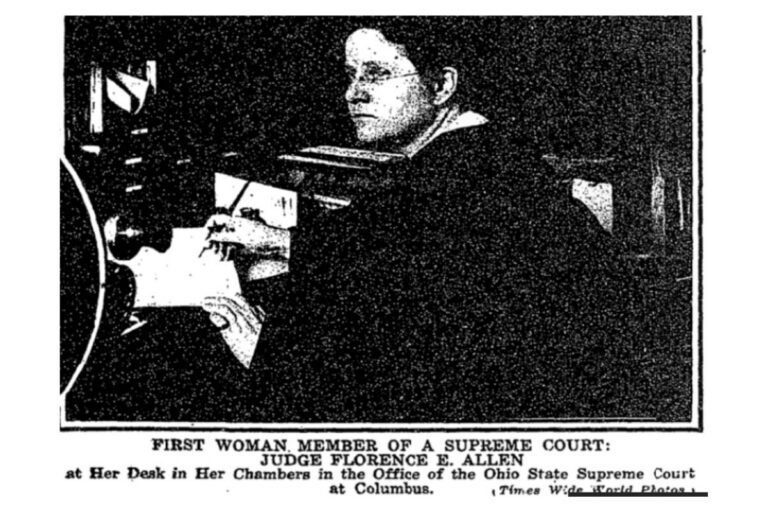
(Photo: Times World Wide Photos, Public domain, via Wikimedia Commons)