

The government regulated rideshare drivers and entrepreneurs, violating principles of federalism

In recent months, state and national governments have acted beyond their constitutional authority by imposing restrictive regulations on rideshare drivers and entrepreneurs. Despite clear constitutional boundaries, governments have unconstitutionally denied out-of-state drivers the ability to drive for rideshare services and required business owners to disclose private financial information to the government.
When the Founders contemplated concentrations of power, they created a system in which certain powers are divided between the state and national governments. But in these cases, the State of California and Congress acted beyond their constitutional authority, hurting hard-working Americans, entrepreneurs, and property buyers alike.
Our constitutional structure enumerates specific powers to the national government, while reserving the remaining powers to the states and the people, thereby protecting liberty. But our government has strayed from its commitment to these original principles.
Reviving respect for our constitutional structure, including the proper demarcations of power, is the first step in preserving liberty. As James Madison wrote in Federalist No. 37—which was published on January 11, 1788—our structural constitution provides “the requisite stability and energy in government,” while also preserving individual liberty.
If liberty is our aim, as our Founding documents proclaim, then we ought to revisit the significance of where power rightly belongs.
Partly national, partly federal
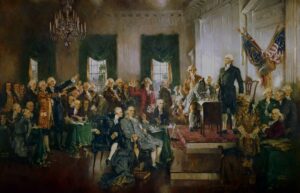
The delegates to the 1787 Constitutional Convention debated several pressing issues, and chief among them was the distribution of power between the national and state governments. Having considered theories of government and the examples of other nations, the Federalists sought to outline how the U.S. Constitution is set apart as the epitome of self-government.
After much deliberation, the delegates agreed on a system that would divide power between the national government—including the legislative, executive, and judicial branches—and the individual states, each with its own legislative, executive, and judicial branches. Each state, through the consent of the people, agreed to unify into a confederated republic, a union of states governed by a representative central government.
Madison understood that a “dissolution or usurpation is the dreadful dilemma to which [the new government] is continually exposed.” Due to the difficulty and technicality of this task, the delegates worked tirelessly to “delineat[e] the boundary between the federal and State jurisdictions.”
After addressing Anti-Federalists objections, Madison explained practical applications of the national and federal structure, also known as federalism. This system ensures the endurance of the union, despite differing views, faculties, and interests among the people and their respective states.
- House of Representatives. The delegates created a national representative body composed of representatives from each state, chosen by their state’s members. This structural addition served as a national voice and legislative body, deriving its power ultimately from the people.
- Senate. The delegates created a national representative body composed initially of members nominated by state legislatures. This structurally federal characteristic ensured that each state was equally represented in national-level decision-making.
- Election of the President. The election of the president is national and federal. First, people cast their votes for a president. Representatives are sent to the Electoral College from each state and serve as the voice of their respective state. This structural protection creates a constitutional distance between the people and their representatives, guarding against mob rule and tyranny.
- Operation of Powers. The operation of constitutional power is national in nature, meaning that the government’s authority, through congressional law, acts upon the individual people in the respective states, rather than the states as a whole. This addition is an important feature because the Articles of Confederation could only make requests that state governments could ignore. Rather than weak requests, national laws reach the people and are binding within the powers expressly given to the national government.
- Extent of Powers. The Constitution enumerates, or explicitly defines, the powers given to the national government. The national government, including the three branches, can exercise only the powers expressly granted. Whatever power is withheld from the national government resides in the states and with the people, as stated in the Tenth Amendment.
These structural provisions resulted in a constitution that is both national and federal—a consolidated, central government and an alliance of individual and independent states. Consistent with Madison’s research, history proves that a confederated republic is a bulwark against tyranny, a champion of individual liberty, and a structure worth protecting.
Efforts to preserve our structure
Federalism acts as a structural guardrail, restricting the state and national governments within specific constitutional boundaries.
The Commerce Clause, for example, allows the national government to regulate commerce between states, but not within states. But in two recent cases—Ted Maack v. Reynolds and Flowers Title Companies v. Bessent—the state and national governments acted beyond their constitutional authority, underscoring why federalism remains relevant today. In California, for example, protectionist laws are hurting American workers, like Ted Maack. Although a Wyoming resident, Maack owns property in California and regularly visits the state to care for his aging mother. Maack wants to drive for rideshare services during his California visits, but he is prohibited from doing so under California law.
As of 2018, California law requires rideshare drivers to possess a California driver’s license, prohibiting non-California residents from picking up riders in California and from completing cross-border trips that begin in California.
On its face, this protectionist law violates the Interstate Commerce Clause, which grants the national government power to regulate commerce between states. States can’t impose burdensome regulations that hurt people like Ted Maack, who are simply trying to earn a living. That’s why Ted sued the president of California’s Public Utilities Commission in California state court.
But that’s not all. While California infringed on the national government’s power in Ted Maack v. Reynolds, the national government infringed upon the rights of Celia Flowers.
Celia Flowers owns and operates East Texas Title Companies with her daughter, Erica Hallmark. Together, Flowers and Hallmark serve thousands of property buyers by providing title services and insurance for real estate transactions.
However, when Congress passed the Bank Secrecy Act, everything changed.
Congress unconstitutionally delegated vague power to the U.S. Treasury Department’s Financial Crimes Enforcement Network (FinCEN), which subsequently issued a rule compelling title companies to collect and report private data to the government. Because Congress failed to adequately define the scope of the Bank Secrecy Act, the U.S. Treasury attempted to regulate commerce within state lines—a power not granted to the national government.
These examples prove a significant point: James Madison was right when he said that it is difficult to maintain a partly national and partly federal government. For our system to function, the state and national governments must comply.
In both instances, the state and the national government acted beyond their constitutional authority.
Our Constitution contains structural protections to prevent unconstitutional actions such as these. The national government can’t step in and take what is not rightfully theirs, nor can the states regulate matters that solely belong to the national government.
This is why Pacific Legal Foundation is working tirelessly to protect our constitutional structure and individual rights, including the right to earn a living and contribute to flourishing communities. Federalism matters—plain and simple.