

The Washington Post: My family farm has prairie potholes. In swooped the feds.
Cody Peterson is a farmer and property owner in North Dakota.
My family has been farming in North Dakota for generations. Like most farmers, we have lived and worked through droughts, floods and price swings that would make a Wall Street trader’s head spin.
Now the government is adding an obstacle that threatens my ability to work my land. In the 1960s, the U.S. Fish and Wildlife Service came to landowners across the Midwest, including the farmer who previously owned my land, with a deal. The government wanted an easement on part of the property to protect wetlands that provide habitats for ducks and other waterfowl. The agency did not offer much money. It paid about $630 for rights across roughly 328 acres of land I now own. The easement document explicitly states that farmers could continue “normal farming practices.”
Farmers across the northern Great Plains signed these deals. In North Dakota, the government claimed easements on 1.5 million acres of privately owned land. It made sense at the time: Landowners got some money for land that they couldn’t farm effectively, and the government got to protect wetlands for waterfowl. It was as simple as a handshake deal between neighbors — except one neighbor was the federal government.
When my family bought farmland in LaMoure County‚ the property had one of these easements on it. If the government had stuck to the agreement, the easement would not have been a big obstacle to our land management practices.
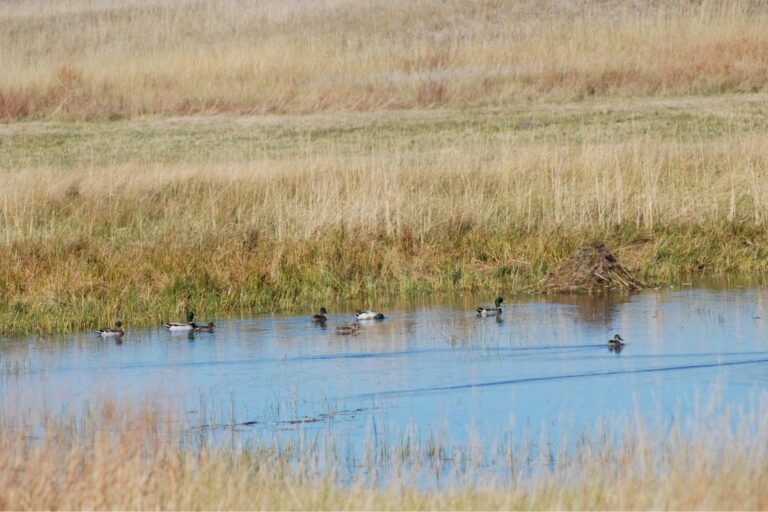
But in 2024, the Fish and Wildlife Service reinterpreted the scope of the wetland easements and updated the restrictions applied to prairie potholes. Prairie potholes are shallow depressions created by glacial runoff thousands of years ago. Water can accumulate in these holes, leaving some wet for large parts of the year. To the government, any activity that affected prairie potholes was a violation of the easement. Not just big, destructive drainage. Not just reckless projects that flood fields or destroy habitat. Any attempt to manage my land that affected the potholes was off-limits, with a violation potentially resulting in up to a year in jail and tens of thousands of dollars in fines.
Under this new standard, the agency expanded the regulated farmland to include 40 percent of my property, covering areas that were not a part of the original agreement. Officials told me I could not install improvements that would increase my crop yield within 190 feet of prairie potholes. Without the agency’s interference, I would be able to install drain tiles, which lower the water table where I want to plant crops while directing the water into an existing wetland. I can’t help a nearby town manage a lake that has a constant flooding problem because the solution would cause water to flow through my land and might affect the wetlands easement.
What bothers me most is the principle: The agency didn’t come back to us with a renegotiated deal. It didn’t discuss this with us like neighbors. Instead, it simply reinterpreted the original agreement in a way that would have made the farmers who granted the easement laugh — or cry.
I’ve watched the Fish and Wildlife Service bully people across the Great Plains for allegedly violating easements. Men and women who have farmed their whole lives are being pressured to abandon normal agricultural practices their families have employed for decades.
Here’s what legal disputes between farming neighbors typically look like: When someone disagrees about shared property rights — whether it’s a fence line, a shared well or drainage affecting both properties — courts typically apply a reasonableness standard, a precedent commonly seen in land disputes. Both neighbors can use their property productively, and if there’s a conflict, a jury decides what’s fair and what’s not.
The federal government’s stance lacks the common sense of that approach. It is claiming that an easement granted six decades ago — one with vague boundaries that the government itself admitted it had trouble defining — now restricts my ability to undertake any projects that might affect a prairie pothole.
I’m a conservationist. I hunt ducks. I believe in protecting the land. I’m not trying to drain every wetland on my property. I just want to farm productively and help my community. But the federal government seems to believe the only acceptable path forward is for me to let them manage my land.
When the previous owners signed the easement, they didn’t intend to give away control of their land. When we bought it, we thought we were buying land with a limited-use restriction on the parts we couldn’t farm productively.
I filed a lawsuit last year with the help of the Pacific Legal Foundation to challenge this interpretation. North Dakota courts recognize that property owners have the right to use their land reasonably, even when an easement exists. Federal courts should, too.
The U.S. Fish and Wildlife Service performs important work. But being a good neighbor means respecting agreements and being clear about expectations — not unilaterally reinterpreting contracts granted long ago.
I want to make a living by farming my land responsibly. That shouldn’t make me an outlaw.
This op-ed was originally published in The Washington Post on July 29, 2026.