

Youth climate suits don’t have a constitutional leg to stand on

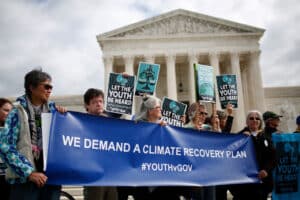
A federal appeals court has just announced an April hearing date in the youth climate suit Lighthiser v. Trump. The lawsuit was filed against the Trump administration in May 2025 by a group of 22 youth plaintiffs and spearheaded by the environmental activist organization “Our Children’s Trust.”
The lawsuit asks the court to strike down a group of executive orders designed to unlock energy abundance and prosperity by eliminating unnecessary red tape to facilitate production. The plaintiffs allege that these executive orders violate their rights—in particular, their right to due process—by contributing to climate change.
Their suit was dismissed by a Montana court in October and is currently before the U.S. Court of Appeals for the Ninth Circuit, where the plaintiffs hope for a different ruling than they received at the lower court.
But ultimately, youth-led climate lawsuits like Lighthiser don’t have a constitutional leg to stand on. Centuries of legal precedent bar or directly contradict their speculative claims. That’s why Pacific Legal Foundation recently filed an amicus brief in the case, encouraging the appeals court to affirm the lower court’s dismissal.
Common law tradition
The Lighthiser lawsuit attempts to pin the responsibility for a global phenomenon on individual actors, alleging through a lengthy chain of tenuous claims that Trump’s energy-and-environment executive orders violate the youth plaintiffs’ right to due process.
“[This] theory is a speculative, multi-step chain where executive orders may facilitate private energy production decisions, which may increase emissions, which may alter global climate systems, which may eventually harm Plaintiffs in unspecified ways.”
The claim runs afoul of centuries of common law precedent, violating long-held requirements for establishing legal liability.
English common law established a brightline rule which the American Founders carried into the Fifth Amendment: Due process requires establishing a direct causal relationship between an individual’s actions and the harm claimed in the suit. If you cannot prove that relationship, you cannot impose liability in court, no matter how much you may personally blame a person or group.
Under this common law tradition, a party can be held responsible for the harm alleged only if their actions directly and foreseeably led to that harm. Speculative and aggregate theories of causation—like those at the heart of Lighthiser—do not fulfill these requirements.
Supreme Court precedent
U.S. Supreme Court precedent similarly bars the Lighthiser plaintiffs from success. The Supreme Court has limited defendant liability in past cases by rejecting theories that impose responsibility on those who are only speculatively tied to a harm, and cannot be shown to have contributed to it. The youth plaintiffs in Lighthiser rely on a “butterfly effect” theory that is not meaningfully different from such liability theories, which the Court has rejected.
In addition, the Supreme Court increased due process protections by supporting a “but-for” causation standard—a standard that requires plaintiffs to prove that without the specific actions of the defendant named in their lawsuit, the harm they face would not have occurred. While the Lighthiser plaintiffs claim scientific advancement bolsters their arguments broadly, proving correlation at a global level does not satisfy the legal requirements needed to impose liability on the individual people and executive orders named in their suit.
The arguments in Lighthiser do not meet these requirements, leaving the plaintiffs’ due process claims unsupportable.
Future economic harm
These legal shortcomings are reason enough for the Ninth Circuit to affirm the lower court’s ruling. But there is also an eminently practical economic reason for the appeals court to dismiss Lighthiser: If the youth plaintiffs’ legal theories were adopted, it would destroy the stable legal framework surrounding the energy industry and its potential for ongoing innovation.
Currently, centuries of legal precedent protect the energy industry from speculative, “butterfly effect” litigation that fails to prove liability and violates due process standards. If that precedent is overturned as the Lighthiser plaintiffs propose, any individual or organization could find themselves the next target of such litigation. These lawsuits would decimate energy abundance and significantly harm individual economic opportunity, with dire consequences for energy producers as well as the individual homes and businesses that depend on accessible, reliable energy. The Ninth Circuit can prevent this harm by affirming the lower court’s dismissal.
Abundance, not artificial limits
It’s not enough to reject bad legal theory and leave it at that. As the courts prepare to dismiss Lighthiser, we should turn our focus and our efforts toward a better future that prioritizes abundance over punitive limits. That is the goal of Pacific Legal Foundation’s newly launched Environment and Natural Resources practice group. As we head into our second year, we look forward to continuing to fight against untenable legal theories and bureaucratic overreach, and to fight for abundance and prosperity for all.
If you agree that a better world is possible through liberty—that a thriving environment and free individuals are not in conflict—subscribe below to follow along.