

State vs. Federal Water Regulation in a Post-Sackett World



This research in brief examines how states have responded to the Supreme Court’s decision in Sackett v. EPA, which narrowed the scope of federal Clean Water Act (CWA) jurisdiction by limiting coverage to relatively permanent waters and wetlands with a continuous surface connection to those waters. The research in brief inventories which states authorize regulation beyond the federal CWA baseline and reviews the empirical literature on whether more expansive state-level CWA-style regulation is associated with better water-quality outcomes. It finds that while many states permit stronger regulation than federal law requires, the evidence does not show a consistent relationship between greater regulatory stringency and improved water quality.
Key Findings
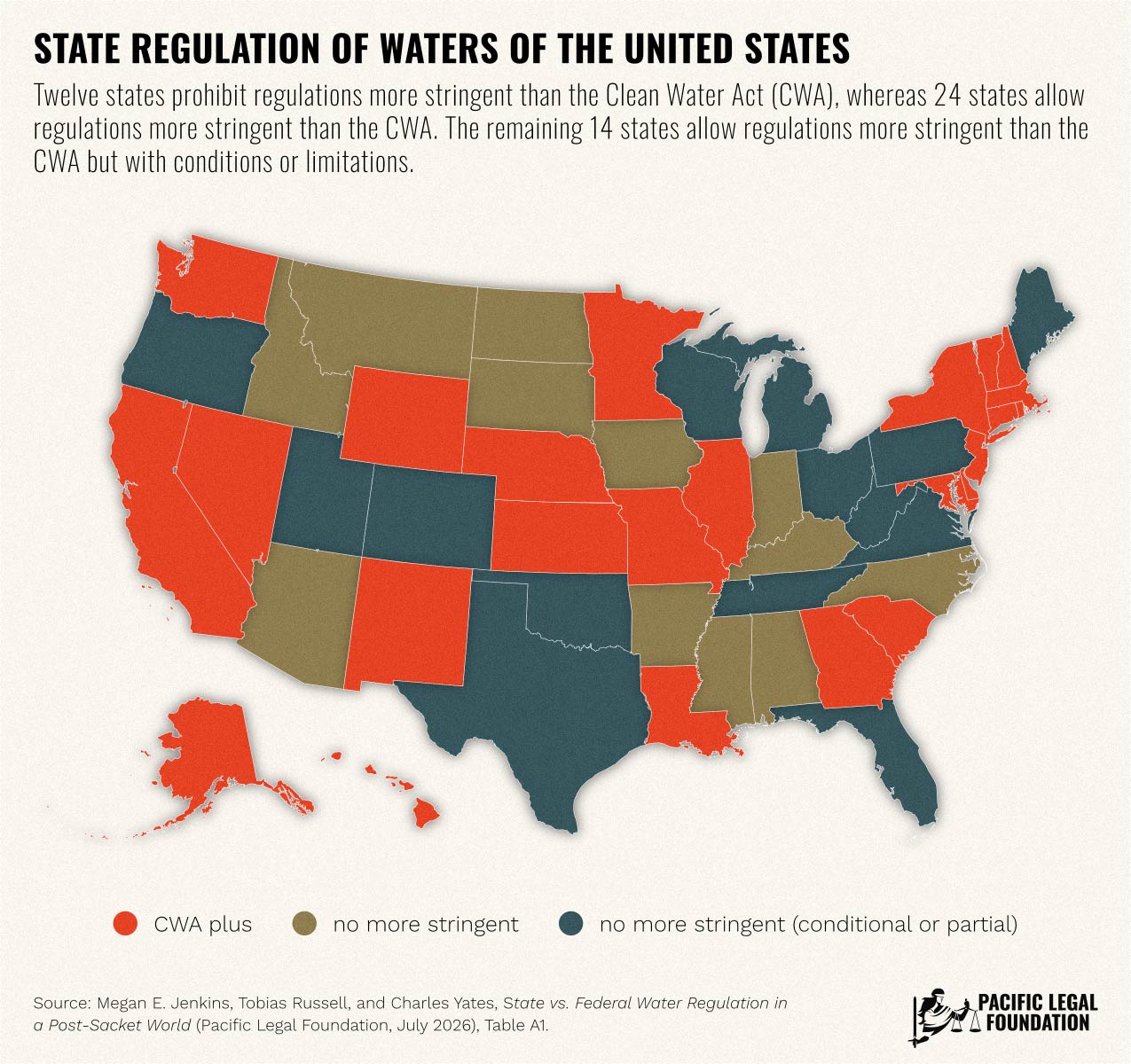
- Twelve states prohibit regulations more stringent than the CWA, whereas 24 states allow regulations more stringent than the CWA. The remaining 14 states allow regulations more stringent than the CWA but with conditions or limitations.
- Research generally finds no consistent evidence that states with more stringent CWA-style regulations achieve better water-quality outcomes than states that do not.
- Many states that legally authorize regulation beyond the federal baseline have not adopted comprehensive permitting programs in practice.
Policy Implications
- States seeking to improve water quality after Sackett may achieve better results by focusing on tools that address nonpoint-source pollution directly and by carefully weighing the costs and benefits of expanding CWA-style permitting regimes beyond the federal baseline.
Download the PDF here.