

Certificate-of-Need Laws Are Associated with Worse Access to Emergency Care
July 28, 2026
Certificate-of-need (CON) laws require healthcare providers in many states to obtain government approval before opening facilities, expanding services, or making major capital investments. This research in brief examines how those laws relate to emergency care access and finds that CON states tend to have less emergency-care capacity, longer waits, and weaker ambulance coverage than states without those restrictions.
Key Findings:
- CON states average 1.8 emergency departments per 100,000 residents, compared with 2.8 in non-CON states—about 36 percent fewer.
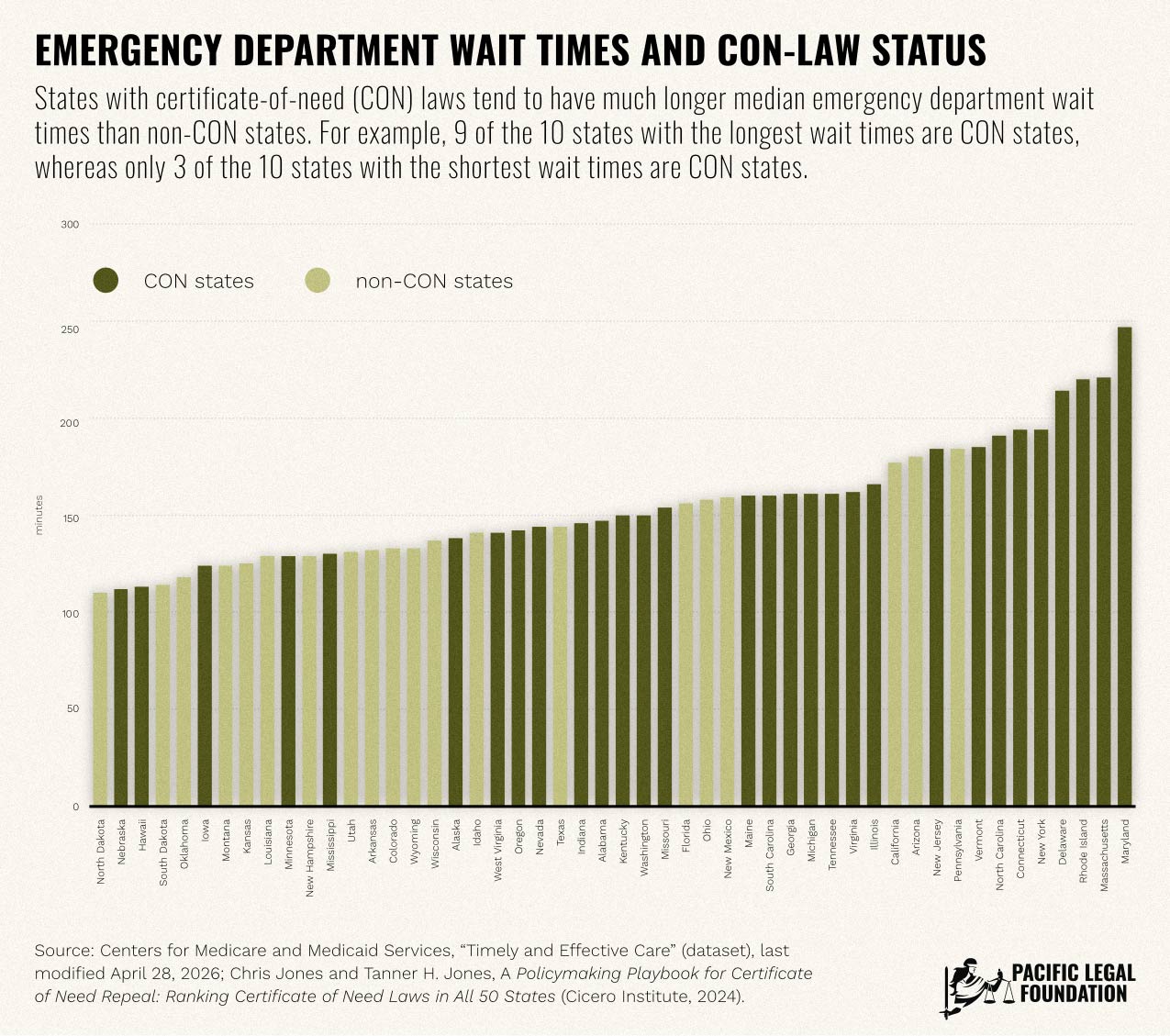
- Of the 10 states with the longest emergency department wait times, 9 are CON states, whereas only 3 of the 10 states with the shortest wait times are.
- CON states have 15 percent fewer EMTs per 100,000 residents than non-CON states, though they have 11 percent more paramedics; overall, total EMS provider supply is still 3 percent lower.
- 3.4 percent of residents in CON states live in an ambulance desert, compared with 3.0 percent in non-CON states—a gap of roughly 13 percent.
- CON states average 6.5 ambulance stations per 100,000 residents, versus 8.6 in non-CON states — more than 24 percent fewer.
- During the COVID-19 pandemic, states with CON restrictions on hospital beds had 12 percent higher bed utilization and 58 percent more days with bed use above 70 percent.
Policy Implications:
- Removing or narrowing CON restrictions could expand emergency department and ambulance capacity, reduce delays in emergency response and treatment, and improve access to timely emergency care, especially in underserved and rural communities.