Supreme Court will hear our school admissions case
Let’s not bury the lede. PLF is going back to the Supreme Court!
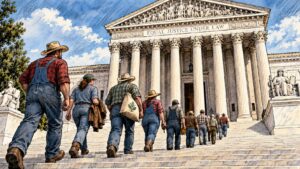
Yesterday, the Court agreed to hear our case challenging Montgomery County’s magnet school admissions rules, which were designed to reduce the number of Asian American students (and did). The lower courts rejected our Equal Protection claim because even despite that policy, Asian students still held a larger share of admissions offers than their share of the applicant pool. In other words, the school district allegedly discriminated, but according to those courts, not enough to give rise to an equal protection claim.
We’re arguing that equality is an individual right, and a child denied an equal opportunity because of race suffers a constitutional injury regardless of how other children of the same race fare. The Supreme Court will now decide whether families must clear that statistical hurdle before courts consider their evidence of intentional discrimination. It’s an important question that will have widespread implications given that, even after SFFA v. Harvard, schools have sought to drive their racial balancing underground, rather than stopping it entirely. A fitting issue for PLF’s 22nd appearance at the Court.
The Court’s enthusiasm for our cases was unfortunately selective. Last week, it declined to hear our cases involving homesharing restrictions, extortive fees in SoHo’s artists-only district, compelled speech at a shopping center, and a military veteran who claims the government improperly treated a private road across his property as public forest access.
Meanwhile, Khatibi v. Yip was relisted for yet another conference. That case asks whether California can claim privately created continuing medical education as its own speech, meaning it can compel, censor, or regulate that speech free of First Amendment scrutiny.
What else happened during the Court’s first two weeks? Here’s the scoop.
First Scoop: Explosive bureaucracy
Disposing of old explosives is dangerous work. Getting permission to dispose of them can be its own ordeal. The Court heard oral arguments about it in Department of the Air Force v. Prutehi Guahan.
At Guam’s Tarague Beach, the Air Force destroys waste munitions through open burning and detonation. Those operations require a permit under the Resource Conservation and Recovery Act, or RCRA, which regulates hazardous waste. When the Air Force applied to renew its permit, however, an environmental group sued, arguing that it first had to conduct a separate review under the National Environmental Policy Act, or NEPA. The Supreme Court faces two questions: Does submitting a permit application constitute “final agency action” that can already be challenged in court? And must the Air Force complete NEPA review before applying, even though RCRA supplies its own environmental safeguards and public-participation procedures?
The Chamber of Commerce argues that layering NEPA onto that process would impose costly, duplicative review, imperiling important developments. And as PLF has documented, NEPA can become a formidable barrier to getting anything done. In fact, approval for one geothermal exploration project took a year and 128 days—even though its proposed probe holes would disturb a combined area roughly the size of an index card. That’s a lot of bureaucracy per square inch.
Rather than being an effective tool for preventing harm, NEPA has turned into an effective tool for stopping even beneficial developments. That’s something that shouldn’t be expanded.
Second Scoop: Can Boulder send the world an invoice?
The highest-profile case from the past two weeks involves the City of Boulder’s attempt to make ExxonMobil and Suncor, two producers of fossil fuels, pay for their purported contributions to local harms associated with climate change, including wildfires, flooding, and reduced snowpack.
The companies argue that Colorado cannot use its tort law to decide what companies should have produced and sold nationwide, let alone throughout the world. Energy policy implicates other states, foreign affairs, and national security. They therefore invoke the Constitution’s structure and early cases treating interstate pollution as a matter for federal law to say that state law shouldn’t govern. Otherwise, Colorado could use damages awards to impose its energy policies on activities that Texas and other states lawfully permit. Boulder argues in response that states have always used tort law to remedy local injuries, including injuries caused by companies operating across state lines. It says it is merely seeking compensation for wrongful conduct, not an emissions limit.
As PLF argues in its amicus brief, attributing liability to a company’s fractional contribution to global emissions could expose energy producers to enormous claims across numerous jurisdictions. That uncertainty threatens investment in the affordable energy that powers human flourishing—and raises due process concerns about the reach and predictability of liability.
At argument, attorney Kannon Shanmugam offered a more personal illustration. Under Boulder’s theory, he argued, the City could sue him when he visits Colorado for contributing to climate change by refilling his car.
(N.B. Even if Suncor loses, Congress could step in and explicitly preempt this type of litigation.)
Third Scoop: Your ‘recently watched’ history has entered the chat
The term opened with ERISA and federal sentencing guidelines. My apologies to the ERISA bar, but these are challenging ingredients for a jaunty newsletter.
Then came Robert Bork’s video rentals.
During Judge Bork’s confirmation battle, a journalist obtained a list of 146 films rented on his family’s account and published “The Bork Tapes” (apparently Bork and his wife, who shared an account, were fans of Hitchcock, Sixteen Candles, and Citizen Kane). In response, Congress passed the Video Privacy Protection Act of 1988, which prohibits certain disclosures of video-viewing information. Salazar v. Paramount considers the breadth of that statute four decades later in the digital age, when streaming and doomscrolling have replaced trips to Blockbuster Video.
The plaintiff Michael Salazar subscribed to a free e-newsletter from 247Sports and watched videos on its website. He alleges that Paramount, which owns the site, disclosed his information to Facebook without his consent in violation of the VPPA. The question is whether his newsletter subscription makes him a protected consumer.
Paramount argues that he wasn’t a “renter, purchaser, or subscriber of goods or services from a video tape service provider” because he subscribed to a newsletter, rather than to a video-related good or service. The meaning of the text, Paramount says, is informed by the surrounding text, and Congress only intended to protect people who specifically rented, purchased, or subscribed to video-related goods. As Chief Justice Roberts observed at oral argument:
[Justice Breyer’s favorite hypothetical] says, you know, no pets in the park, and the question was, did that mean that the person carrying his pet snail in his pocket was subject to prosecution.
In other words, context matters.
Salazar argues in response that no such qualification is present in the text, and if Congress had wanted to limit the statute, it would’ve said so. On this point, Justice Jackson used Justice Breyer for a competing hypothetical: If Breyer entered a video store and watched some videos but only bought a book, and if the store later went on to disclose his watch history, why should it matter that he only bought a book? Paramount’s attorney Paul Clement responded that “no statute pursues its purpose to the ends of the earth. And, here, Congress was very clear that if you don’t have a [specific] rental, purchaser, or subscription relationship, then you’re not covered by this statute.”
There were also some questions about whether a sports site like 247 is even a “video tape service provider” to begin with, or rather some sort of other provider that happens to offer videos. Justice Alito remarked that if someone asked where you got gas and you got it from Costco, you wouldn’t respond by saying “I got it from a provider of optical services,” merely because Costco offers those things, too.
The case may have far-reaching implications in the digital world. As the justices noted, almost every company now provides videos on their websites—from gyms to Chick-fil-A to universities. Clement argued that ruling for the plaintiff would open the scope of liability too broad. Justice Kagan pressed a practical response: just get consent or stop sharing people’s private information.
Cherry on top
The Milwaukee Brewers are going to the World Series—for the first time since 1982! Congratulations to PLF attorney and Wisconsin native Joshua Thompson, whose October just got considerably better. In the Brewers’ honor, I’m resurfacing my interview with Brewers great Jonathan Lucroy, who talked about hard work, praised the First Amendment, and taught me (and my son!) how to block passed balls.
Speaking of baseball, Justice Alito has a new book out that speaks of his love for the game and that likens judging to umpiring. He’s a Phillies fan, but I reviewed it fairly anyway. Read my book review for The Dispatch.
Oh, and did I mention PLF got a case granted by the Supreme Court? Raise a glass to freedom.
See ya in two weeks,