

American Bar Association: Environmental law in the 2024-25 Supreme Court term
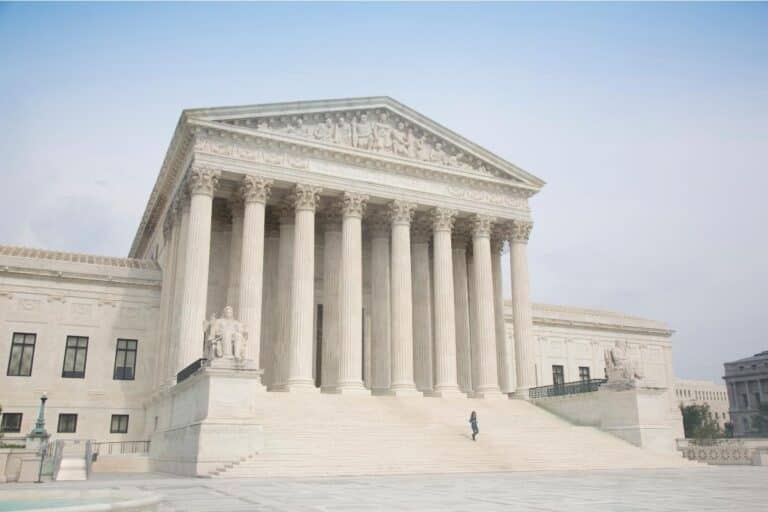
This article originally appeared in the American Bar Association’s Supreme Court Preview.
During the 2024-25 term, the Supreme Court squarely addressed environmental statutes in two important cases. One is a blockbuster that aims to rein in judicial review under the National Environmental Protection Act. In the other, the Court established a novel framework for resolving venue battles under the Clean Air Act. Beyond statutory review, the Court issued significant decisions involving justiciability and jurisdiction, which are sure to affect environmental law indirectly.
Court issues ‘course correction’ on NEPA
In Seven County Infrastructure Coalition v. Eagle County, Colorado, the Supreme Court took on the text of the National Environmental Policy Act (NEPA) for the first time in almost two decades. See 145 S. Ct. 1497 (2025). Mincing no words, the controlling opinion calls for a “course correction” in “overly intrusive” lower courts. It is a landmark case.
NEPA creates procedural obligations for federal agencies. See 42 U.S.C. 4321 et seq. The idea is to get these agencies to take a “hard look” at environmental consequences before undertaking major federal actions. See Robertson v. Methow Valley Citizens Council, 490 U.S. 332 (1989).
More concretely, NEPA requires federal agencies to prepare an environmental impact statement, or EIS, for certain infrastructure projects that are built, funded, or approved by the federal government. See 42 U.S.C. §§ 4332(2)(C) (requiring a “detailed statement” for any “major” federal action that “significantly affect[s] the quality of the human environment”). An EIS must describe the proposed action’s “environmental effects,” among other things. See 42 U.S.C. §§ 4332(2)(C)(i) – (v). Under then-prevailing NEPA rules, “effects” encompass “indirect effects.” See 40 C.F.R. § 1508.8(b) (2019).
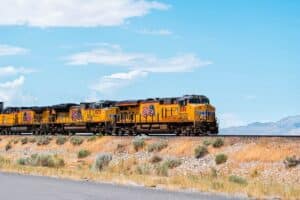
Seven County involved an EIS prepared by the Surface Transportation Board (Board), as part of the agency’s process for licensing the construction of an 85-mile railroad track that would connect rural northeastern Utah with the national railway network. See 49 U.S.C. §§10101, 10502, 10901 (establishing framework for Board approval of railway construction). Initially, at least, the primary commodity shipped by the new line would be oil produced in Utah’s Uinta Basin, which would be bound for new markets via the national rail system.
After an 18-month process, the Board issued a 3,600-page EIS in August of 2021. See 86 Fed. Reg. 43,236 (Aug. 6, 2021). A few months later, the Board approved construction of the proposed rail line. See 86 Fed. Reg. 72,366 (Dec. 21, 2021).
Following the Board’s approval of the license, Eagle County (Colorado) and several environmental organizations filed petitions for review in the D. C. Circuit. That court sided with the challengers, finding “numerous NEPA violations arising from the EIS.” See Eagle Cty. v. Surface Transp. Bd., 82 F. 4th 1152 (2023). The problem, according to the D.C. Circuit, was the Board’s failure to more extensively analyze the project’s indirect effects—namely, its “upstream”(oil drilling) and “downstream” (oil refining) impact on climate change.
The project’s proponents then sought review in the Supreme Court, which granted certiorari and, ultimately, reversed. Justice Brett Kavanaugh delivered the opinion of the Court, joined by five justices.
In sharp-elbowed prose, the Seven County majority admonished lower courts for “assum[ing] an aggressive role in policing agency compliance with NEPA.” This judicial overreach, in turn, “transformed” NEPA “from a modest procedural requirement into a blunt and haphazard tool … to stop or at least slow down new infrastructure and construction projects.”
To help lower courts chart a new course, the majority elaborated on two reversable mistakes made by the D.C. Circuit.
The D.C. Circuit’s first error was that it “did not afford the Board the substantial judicial deference required.” Such deference, the majority asserted, is “the central principle” of NEPA judicial review. Administrative law scholars take note: here, the Court creates a new class of super deference. The majority reasoned that because NEPA is a “purely procedural statute,” agency decisions warrant judicial respect above and beyond that afforded by “arbitrary and capricious” review, which already is highly deferential.
The D.C. Circuit’s second big mistake pertained to the scope of an agency’s NEPA analysis, or where to draw the line when considering a project’s “indirect” environmental effects. The D.C. Circuit “incorrectly interpreted NEPA to require the Board to consider the environmental effects of upstream and downstream projects that are separate in time or place.” According to the majority, a separate project “breaks the chain of proximate causation between the project at hand and the environmental effects of the separate project.” Going forward, lower courts should not read NEPA to require analysis of separate projects unless they are “interrelated and close in time and place to the project at hand,” such that there is a “single project within the authority of the agency in question.”
Justice Sonia Sotomayor, joined by Justices Elena Kagan and Ketanji Brown Jackson, concurred in judgment. Justice Sotomayor would have reached the same result, but on narrower grounds. The majority, she wrote, “unnecessarily ground[ed] its analysis largely in matters of policy.”
NEPA takeaways
The Seven County decision fell against a backdrop of legislative change. In 2023, nearly two years after the Board issued the EIS in this case, Congress significantly amended NEPA, clarifying that the statute requires agencies to consider “reasonably foreseeable” environmental effects. See Pub. L. 118–5, Div. C, Tit. III, §321(a)(3)(B), 137 Stat. 38, codified at 42 U.S.C. §4332(2)(C)(i). Crucially, the Seven County majority specified that its analysis “applies to NEPA as amended.”
Again, this is a landmark decision—and that’s by design. The majority set out to rein in the lower courts on NEPA and thereby alter the course of judicial review. If this decision reaches the lower courts as intended, the result will be a significant reduction in judicial scrutiny of “indirect” effects under NEPA.
New Venue Test for Judicial Review under the Clean Air Act
In two companion cases, the Supreme Court set forth a new (and nuanced) framework for deciding where judicial review should take place under the Clean Air Act (CAA).
Congress addressed venue in section 307(b) of the CAA:
- For any EPA “action” that is “nationally applicable,” petitions for review must be filed in the D.C. Circuit.
- For “action” that is “locally or regionally applicable,” section 307(b) creates a presumption that judicial review should proceed in a regional circuit court—but this is only a default rule.
- Even if its rule or order is local, EPA may find that its action is “based on a determination of nationwide scope or effect,” with the result being that challenges must be routed through the D.C. Circuit. See 42 U.S.C. § 7607(b).
The CAA, therefore, funnels judicial review into either the D.C. Circuit or regional circuit courts, depending on the nature of EPA’s action. This dual track venue provision has led to many controversies and consequent confusion in the lower courts. At bottom, these disputes boil down to litigation strategy, or “home court advantage,” as Justice Samuel Alito described it during oral argument. See 2025 WL 905476 (U.S.), 96 (U.S. Oral. Arg., 2025). EPA generally prefers being in the D.C. Circuit, while regulated entities often think that regional circuits are better attuned to local concerns.
EPA v. Calumet Shreveport Refining (Calumet) involved EPA’s denial of petitions, submitted by small refineries, seeking an exemption from a renewable fuels program. See 42 U.S.C. 7545(o)(2)(A)(i) and (B)(i) (establishing Renewable Fuel Standard); §7545(o)(9)(A) (establishing exemption for small refineries).
In issuing these denials, EPA took a belt-and-suspenders approach to ensure the D.C. Circuit would hear any legal challenges. First, EPA combined scores of individual denials into two omnibus notices published in the Federal Register. See 87 Fed. Reg. 24,300 (Apr. 25, 2022); 87 Fed. Reg. 34,873 (June 8, 2022). According to the agency, these mass denials are “nationally applicable” action, because the omnibus notices reached refineries in multiple states. See 87 Fed. Reg. at 24,300-01; 87 Fed. Reg. at 34,874. As an alternative basis for judicial review to go through the D.C. Circuit, EPA invoked the statutory exception to the default rule that local actions should be reviewed in regional courts. See 87 Fed. Reg. at 24,301; 87 Fed. Reg. at 34,874. That is, the agency published a finding that its actions were “based on a determination of nationwide scope or effect” because the agency had employed a common methodological framework in denying the petitions.
Despite the EPA’s redundant efforts, many of the affected refineries sought judicial review in a regional circuit court. In each case, EPA moved to either dismiss for improper venue or transfer to the D.C. Circuit. In the Third, Seventh, Ninth, Tenth, and Eleventh Circuits, panels sided with the government. See Env’t Prot. Agency v. Calumet Shreveport Ref., L.L.C., 145 S. Ct. 1746, n. 1 (2025) (collecting cases).
Only the Fifth Circuit denied EPA’s motion, setting up a direct circuit split. See Calumet Shreveport Refining v. EPA, 86 F.4th 1121 (5th Cir. 2023). EPA then petitioned for Supreme Court review, which granted certiorari “to clarify where venue properly lies.” 604 U. S. ___ (2024).
By a 7 – 2 vote, the Court reversed. Justice Clarence Thomas wrote the opinion of the Court.
The majority set forth a “two-step” framework for interpreting CAA 307(b). At step one, courts determine whether EPA “action” is “nationally applicable” or “locally or regionally applicable.” Here, judges “must look to the authorizing CAA provision to identify the ‘action’ at hand.” If the agency’s action is “nationally applicable,” then the inquiry ends, and the case belongs in the D.C. Circuit.
Step two comes into play only if the EPA’s action is “locally or regionally applicable,” and the agency formally finds that its action was “based on a determination of nationwide scope or effect.” At step two, courts vet this finding, which, if valid, overcomes the CAA’s presumption for local action to be reviewed in regional circuits. Here, the crucial inquiry is “the degree of causality contained in the phrase ‘based on.’” According to the Calumet majority, nationwide factors must comprise the “most important part of the agency’s reasoning” for the “nationwide scope or effect” exception to apply. Although step two is a fact-intensive inquiry into the agency’s decision making, the Calumet majority stressed that courts should operate de novo, without any deference to EPA.
In Calumet, at step one, the majority decided that EPA’s denials are “paradigmatically” local. The agency could not escape this result simply by aggregating individualized denials into an omnibus notice.
At step two, however, the Calumet Court sustained the EPA’s finding that its denials were “based on a determination of nationwide scope and effect.” After performing de novo review, the majority concluded that the nationwide factors employed by EPA “plainly are the most important parts of its reasoning” in denying the petitions. As such, “the Fifth Circuit should have transferred this case.”
Justice Neil Gorsuch, joined by Chief Justice John Roberts, dissented. Although he agreed with much of the majority’s analysis, Justice Gorsuch objected to step two, which he viewed as “mistaken and likely to cause confusion.” Rather than looking to the “nature of [EPA’s] reasoning,” the dissent would look to the statute alone. Because nationwide considerations are absent from the statutory criteria that guide EPA’s discretion in granting or denying exemptions, all decisions in the space are “refinery-specific.”
Court Applies New Calumet Test in Companion Case
In a companion case decided the same day, Oklahoma v. EPA (consolidated with Pacificorp v. EPA), the Court applied Calumet, coming to the opposite conclusion. See 145 S. Ct. 1720 (2025).
Oklahoma/Pacificorp centered on where to review EPA denials of state compliance plans with national air quality standards under the CAA. As with Calumet, EPA took a belt-and-suspenders approach to ensuring these denials could be challenged only in the D.C. Circuit. EPA aggregated disapprovals for 21 states into a single omnibus notice published in the Federal Register. See 88 Fed. Reg. 9,336 (Feb. 13, 2023). In the notice, EPA stated that its omnibus action was “nationally applicable” because affected states across the west. As a backup argument, the agency announced its action was “based on a determination of nationwide scope or effect.”
Despite EPA’s efforts, twelve states sought review outside the D.C. Circuit in multiple regional circuit courts. In each case, the EPA moved to transfer to the D.C. Circuit. The agency was rebuffed by the Fourth, Fifth, Sixth, and Eighth Circuits, each retaining venue.
Only the Tenth Circuit granted EPA’s motion, setting up a direct circuit split. See Oklahoma v. EPA, 93 F.4th 1262 (10th Cir. 2024). The challengers—Oklahoma and Utah—sought review, and the Supreme Court granted certiorari.
In Oklahoma/Pacificorp, the Court reversed by a 9 – 0 margin after applying the two-step framework set forth by Calumet.
At the first step, the Court determined the relevant “action” is EPA’s disapproval of the state plans, which is “the prototypical locally or regionally applicable action.” And at the second step, the Oklahoma/Pacificorp Court concluded that the disapprovals “were not based on any determination of nationwide scope or effect” because nationwide criteria were insufficiently central to the agency’s analysis.
Justice Gorsuch, joined by the Chief Justice, concurred in judgment. While agreeing with the result, he could not join the majority’s reasoning. As he explained in his Calumet dissent, he failed to understand why the cases came out differently, despite their similar fact patterns. He took the cases’ divergent outcomes as a sign of the confusion to come.
Clean Air Act Takeaways
In resolving these companion controversies, the Court introduced a much richer framework for deciding the appropriate venue for judicial review under the CAA. Perhaps too rich—Justice Gorsuch and Chief Justice Roberts think the Calumet two-step will prove difficult to implement in the lower courts.
As a matter of environmental law, these cases likely will expand the scope of section 307(b)’s exception to the default rule that local action should be received in regional courts. In the perpetual battle between EPA and regulated entities over “home turf” for judicial review under the CAA, the agency seems to have won a significant skirmish.
Jurisdiction & Justiciability
In Diamond Alternative Energy, LLC v. EPA, 145 S.Ct. 2121 (2025), the Supreme Court, in a 7 – 2 vote, held that fuel producers have standing to challenge EPA’s approval of California’s authority to regulate fuel economy outside of the Clean Air Act. This justiciability controversy centered on whether an unregulated entity, claiming an indirect economic injury, could demonstrate Article III standing. From a doctrinal standpoint, the majority clarified that the redressability prong of standing allows “predictable, commonsense inferences” about how regulated entities’ behavior affects entities that aren’t regulated directly. More generally, the Court cautioned against using the redressability requirement “to prevent targets of government regulations from challenging regulations that threaten their businesses.” The Supreme Court’s decision should make it easier for unregulated parties to challenge environmental regulations that indirectly affect them.
In Nuclear Regulatory Commission v. Texas, 145 S.Ct. 1762 (2025), a 6 – 3 Court held that circuit courts do not have jurisdiction to review Nuclear Regulatory Commission (NRC) licenses unless the petitioner had intervened in the underlying licensing proceeding. Because NRC tightly controls access to its proceedings, the decision will make it more difficult to challenge the agency in court. See Will Yeatman, What the Supreme Court Got Wrong in NRC v Texas, Pacific Legal Foundation Blog (June 25, 2025). By reversing the Fifth Circuit, which had reached the merits and ruled against NRC, the Court sustained (for now) the agency’s post-Yucca Mountain strategy—namely, to store nuclear fuel at regional sites on an interim basis.
Conclusion: A Common Thread?
All in all, it was an eventful term in environmental law. The marquee case, of course, is the NEPA “course correction” announced in Seven County. And yet, as with any result at the Supreme Court, all the cases discussed above move the needle in their respective realms.
Looking at the whole, no patterns are readily evident, at least when it comes to whether the Court is pro- or anti-environment or pro- or anti-agency. However, from a broader administrative law perspective, at least one commonality is apparent. It is striking, to this author at least, how the Court employed deference (or not) in the two lead cases. In Seven County, the Court established a super deference to review an agency’s fact-ladened NEPA determinations. But in Calumet, when reviewing EPA’s fact-intensive reasoning under the CAA’s venue provision, the Court called for de novo review. In our post-Chevron world, these cases demonstrate how the Court is calibrating deference on a regime-by-regime basis for so-called “mixed questions” of law and fact.