

Big decisions at the Supreme Court
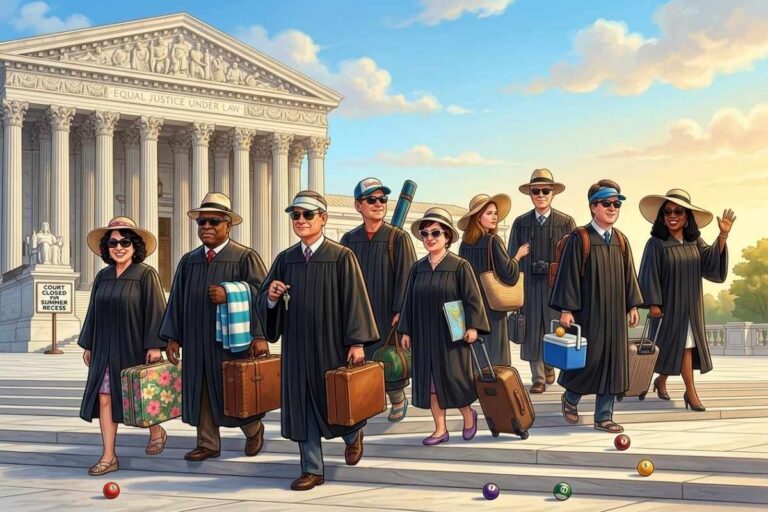
The Supreme Court has started releasing the blockbuster opinions everyone’s been waiting for. This week brought major decisions on property rights, religious liberty, immigration, and the Second Amendment. Here’s what stood out to me.
The Pungs live to fight another day
The Supreme Court handed down its decision in Pung v. Isabella County, Pacific Legal Foundation’s latest home equity theft case. The decision isn’t perfect. If I could have written it myself, it probably would’ve looked more like Justice Thomas’s concurrence. But I’m genuinely pleased with the outcome because I think it moves the law in the right direction.
First, the facts. I’ve read them dozens of times, but they still shock me.
For nearly two decades, the Pung family lived in the same modest Michigan home and paid their property taxes. Then a local tax assessor wrongly revoked a primary-residence tax exemption and assessed thousands of dollars in additional taxes. The Pungs challenged the assessment in court and won, where they confirmed they didn’t owe the additional taxes.
That should have been the end of the story. Instead, the assessor imposed the same additional taxes again. Speaking of the judge who ruled for the Pungs, she remarked, “I don’t care what he says,” and she sent the bill separate from the main tax bill and in the way most likely to end in delinquency.
It was only when one of the Pungs arrived at the township office to pay the full amount listed on the bill that he was told that additional taxes had been added. He explained they weren’t owed, showed that the home remained the family’s primary residence, and paid the amount reflected on the first bill. The rest became an “unpaid” tax.
The County nevertheless foreclosed on the family’s home over roughly $2,000. It took title to the home the Pungs had owned for 27 years and sold it at auction for just $76,000—even though the County itself had taxed the property based on a nearly $200,000 value. Less than 18 months later, the purchaser resold the home on the open market for $195,000.
Thanks to PLF’s earlier case, Tyler v. Hennepin County, the Pungs were at least owed the surplus from the sale. The problem was that the County had sold the home for nearly half its price, meaning they lost half their home equity. The Pungs sued, arguing that they were entitled to the fair market value of their home minus the tax bill, rather than the sale price minus the tax debt.
In an opinion by Justice Alito, the Court said no. Historically, tax foreclosure sales have not required governments to compensate owners based on market value. And because tax sales are different from ordinary real estate transactions, they almost always will result in lower-than-market price. If the government were forced to pay market value minus the debt, they’d almost always come out at a loss and leave taxpayers on the hook for the unpaid taxes.
But then comes the most important part of the opinion: The Court emphasized that this rule assumes the sale was done under a fair process. So the Court sent the case back to the Sixth Circuit to determine whether Isabella County’s procedures were deficient in a way designed to lead to a lower sale price.
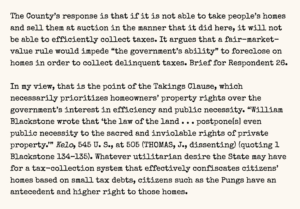
Justice Thomas’s concurrence—joined by Justice Gorsuch—was the standout. He painstakingly recounted the County’s conduct, noting that even at oral argument the County couldn’t explain why the tax assessor had imposed the disputed tax. He stressed that when the government takes property to recoup a debt, it “can be no broader than what history justifies,” emphasized the government’s obligation to first go after personal property rather than their homes, and concluded with perhaps the most memorable line of the week:
“What Isabella County did to the Pungs was wrong, and, on my initial view, likely unconstitutional.”
That’s an extraordinary statement from a justice whose concurrence now becomes the roadmap as the case returns to the Sixth Circuit.
Here’s my favorite part, again from Justice Thomas:
What if we tried more accountability for rights violators, not less?
One of the Court’s quieter decisions this week may end up having outsized consequences for Congress’s spending power.
This case begins (again) with troubling facts. A Rastafarian inmate was preparing to leave prison when officials said they would shave the dreadlocks he had grown in accordance with his religious beliefs. When he showed them a court opinion explaining that his faith protected his right to keep them, the officials threw the opinion in the trash and shaved him anyway.
By the time he sued, an injunction wouldn’t help. His hair had already been cut, and he had already been released. The only meaningful remedy left was money damages.
So he sued under RLUIPA, the Religious Land Use and Institutionalized Persons Act, which protects religious exercise in prisons and land-use decisions. The question before the Court was whether RLUIPA authorizes damages against prison officials in their personal capacities.
Justice Gorsuch, writing for the majority, said no. The decision turns on an important constitutional distinction. Unlike the Religious Freedom Restoration Act (RFRA)—which rests on Congress’s independent authority to regulate—RLUIPA is largely grounded in the Spending Clause. That means it operates like a contract: Congress offers federal funds, and states voluntarily accept certain conditions in exchange.
Because Spending Clause legislation depends on consent, the Court reasoned that Congress cannot impose personal liability on individual employees who never agreed to those conditions. Allowing damages suits against prison officials would transform Congress’s power to spend money into a much broader power to regulate private individuals.
In dissent, Justice Jackson argued that RLUIPA’s text authorizes damages and that officials working for institutions accepting federal funds may be bound by the obligations attached to those funds. She also rejected the majority’s narrow reading of the Necessary and Proper Clause, concluding that Congress may authorize damages as an appropriate means of carrying its spending power into execution.
I understand the majority’s federalism concern. Congress’s Spending Clause power isn’t a general police power, and the Court is rightly wary of allowing Congress to regulate private parties indirectly simply because federal dollars changed hands. Still, I found the result difficult to swallow. It seems to me that the prison officials very much could have been said to have accepted liability by virtue of accepting their employment.
It would probably be easier to accept if it didn’t seem like the Court was continually narrowing the scope of judicial review and the scope of governmental accountability along with it. In recent years, the Court has repeatedly limited avenues for obtaining damages or other meaningful relief against government officials. When rights are violated, obtaining an effective remedy has become increasingly difficult.
The immigration cases weren’t really about immigration
Two of Thursday’s biggest immigration decisions were portrayed as major policy rulings. But they’re better understood as cases about textualism and judicial review.
Temporary Protected Status
In Mullin v. Doe, the Court confronted a statute that says there is “no judicial review” of the Department of Homeland Security’s decisions regarding Temporary Protected Status and designations and terminations. TPS is a designation that means aliens can stay in the country and work when it’s unsafe for them to return to their home country. Haiti and Syria had formerly been designated due to destruction caused by an earthquake and the brutal governmental regime, respectively. But DHS withdrew those designations last year. A group of plaintiffs challenged the termination, saying they were improper and based on racial animus.
The Supreme Court ruled that courts can review TPS decisions only when based on a constitutional challenge—meaning there’s an unusually high bar to judicial review. The Court also rejected, at this preliminary stage, the argument that Haiti’s TPS termination likely resulted from unconstitutional racial discrimination. The majority noted an irony: The challengers themselves argued that the administration had been terminating every TPS designation that came up for renewal, suggesting a broader policy objection to the program, rather than race-based decision-making.
The Asylum Case
It’s a case about the meaning of two words: “arrive in.”
Federal law requires the government to inspect non-citizens and process asylum claims from people who “arrive in the United States.” During the first Trump administration, the government adopted a practice known as “metering,” which limited the number of migrants allowed to enter through ports of entry each day, delaying their ability to apply for asylum.
The plaintiffs argued that once someone reaches a port of entry and presents themselves to U.S. officials, they have effectively “arrived in” the United States and are therefore entitled to inspection and the opportunity to apply for asylum—even if they never actually enter the port.
The Supreme Court disagreed. Writing for the majority, Justice Alito took a straightforward textualist approach. In ordinary English, he explained, someone standing in Mexico has not yet “arrived in the United States.” His opinion offered several memorable examples:
“A running back does not arrive in the end zone when he reaches the 1-yard line. A guest does not arrive in a house when he knocks on the front door. An army does not arrive in a city by encamping outside its walls.”
The dissent, led by Justice Sotomayor, thought the majority’s reading was too literal. In her view, Congress enacted these provisions to ensure that people seeking refuge would have access to the asylum process. Reading “arrive in” so narrowly, she argued, would allow a future administration to effectively shut down asylum altogether simply by refusing to admit people through ports of entry.
The majority responded that those concerns were directed at a different question. And if Congress believes the statute should reach people waiting at ports of entry, Congress can amend the law and write it that way.
More Bruen cleanup decisions
The Court also continued refining its post-Bruen Second Amendment doctrine in Wolford v. Lopez and US v. Hemani. Bruen, as you’ll recall, threw out the usual means-end balancing test for judging whether something violates the Second Amendment and instead tasked courts with finding a historical analogue to the challenged law to determine if it’s valid.
Wolford involves a Hawaii law prohibiting licensees from carrying firearms on virtually all private property open to the public unless the owner gave express permission. The Supreme Court said that flips centuries of common-law tradition on its head and there was no historical analogue to justify it. Hawaii tried to rely on 1) the alleged Hawaiian aversion to guns, 2) historical regulations related to unauthorized hunting on private property, and 3) most shockingly, the Black Codes. The Court held that the Second Amendment means the same thing in every state, such that the Second Amendment cannot give way to “the spirit of Aloha” any more than it yields to the spirit of the Big Apple or the Windy City. And with regard to the two analogues, they were not sufficiently analogous in the how or the why.
In her concurrence, Justice Barrett wrote another great quote of the week:
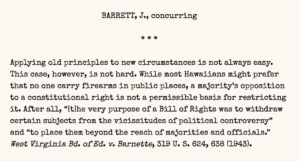
I just wish the Court felt the same about all of our rights.
What else?
I joined The Jesse Weber Show to unpack what many headlines got wrong about the Supreme Court’s latest decisions.
We won another First Amendment case! A federal court ruled for our client Nourish Our Neighbors after one of the charity’s volunteers was handcuffed for handing a homeless man a burrito without a permit. The opinion even includes what may become one of my favorite judicial discussions ever: the now-famous “taco test.” This case is a sweet reminder that being good to your neighbor is not a crime. Cleaning up parks is not a crime. And government doesn’t hold a monopoly on charity
New podcast episode: A fresh episode of In Dissent is now available wherever you get your podcasts. In Episode 3, Georgetown Law Professor Randy Barnett, NYT columnist and author Jesse Wegman, and Cato Institute Senior Vice President for Legal Studies Clark Neily discuss the Declaration’s famous phrase “consent of the governed” and whether, in this day and age, it’s still meaningful.
New at The Dispatch: My review of Jesse Wegman’s new biography of forgotten Founding Father James Wilson is now live.
New at SCOTUSblog: I also have another installment of my SCOTUSblog column In Dissent, looking back at one of Justice Ruth Bader Ginsburg’s most famous dissents—and how it ultimately changed federal law.
Next week, the Supreme Court is likely to close out the term and release its blockbuster-iest decisions….
Until then,