

Can California silence a doctor-patient phone call?

Trinidad, California, sits at the edge of the continent, a small coastal town nearly 300 miles north of San Francisco. In many ways, its remoteness is part of its charm. For Shellye Horowitz, who has a rare and potentially life-threatening bleeding disorder, it comes with a serious drawback: a state law that restricts her ability to communicate with her healthcare specialists.
Shellye suffers from hemophilia A, which has complications so severe that even routine physical activity can trigger dangerous internal bleeding. She has struggled to find quality care close to home and already suffered through a negative surgical experience in the Bay Area.
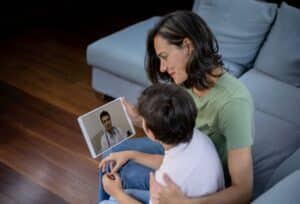
When she discovered a renowned multi-disciplinary clinic for treating women and girls with bleeding disorders in Portland, Oregon, Shellye says “it changed everything.” She began making the eight-hour trek out of state to receive treatment. In between visits, she would often consult with her specialists via telehealth calls.
Those consultations had always been illegal under California law. But when the COVID-19 pandemic hit, the state temporarily lifted that restriction, making telehealth widely accessible for the first time. Once the emergency ended and the regulations snapped back into place, those life-saving consultations were suddenly off limits.
California requires any physician who provides telehealth consultations to California patients to hold a California medical license, meaning Shellye’s Oregon specialists were no longer authorized to provide her care remotely. Now, if she wants to ask her doctor a question about managing her rare condition, she needs to travel to Oregon—which includes taking time off work and incurring travel expenses. In practice, it forces her to forgo or severely limit quality care. It also stands in the way of the specialists most qualified to provide that care.
This week, Pacific Legal Foundation senior attorney Caleb Trotter argued Shellye’s case before a three-judge panel at the Ninth Circuit Court of Appeals.
PLF’s lawsuit also represents Dr. Sean McBride, a radiation oncologist at Memorial Sloan Kettering Cancer Center in New York. He uses telehealth to consult with his out-of-state patients virtually, discuss whether they should travel to New York for treatment, and follow up with them upon their return home. Under California law, those consultations are prohibited unless he obtains a California license.
The panel focused its questioning on the First Amendment—specifically, whether consultations and follow-up calls between doctors and patients constitute conduct that the state can regulate, or speech that the Constitution protects.
Trotter argued that the consultations and follow-up calls at the heart of this case—conversations that happen before and after treatment, not during it—are speech fully protected by the First Amendment. For that reason, any attempts to silence those conversations should be subject to the highest standard of constitutional review. He also highlighted an inconsistency in California’s own rules: The state already permits out-of-state doctors to write prescriptions for California patients, making it difficult to justify why a phone call warrants stricter regulations than a prescription.
“The state says this is about protecting patients. But the only person this law is protecting is the California doctor who doesn’t have to compete with a specialist in Oregon,” Trotter said. “We’re confident the court will recognize that a phone call is protected speech under the First Amendment.”
At the end of the day, a state law that forces a woman with a life-threatening condition to choose between an eight-hour drive and no care at all—when a phone call would suffice—isn’t protecting anyone. It’s just getting in the way.
The Ninth Circuit’s decision could affect not just Shellye and Dr. McBride, but every Californian who depends on a specialist who happens to practice across a state line.