

Could lower impact fees be key to solving California’s housing crisis?

California currently has some of the highest housing prices in the nation. But a recent study suggests that one policy change would help the state address this without costing taxpayers a dime: lowering impact fees on new home construction. New research from the RAND Corporation suggests reducing impact fees in California by just 25% could significantly increase housing production while allowing local governments to recover lost revenue through higher tax collections generated by the new development.
That finding should attract attention from state and local policymakers searching for practical ways to increase housing supply without burdening taxpayers. It also reinforces an argument Pacific Legal Foundation has made for years: when governments impose excessive fees on new housing, everyone pays the price.
The hidden cost of building housing
“Impact fees” are charges local governments impose on permits to construct new homes or other developments. The fees are typically justified as a means to cover the costs of infrastructure expansion, such as roads, sewer systems, schools, and parks.
In principle, there is nothing wrong with requiring builders to pay for the impact their developments actually create. But impact fees create a tradeoff for cities. While the fees can provide local governments with immediate revenue for new infrastructure, they also increase the cost of construction. Higher development costs can make some projects financially unfeasible, leading builders to scale back plans or cancel them entirely. This results in fewer housing units, reduced affordability, and slower growth in the property tax base over time.
The RAND study examined these results in four California cities: San Francisco, Los Angeles, Palo Alto, and San Diego. The researchers found that a modest 25% reduction in impact fees could dramatically improve the housing crisis, leading to over 9,000 more housing units across these cities. The additional homes would generate enough tax revenue to offset the revenue lost from the fee reductions, with full recovery occurring within four to seven years. And over the long haul, the financial benefits for local governments could even be more substantial: for example, over 175% of the impact fee revenue would be recovered in 8 years in San Francisco.
California’s fees stand out
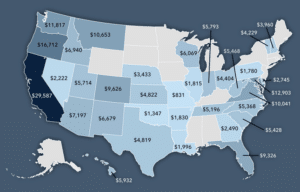
These findings are particularly important because California’s impact fees are extraordinarily high. Pacific Legal Foundation’s research team found that the state’s average impact fee in 2019 was almost $30,000 per new housing unit—more than three times the national average of over $9,000. In San Diego and Palo Alto, the fees reached a staggering $62,000 and $82,000, respectively.
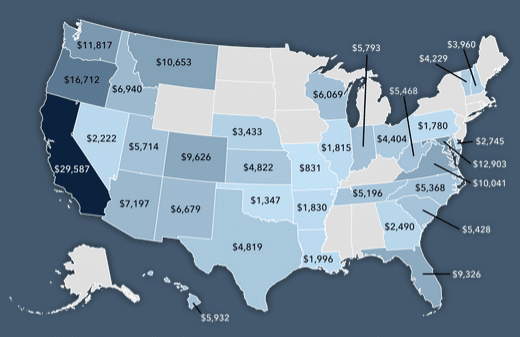
When fees reach those levels, they become a major barrier to housing production because they significantly add to the cost of construction. Every additional $1,000 in impact fees charged to a builder increases the cost of bringing new homes to the market by $1,390.
In California, which is already struggling with high housing prices and shortages, that disproportionately harms financially disadvantaged renters and buyers. The National Association of Home Builders found that every $1,000 increase in the price of homes prices out an additional 11,302 households in California.
The constitutional problem
There is another reason to scrutinize impact fees: the U.S. Constitution.
Local governments may require property owners to mitigate impacts caused by their projects. But sometimes governments go beyond that limit, demanding fees for entirely unrelated impacts.
The Supreme Court has long held that development exactions like impact fees must be related to the impacts of the proposed development and roughly proportional to those impacts. When governments demand more than that, they violate homebuilders’ property rights by wrongly forcing private individuals to foot the bill for public projects.
Pacific Legal Foundation has represented property owners across California challenging unlawful and excessive housing exactions. In Sheetz v. County of El Dorado, for example, PLF represented George Sheetz, a California retiree who was ordered to pay over $23,000 to subsidize future commercial development before the County would allow him to build his home. George secured a unanimous victory at the U.S. Supreme Court, in a landmark decision reaffirming that governments cannot avoid constitutional limits simply by imposing exactions through legislation rather than individualized permitting decisions.
PLF has also successfully challenged burdensome housing exactions in other California cities, including Healdsburg and East Palo Alto, and is currently litigating in San Luis Obispo. Each case highlights that this is a problem California must address.
A win-win policymaking opportunity
Impact fee reform is a rare win-win opportunity for local governments as well as home builders, owners, and renters in California. Many Californian cities could increase housing production, improve affordability, and grow their long-term tax revenue base simply by lowering impact fees that have become barriers to new construction. For a state facing one of the nation’s most severe housing crises, that is an option policymakers should not ignore.
And, as the RAND study highlights, reducing unnecessarily high impact fees does not require massive spending or new taxes to recoup lost revenue. Instead, it means carefully evaluating existing fee structures and ensuring they are the proper size and reflect actual development impacts.
PLF has advanced model policy that can help states enact this reform easily. The Safe Harbor from Excessive Exactions Act ensures impact fees are properly set by allowing property owners to challenge impact fees and other exactions when they seem too high or not connected to the construction project.
By reforming impact fees, California can secure more stable sources of long-term revenue for its cities, defend Californians’ property rights, and increase the supply of more affordable housing for the residents who need it most.