

Fourth Amendment rights should not depend on your proximity to the border
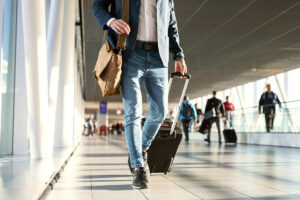
International travel can be a stressful experience. Between remembering passports, language barriers at foreign airports, and customs, it’s enough to frustrate even the most seasoned travelers. After a long journey, there is no greater relief than landing safely back in America, clearing customs, and heading home.
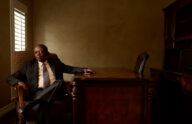
But that relief turned to horror for Vermont school superintendent Wilmer Chavarria when he was detained by U.S. Customs and Border Protection (CBP) at Houston’s George Bush Intercontinental Airport, denied legal counsel, interrogated for hours, and stripped of his Fourth Amendment rights.
Now, he is fighting back and challenging a directive that allows CBP agents to suspend constitutional rights within an expansive “border zone” encompassing any location within 100 miles of U.S. borders.
Out of poverty
Before becoming a naturalized U.S. citizen in 2018, Wilmer Chavarria had an upbringing most people only see on screen. He was born in a fenced-in refugee camp on the border of Honduras and Nicaragua near the end of the Contra conflict in the late 1980s.
When his family repatriated to Nicaragua, they were treated as second-class citizens. Even though untrue of Wilmer’s family, refugees were broadly linked with the Contra fighters, making his generation the “undesirable” children of a not-so-distant revolution.
Wilmer’s family was forced to settle on the poverty-ridden outskirts of the city. “Nicaragua at this time was very poor, but we were poorer,” Wilmer remembers. They had nothing but were eventually able to build a small adobe hut, where they lived.
His mother sold bread in the street to support her seven children. It was common for kids to help earn money for their families, but Wilmer’s mom refused to let that happen.
“She was obsessed with the idea of all of us going to school no matter what. I would help her sell bread in the afternoons, but I could not use helping her as an excuse to miss school,” he said.
He and his siblings didn’t always have notebooks, backpacks, or even shoes, but they thrived in school. Wilmer, who was the youngest of the bunch, was especially bright and even became valedictorian of his high school.
In Nicaragua, the valedictorians of each high school take an hours-long test to see who will become valedictorian for their entire city. Wilmer won that honor and went on to compete in and win the regional valedictorian competition.
Wilmer never let his hardships stand in his way. “I remember those years as some of the hardest times in my life. But it was also a good time in my life because I could see the results of my work. I felt like there was a path forward out of poverty through education.”
At 15, he finished high school and received a full-ride scholarship to study at a national university five hours from home.
In college, Wilmer was laser-focused on his goals: “Get a degree, get a job, get my mother out of poverty.” He hadn’t been in school long before he learned that he had been awarded another prestigious scholarship to study at a school in Canada for two years—an honor given to only one student in all of Nicaragua. When he arrived in Canada, he didn’t speak a lick of English. He powered through and in just a few months, he was able to hold full conversations in English.
When the program ended, he received another full-ride scholarship, to Earlham College, a private liberal arts school in Indiana, where he met his future husband, to whom he’s been married for over 15 years.
After his undergrad, he got into a master’s program at Harvard. Wilmer was thrilled to tell his mother that all her sacrifices and encouragement had not been in vain. She told him she was proud but asked him why this Harvard place was such a big deal.
“Even if she doesn’t understand the magnitude of things, she’s just very happy,” Wilmer said. “She tells the story of how we got to the refugee camp. She walked for three weeks in the mud through the mountains, and at some point, she thought she was going to die. She prayed to God all night just for a few more days so that she could make sure her children made it to the camp.”
All her children are not only alive but are thriving professionally. His mother likes to say, “God answered my prayer way beyond my wildest dreams.’”
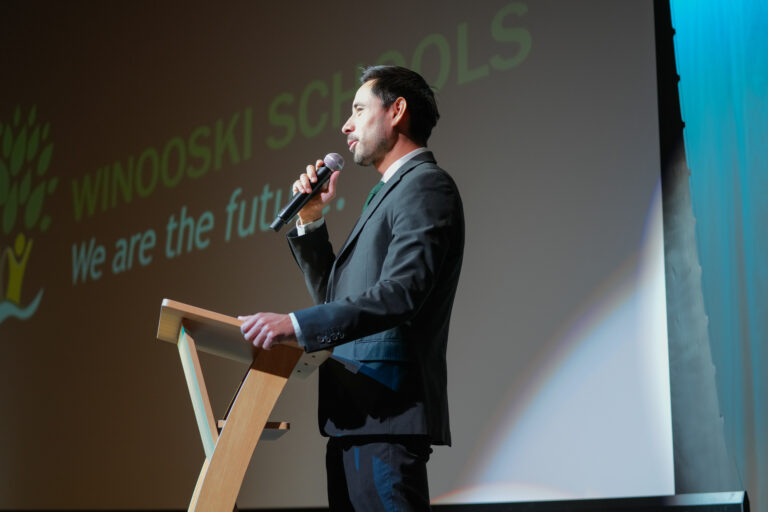
Her emphasis on education made an impression on Wilmer, who now works as a superintendent in Vermont’s Winooski School District, where he gets to help other students.
His mother means everything to him and he often returns to Nicaragua to see her. In July 2025, Wilmer was on his way home from a visit when he was detained by CBP.
When constitutional rights meet the border zone
When Wilmer and his husband landed back in America, they did what they usually do after an international trip—headed to the expedited customs line reserved for American citizens who are part of the CBP Global Entry program.
They prepared to walk past the final CBP agent, and right after his husband was let through, Wilmer was stopped. Wilmer was surprised, but he knew he had done nothing wrong and tried to remain calm. Surely, this mistake would be rectified shortly.
He and his husband were led to the backroom meant for additional screening, where they were met by a woman in plainclothes. She led Wilmer deeper into the building, leaving his husband behind to wait.
Wilmer was ushered into a cold, windowless room where a mix of federal agents—some in uniforms, some in plainclothes—rotated through, towering over him and subjecting him to hostile lines of questioning. Never once was he told why he was there. This continued for over four hours, but without a clock in the room, Wilmer had no concept of time.
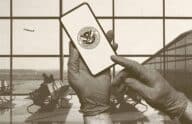
Even though they made no formal accusations, his interrogators demanded that he hand over his electronic devices—which included his personal phone and his work tablet and laptop—and all his passwords. Wilmer knew his Fourth Amendment rights and refused. The agents continued their intimidation tactics to break Wilmer down.
“They said they were going to taint my record so that I could never get a job again. They were going to refer me to the FBI because I had something to hide. They were telling me out loud that they would destroy my life if I didn’t do what they were asking me to do,” Wilmer remembers.
At one point, he capitulated and handed over his devices but still refused to give his passwords. Wilmer’s primary concern was his work laptop, which contained sensitive student information. He tried to explain that he believed the data was confidential and he was forbidden to provide that information without a judicial order or lawfully issued subpoena. He repeatedly asked to speak to his school district’s attorney but was denied and told that he had no Fourth Amendment rights.
Eventually, the agents’ tactics worked. Willmer was physically and mentally exhausted and he just wanted to go home.
As he recalls, “They finally said, ‘We’re going to make a deal. We’re going to accept that you don’t consent for us to touch anything that has to do with student and family information, but that we can go into personal things like your personal email and stuff like that.’” He was then told to make a list of files he believed were school records, so that they knew which records were off limits.
Wilmer knew that once they left the room with his devices, none of their promises really mattered.
“I knew that they were lying. Once they have access to my devices, they’re going to access whatever the hell they want.”
After he was finally released, an agent rubbed salt into the wound by shaking his hand and applauding him for his resilience and commitment to his students during the interrogation.
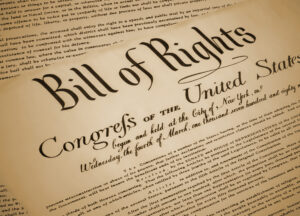
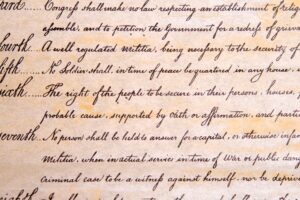
Growing up in Nicaragua, Wilmer was no stranger to the wiles of corrupt government. But America’s constitutional rights are supposed to be ironclad. The government cannot force Americans to surrender their constitutional rights as the price of traveling with their electronic devices. And Fourth Amendment rights should not depend on your proximity to the border.
Wilmer was unwilling to quietly move on with his life when he knew CBP could keep doing this to others. Teaming up with Pacific Legal Foundation, he is challenging the CBP’s authority to conduct warrantless and suspicionless searches and seizures in border zones.
As awful as it was, Wilmer hopes that something good can come out of his experience.
“Given my history since childhood, I’ve experienced abuse, I’ve experienced injustices and I can take it. I know that life is hard and sometimes you’re going to have to face obstacles. And as long as you survive them, then we can grow from that,” he says.
He continued:
But I hope that the pain I’ve gone through doesn’t have to be forgotten. I think it should be used for something. The reason I’ve been so public about this is because I want people to understand that this could happen to any of us and that when I’m abused, it makes it easier for you to be abused next time.
For Wilmer, the stakes of this case are so much bigger than him alone.
For me, winning this case would be consistent with the mission in my life, which is to actually make an impact for my family, for my community, and if possible for the country. If I can use the frustration and injustices that have happened to me as a catalyst for protecting the rights of other people, then I will be satisfied with that.