

From Magna Carta to American independence: The legacy behind America’s 250th birthday
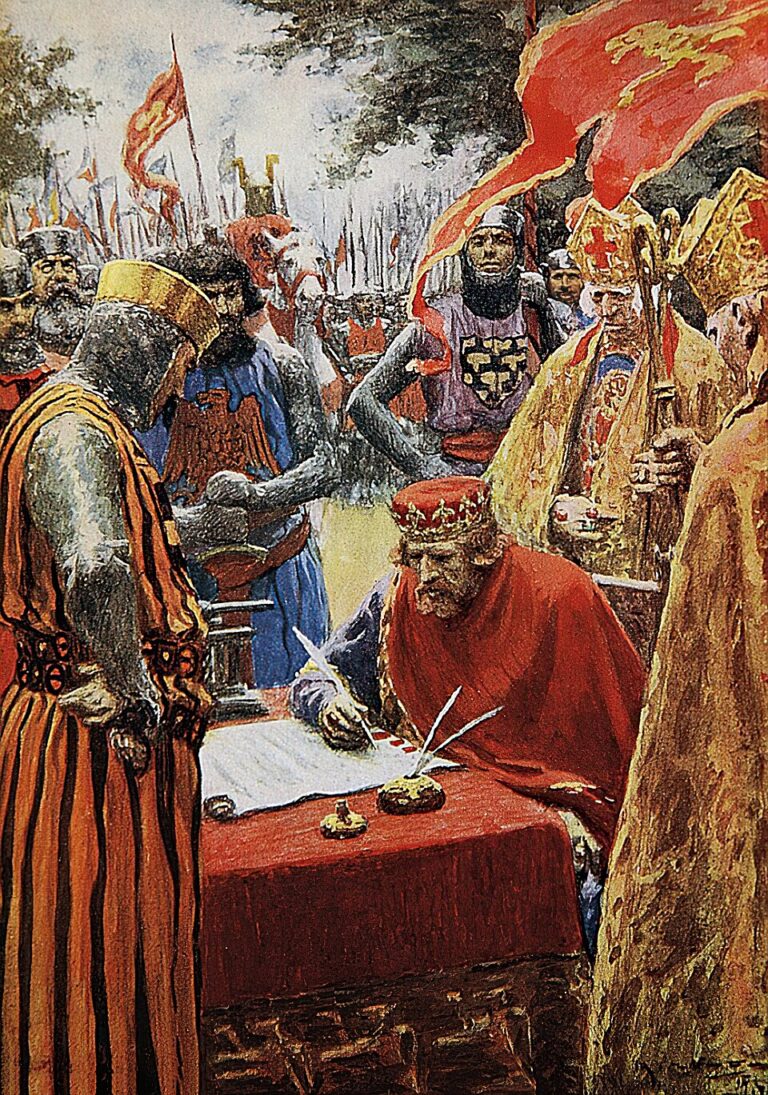
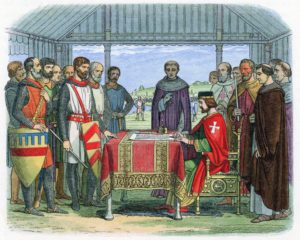
This month marks the 811th anniversary of the signing of Magna Carta, an event regarded by many as the foundation of the English Constitution and an inspiration for American independence.
Magna Carta’s lore has taken on a legendary quality over time, but the tale of the rebel barons compelling the tyrant King John to affix his seal to a document limiting his power is only one part of the story of the charter’s enduring legacy.
The “Great Charter” is important, not because of how it was signed but because it endured—not only throughout generations of English political discourse, but across the Atlantic, where the American colonists gave it new life.
What happened at Runnymede that summer day in 1215 sent a profound message that no king or ruler was above the law. While the rule of law would become a cornerstone of English constitutionalism, it was not the magic elixir the barons had hoped. Just weeks after the signing, King John had his revenge.
At the King’s behest, Pope Innocent III annulled Magna Carta. In the aftermath, war continued, John died, and Henry III, the late King’s nine-year-old son, inherited the throne. As was customary with such a young king, a regent—William Marshal in this instance—stepped in and governed on Henry’s behalf.
The barons were not thrilled. Rather than accept Henry’s rule, they turned to France, inviting Prince Louis to take the throne. Marshal now had a choice to make: continue the bloody civil war or find a way to bring the barons back into the fold. For the sake of unifying the kingdom, he chose the latter and reissued Magna Carta in 1216—albeit slightly edited. Most notably, Clause 61, the “security clause” that had allowed the barons to compel the king’s obedience, was cut entirely.
The Great Charter was reissued again in 1217 and once more in 1225, each time with additional revisions.
At first glance, the repeated reissuance of the Great Charter might not seem as thrilling as 25 barons holding a king hostage at swordpoint, but this is where Magna Carta’s true story begins.
An English charter, an American cause
By the time the first English colonists arrived in the New World, more than four centuries had passed since Magna Carta was signed. No matter how much distance was now between these settlers and their mother country, they considered themselves Englishmen, through and through. And as Englishmen, they were entitled to the rights and liberties guaranteed to them in the English Constitution and, specifically, the Great Charter.
When James I authorized the creation of the Virginia Colony in 1606, he declared that colonists and their descendants “shall have and enjoy all Liberties, Franchises, and Immunities as if they had been abiding and born, within this our realm of England.”
The early colonists took him at his word and shaped their own laws accordingly.
In 1628, the Maryland legislative assembly promised the people of Maryland all their “rights and liberties according to the great charter of England.” Likewise, when William Penn established Pennsylvania and Delaware, he incorporated principles of Magna Carta into their governing documents. Penn held Magna Carta in such high regard that he was responsible for its first printing in America. He included the 1225 version in The Excellent Privilege of Liberty and Property: Being the Birth-Right of the Free-Born Subjects of England.
As the decades passed, the Great Charter maintained its significance in the colonies. The colonists believed Magna Carta already belonged to them. They were not claiming new rights but demanding the rights they had inherited as Englishmen.
Thus, when patriots protested the king and Parliament’s trespassing on their rights, they did so in the spirit of Magna Carta.
As the late historian Gordon S. Wood observed, “More than any other document it came to stand for what Americans meant by rights, and by liberty, and their liberties.” He continued, “Until almost the moment of Independence, they correctly insisted that they were revolting not against the English Constitution, but on behalf of it.”
Magna Carta became a symbol for the revolutionaries—a measuring stick by which they judged the king and Parliament’s actions.
When the Townshend Acts inspired John Dickinson to pen his series of essays Letters from a Farmer in Pennsylvania, he included on the title page an illustration of himself standing with a copy of Magna Charta (as it was commonly spelled) under his arm.
Magna Carta appeared everywhere in revolutionary America.
In 1774, the Royal American Magazine commissioned Paul Revere to create engravings of the famous Bostonian patriots Samuel Adams and John Hancock, both with scrolls labeled “Magna Charta” underneath their busts. When proceedings from the First Continental Congress were published, the title page bore the image of twelve hands clinging to a pillar with “Magna Charta” written on its base. -Paper money from Massachusetts was decorated with yet another Revere illustration, which featured a Minuteman holding a sword in one hand and Magna Carta in the other.
When the time finally came to debate independence from England, the Second Continental Congress participants compared themselves to the rebel barons at Runnymede. Even the text of the Declaration echoes many of the same complaints that animated Magna Carta.
Yet, for all Magna Carta did to justify the Revolution, it receded into the background when it came time to frame the U.S. Constitution.
The Constitution without Magna Carta?
During Pennsylvania’s ratifying convention, James Wilson, one of only six men to sign both the Declaration of Independence and the Constitution, argued that Americans no longer needed to look to Magna Carta for inspiration. Like many other Federalists, he believed the new Constitution could protect liberty without spelling out every right.
Others were not so convinced.
The Anti-Federalists did not want to support a constitution that left so many rights implied. History had shown that unless rulers were explicitly told what not to do, rights would always be vulnerable to their whims. Checks and balances could help keep the branches accountable to one another. But more was needed to restrain the government from encroaching on the people.
Thus, the great debate over the Bill of Rights began.
Alexander Hamilton famously rejected the idea of a Bill of Rights in Federalist No. 84, echoing many of Wilson’s arguments. A strong supporter of Federalism, pamphleteer Noah Webster thought the inclusion of a Bill of Rights absurd. To him, declarations of rights like Magna Carta only made sense when they were meant to protect people from a king. But the new legislature was elected by and represented the people themselves. As Wood described it, Webster was essentially asking, “How can the people tyrannize themselves?”
Eventually, a compromise was struck: The Federalists would get their Constitution, and the Anti-Federalists would get a Bill of Rights.
As James Madison worked to draft the Bill of Rights, he drew from the rights and legal protections that Americans had long associated with Magna Carta—due process, jury trials, excessive fines, and property rights. And when those first ten amendments were adopted, “Magna Carta was once more placed at the center of American constitutionalism,” Wood said.
Even though many Federalists were convinced that America’s new government had outgrown Magna Carta, its influence on the new American Constitution was undeniable. Like the Great Charter, the U.S. Constitution was written to place government under the rule of law rather than above it.
On the eve of the Declaration of Independence’s 250th birthday, it is worth remembering that the principles that shaped the American Founding were planted centuries before the first colonist arrived in America.
Yet eight centuries after Runnymede, the central struggle between government and the people remains unchanged. What the colonists inherited from the rebel barons has been handed down to us. Every generation must determine how power will be restrained, how liberty will be preserved, and whether government remains subject to the rule of law or above it.
The spirit of Magna Carta is alive and well in the work we do at Pacific Legal Foundation, holding governments accountable when they step outside the bounds of the Constitution.