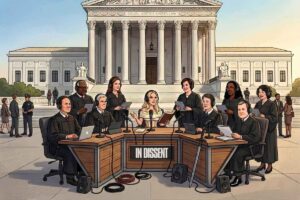


Justice Gorsuch charts the path to “return, all the way, to the Constitution”

Last term, the Supreme Court took a major step toward restoring the separation of powers. In Trump v. Slaughter, the Court ruled that congressional limitations on the president’s authority to remove commissioners of the Federal Trade Commission (FTC) are unconstitutional.
As Chief Justice John Roberts wrote, “Subordinates who exercise the President’s power are subject to removal by him. Then, and only then, can they remain accountable to the President, and the President to the people.” In other words, government officials who wield executive power—even those at “independent” agencies—must be accountable to the head of the executive branch under the Constitution.
But despite being a significant step forward, Slaughter also reveals how much remains to be done to address the separation-of-powers nightmare posed by the broad powers Congress has delegated to independent agencies.
“The fact remains that Congress has endowed formerly independent agencies not just with executive authority, but with enormous legislative and judicial powers as well,” Justice Neil Gorsuch wrote in his concurrence. “And now the President enjoys control over all those powers too.”
Justice Gorsuch then identified the next step after Slaughter. “From here, the only sure path is to finish the journey we start today and restore legislative and judicial powers to where they belong: in Congress and the courts. We have tolerated adventurous theories long enough. It is time to return, all the way, to the Constitution.”
These independent agencies—the Federal Trade Commission (FTC), National Labor Relations Board (NLRB), Consumer Product Safety Commission (CPSC), and others like them—exercise all three powers of government. They make rules and regulations that carry the force of law and are often indistinguishable from actual laws passed by Congress; they investigate potential violations and enforce federal law and regulations; and they settle disputes through their own in-house adjudication proceedings and exact civil penalties from defendants.
Before Slaughter, limitations on the president’s removal power insulated these agencies from constitutional accountability. And even after Slaughter, as Justice Gorsuch noted, these agencies still exercise legislative, executive, and judicial powers. As Justice Robert Jackson said almost 75 years ago, these agencies have become a “veritable fourth branch of the Government.” Slaughter confirms that these agencies are housed in the executive branch, but the executive branch is charged with law enforcement, not lawmaking or adjudication. This presents a real constitutional problem.
Take the NLRB, for example. The NLRB has the authority to make rules and regulations that are necessary to carry out federal law, prevent anyone from engaging in unfair labor practices, investigate possible violations of laws and regulations, adjudicate disputes between private parties, and order compensatory damages. The Board even claims to create “policy for the Agency primarily through adjudication” in a practice known as regulation by adjudication. From 2016 to 2025, the NLRB issued nearly 1,800 decisions in cases concerning unfair labor practices.
This confluence of powers in the hands of these agencies is far from being just an abstract debate of constitutional structure. It has real consequences for people.
Phil Peerless’ meat processing and distribution company, Atlantic Veal & Lamb, was accused by the NLRB’s general counsel of committing unfair labor practices when it let six employees go after the economic hardships of the COVID-19 lockdowns. But the Board’s enforcement action wasn’t filed in a court of law; it was filed in-house before an NLRB administrative law judge (ALJ). The ALJ agreed with the allegations, and, on appeal to the Board itself, the Board agreed with the ALJ, ordering Atlantic Veal to pay the discharged employees compensatory damages.
In this one case, the NLRB acted as lawmaker, law enforcer, and law interpreter, to the detriment of Atlantic Veal’s constitutional rights.
The Supreme Court was right in Slaughter not to erode the separation of powers further and strike down the FTC’s removal protections. The separation of powers requires subordinating officials who exercise significant executive power, like the commissioners at the FTC and the board members at the NLRB, to the chief executive. This represents a first step in correcting a major structural violation of the Constitution. But we shouldn’t stop there.
A full correction also requires returning legislative and judicial powers to where they belong under the Constitution. And as Justice Gorsuch says, that’s with Congress and the courts, not the executive branch.