

Napa County collected taxes on her wine for decades. Now it wants $4 million because she poured it.
Napa Valley, California, is home to some of the most sought-after wine in the world. Here, the elements conspire as warm afternoon sunshine and rolling evening fog slowly ripen the grapes, giving them time to develop that deep signature complexity.
Each bottle of Napa wine tells the story of the vineyard and the people who gave it life. These businesses—many of them family-owned—are the backbone of the county. Yet, instead of supporting this essential industry, the county government has gone after one small family business, fining them to the brink of bankruptcy over so-called offenses that the County has long supported.
Creating an oasis
Lindsay Hoopes spent her whole life in Napa. In the 1980s, her parents purchased their modest vineyard and began producing wine. Like many small wineries, they weren’t rolling in money. They earned a humble living working on land that they loved.
As an only child, there was no one else to take over the family business for her dad. With family legacy in her hands, Lindsay admits experiencing a bit of an identity crisis. Of course she wanted to help her father; but she also wanted the winery’s new era to reflect her own values.
She was also passionate about helping her community. Napa was changing. The local wine industry had been built over generations by small, family-oriented businesses. But in recent years, outside interests moved in and dominated the Napa wine scene.
Small wineries were going to need to change the way they did business if they were going to survive.
For smaller wineries to make money, they need consumers outside of Napa. Traditionally, this means that small wineries send sales reps on the road to present and sell their product to distributors. Naturally, smaller brands are at a huge disadvantage when they compete against bigger companies who don’t want to share their market. While direct-to-consumer sales have been a good source of revenue, consumers have to know you exist to order your wine.
Lindsay wanted to connect to consumers by bringing them to her. People travel to Napa specifically to try new wine. By adding tastings and other events to her business model, she could introduce Hoopes wine to a whole new audience.
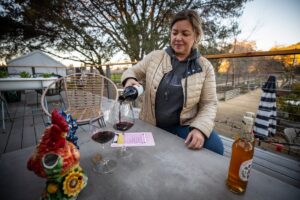
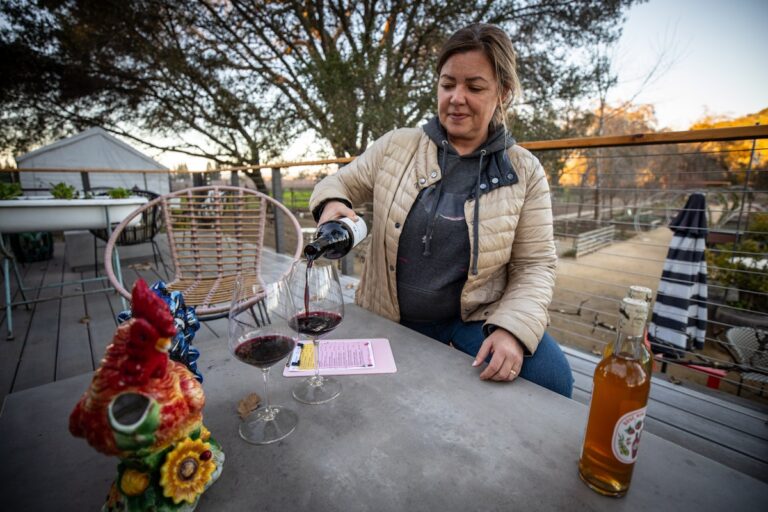
To make this happen, she was going to need a new space for events. Lindsay envisioned an oasis that would draw in customers and community members—a blend of family-friendly charm to be provided by a shiny Airstream RV, string lights, striped umbrellas and Adirondack chairs, and a breezy tasting room where customers could sip Cabernet while overlooking the vines, lush gardens with a regenerative farm, and a peaceful animal sanctuary.
Unless you have deep pockets or connections, finding land in Napa is not easy. Lindsay has neither and kept finding herself outbid by other buyers. Then suddenly, the stars seemed to align.
In 2017, a friend of a friend just happened to be getting drinks with an older gentleman who was interested in selling his winery to someone like Lindsay, rather than a large corporate buyer. After a miscommunication, Lindsay had to guess two digits of his phone number, but as fate would have it, the number worked. Forty-five days later, after securing a small business loan, Hoopes closed on the property that was just seven minutes from her childhood home. She could finally open the Hoopes Vineyard Oasis.
A shocking notice from Napa County
The story was almost too good to be true … until it wasn’t.
Napa County typically requires additional permits for wineries who want to host tastings or events. But in Napa’s earlier days, a simplified permitting process, known as a Small Winery Exemption (SWE) was available to make it easier for small wineries to open for business. The exemptions are tied to the land, not the owner, and they do not require renewal. And since the property had an SWE (issued in 1984 and amended in 1987), and had been hosting tastings ever since, everything should have been fine. Lindsay planned to update the dark German-style building, add space for an animal sanctuary and chickens to provide farm fresh eggs, and lush vegetable and flower gardens.
Giving the winery a modern facelift to attract new customers required Lindsay to jump through endless regulatory hoops with the County. Every time one issue was resolved, the County always found something else. But Lindsay jumped through every hoop, obtaining multiple building permits, seeking and obtaining approval from every department in Napa County that the building possessed sufficient infrastructure for winery use. Lindsay complied with all requirements, even when the County’s requirements were eyebrow-raising (like their requirement that she install an ADA-compliant bathroom on the second floor—which is only accessible via stairs and only houses her private office—in addition to the two ADA-compliant bathrooms on the ground floor).
Lindsay persisted, and in 2019 she applied to the State Alcoholic Beverage Control (ABC) for her Type 02 License, the “liquor license” which would entitle her to serve wine to customers on the premises, also known as wine tastings. Napa told the ABC that this use was and is “allowed and approved” on the property and had been since 1987, when all required use permits had been originally approved. So the ABC issued Lindsay her Type 02 license.
But in February of 2020, the County sent Lindsay a Notice of Apparent Violation alleging that she was “exceeding the allowed uses of the approved Small Winery Exemption (approved in 1984 and amended in 1987) by allowing tours, tasting and marketing events without the benefit of a Winery Use Permit.”
This confused her, especially since the Hoopes Oasis wasn’t open yet, due to building permit delays and wildfires. She hoped to open in March, but at the time all she had was a website with pictures of the beautifully updated winery, including a sustainable vegetable garden and quaint animal sanctuary, and information about future opportunities for the public to visit.
Lindsay asked for an administrative hearing to clarify the alleged violation, but was denied this opportunity and told there was no process for one. After a meeting with the code enforcement personnel, the matter seemed resolved, and Lindsay confirmed compliance with Napa’s codes. She was even told that if the County had wanted to escalate the situation, they would have issued an actual citation—but it never did.
Then COVID-19 hit—further delaying the opening of the Hoopes Oasis. Now going on year four of carrying a mortgage for a winery that had yet to open, Lindsay persevered to keep their multigenerational family livelihood and her new dream alive.
In March of 2021 the ABC approved Lindsay’s application to expand her licensed consumption area to include an outdoor deck and tastings within the garden, and confirmed in writing that this activity was not in conflict with local zoning ordinances.
Two months later, she received an email from Napa about a Second Notice of Apparent Violation for “tours and tastings”. Once again, she asked for clarification: the County had specifically told her (and the ABC) that she was allowed to host wine tastings on the property, so what was the problem? Lindsay asked to discuss the matter. The County never responded.
Eight months later, she received a notice stating that she was operating without a Winery Use Permit. She opposed the notice, explaining that she had an SWE—a use permit exemption dating back to 1987 – which entitled the property as a winery, and had enabled the property to host tastings for the past 40 years. Lindsay also had the required state license from the ABC that Napa confirmed could issue. The County once again did not respond.
In October 2022, the County sued Lindsay and requested that the judge immediately shut her business down.
The civil case went to the Superior Court where the judge sided with Lindsay, denying the County’s request to shut her down. The county had continuously accused Lindsay of operating without permits that she had actually obtained, and couldn’t even point to any specific provision of the code that she had violated. The judge ruled that it was Napa’s burden to show what activity or circumstances warranted classifying Lindsay’s commonplace activities as a “public nuisance,” and the County had failed to do so. The Hoopes Oasis could remain open. That should have been the end of it.
Napa County wasn’t happy and later requested that the judge be recused. According to the County, the judge had family ties to a different winery. In Napa, you would be hard-pressed to find someone who doesn’t have connections with the industry. Nevertheless, the case was handed over to a new judge, who did not have experience in civil cases like Lindsay’s.
Interestingly, while the County claimed that the property lacked permits to serve wine for on-premises consumption, they were also collecting taxes on the wine poured at that property for the last 40 years (and continues to do so to this day). The California State Controller even wrote to Napa to point out that discrepancy, confirming the business had been operational with wine tastings for decades, and noting concern over the County’s actions against a small business.
Adding to the County’s shady behavior, they also decided to hire outside counsel, intending to slap Lindsay with the bill, even though they already had in-house counsel who had been working on the case.
The legal battle continued for years with the County still unable to point to specific codes Lindsay had violated. Lindsay requested clarification of what conduct was at issue so she could present a defense but was denied.
After trial, Lindsay located thousands of pages of government records through the Public Records Act explicitly showing that the property was recognized as having tours and tastings. Lindsay requested these documents before the trial, but they were inexplicably withheld. Lindsay identified that private counsel had inexplicably and unlawfully withheld these documents which directly discredited their trial statements that the property was not entitled for wine tastings. In fact, until 2015, the County published information confirming that the winery, in fact, was authorized for this use. These entitlements were mysteriously deleted from County records when Hoopes purchased the property and the documents were hidden from use at trial.
Nevertheless, the County continued to seek fines to put Hoopes out of business.
A heartbreaking ruling
In January 2026, the judge issued his ruling, siding with Napa and ordering Hoopes to pay nearly $4 million in fines—$1,525,000 in civil penalties, $111,229.80 for costs of abatement, $69,792.25 in statutory costs, and a whopping $2,253,991 to pay for the County’s outside legal counsel.
Hoopes does not have the means to pay fines of this magnitude. Already, as result of this legal battle, Lindsay, her husband, her four children, and her father have been forced to sell the home where she grew up. Lindsay now faces bankruptcy and the loss of her family’s business. The County didn’t just sue the business: They are holding Lindsay personally liable—simply because she invested her own money into the business to keep it afloat during COVID and while defending against the County’s lawsuit.
The Eighth Amendment specifically protects individuals from excessive fines. Over the years, the Supreme Court further strengthened this protection, reaffirming that fines must be proportionate to the offenses committed where a court-imposed cost is even partially punitive. Judges are required to consider the harm caused by the offense and the defendant’s culpability (a.k.a. blameworthiness or fault) to ensure the punishment fits the crime.
So important is this right, Justice Ruth Bader Ginsburg once went so far as to call the protection “fundamental to our scheme of ordered liberty.”
In California, judges are supposed to confirm that the defendant is able to pay the amount imposed, usually accomplished by holding a hearing to consider evidence about the defendant’s current financial condition. Lindsay has repeatedly requested that hearing and explained that she cannot afford to pay these fines. But the judge refused to hold the hearing, and the County’s attorneys keep insisting Lindsay has more assets somewhere, even citing homes in other states to which she has no ties. The judge has maintained that because the Napa County Code allows for this huge amount to be imposed, the amount is not excessive. But that is not what the Constitution says. If governments can impose any penalty scheme they want, and foreclose judicial review of those amounts, no matter the disproportionality to the offense, then the Eighth Amendment means nothing.
Napa County is chomping at the bit to collect on these fines, demanding that Lindsay immediately pay, or post a bond for almost $6 million while she appeals the judgment. They say she should “welcome bankruptcy.” But if you have to pay the excessive fine (or post a bond for an even larger amount) in order to challenge that fine, then you are not truly protected by the Eighth Amendment guarantee.
The judge did grant a Motion to Stay, preventing the County from freezing all of Lindsay’s assets—but only for ten days. Ten days will not change Lindsay’s inability to pay fines that far exceed the lifetime revenue of the Hoopes Oasis and her own personal assets, or make the amount proportional to her offense—because there was no harm from hosting wine tastings and it was perfectly reasonable for her to believe she was allowed to continue the 30+ year practice of hosting tastings on the property.
Pacific Legal Foundation helped Lindsay file a Petition for Writ of Supersedeas, asking the appellate court to grant an emergency stay that would stop the County from going after her assets until the appellate court has a chance to review the case.
With one day left before the ten-day stay ended, the appellate court granted a stay to stop the County from enforcing the monetary penalties (for now), throwing Lindsay a much-needed lifeline. Hoopes Oasis remains open for tastings and their wine can be purchased at the property or on their website.
But the fight isn’t over yet. Protecting individuals from excessive fines, especially when those fines inhibit their ability to earn a living, is unconstitutional. And Pacific Legal Foundation is fighting to make sure governments like Napa County are held accountable.