

New PLF research shows state licensing laws are keeping patients from their doctors

When COVID hit, the world was in a state of emergency, forcing Washington to cut all sorts of red tape. TSA waived its longstanding size limits on liquids to make room for hand sanitizer. Restaurants got the green light to sell beer and wine for delivery. Cities cleared the way for sidewalk dining that permit rules long had prohibited.
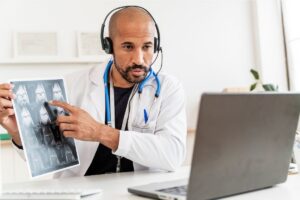
Healthcare was no exception. States lifted the licensing restrictions that had kept doctors tethered to a single state, and patients could finally consult with their doctors from home. A follow-up appointment with an out-of-state doctor became a video call instead of a plane ticket.
And the sky did not fall. If anything, Americans were left wondering: What purpose did these barriers serve in the first place?
The pandemic created an accidental case study out of what happens when those barriers come down. New PLF research on state barriers to telehealth and improving healthcare access confirms what patients experienced firsthand: More physicians practicing across state lines means more patients getting care.
A boy in New Jersey, a doctor in Boston, and a law that stands between them
Jun Abell was 18 months old when he was diagnosed with pineoblastoma—a rare and aggressive brain tumor. After multiple surgeries and six rounds of chemotherapy, his oncologist referred him to Dr. Shannon MacDonald, a radiation oncologist at Massachusetts General Hospital renowned for her expertise in pediatric proton therapy. Jun’s family relocated to Boston for two months while he underwent treatment—and it worked. Jun went home.
He is years removed from that fight now, back in New Jersey and living the life of a kid, not a cancer patient. But his tumor could return, and Dr. MacDonald remains the specialist best positioned to catch it. For years, his follow-up appointment was a video call. Then New Jersey reinstated the telehealth licensing rules it had suspended during the COVID-19 pandemic, and those calls became illegal.
Now, under state law, a check-in call between a cancer survivor and his specialist is a criminal offense, punishable by fines, criminal charges, and the loss of a medical license if the specialist does not have a New Jersey medical license.
Jun’s family can make the trip to Boston, but not every family can. And in a country facing a projected shortfall of as many as 86,000 physicians over the next decade, states that actively prevent qualified specialists from seeing patients across state lines are making a choice with a cost that falls entirely on patients.
How licensing laws harm patients
Jun’s situation is the predictable result of a system that treats state borders as the edge of a doctor’s competence. A tumor does not behave differently in New Jersey than it does in Massachusetts, but the moment a doctor’s expertise crosses state lines, it becomes illegal to use it.
Every state sets its own licensing requirements for physicians, and most require doctors to hold a license wherever their patient happens to be located, even for a follow-up video call. A specialist who wants to see patients in a neighboring state must apply for a second license, submit to fingerprinting and background checks, compile extensive documentation, and wait. In New Jersey, that process costs roughly $550 in fees and takes an average of three months. Specialists who see patients in multiple states must juggle multiple licenses, track separate renewal deadlines, and pay recurring fees to each state.
But specialists cannot simply predict in advance which states their telehealth patients will live in. That means patients in rural and underserved communities, who already struggle with limited access to care, lose access to the specialists who could help them most. For someone with a rare condition like Jun, these licensing barriers could mean no adequate care at all; the specialists they need may live in only a handful of places in the country, none of them in-state.
A solution: universal licensure recognition
Twenty-eight states have adopted some version of universal licensure recognition—a reform that allows physicians licensed in one state to practice in another without starting the process over from scratch. The research is unambiguous: States that adopt it see more physicians practicing across state lines, better patient access, and measurably improved outcomes, with the largest gains for older patients.
Research conducted during and after COVID-19 found that telehealth produces patient outcomes comparable to in-person care across a range of medical specialties. The condition-specific data is sharper still.
For cancer patients, a 2023 study found that telehealth use was 15% lower in states with more restrictive licensing laws. A 2025 study of rural Medicare beneficiaries found that cancer patients regularly cross state lines for treatment and that telehealth could reduce that burden where states allow it. In radiation oncology specifically—Dr. MacDonald’s specialty—a 2024 review found that telehealth provides immunocompromised patients with safer and more efficient access to care.
States that have adopted universal licensure recognition see more physicians practicing across state lines, better patient access, and the largest gains for older patients. A Cigna analysis found that telehealth users had 17% lower total medical costs and 36% fewer emergency department visits than patients seen only in person.
The research does not describe a tradeoff between access and quality. It describes a system in which licensing barriers are producing worse outcomes and higher costs.
The path forward
PLF is pursuing reform in court and in statehouses. Dr. MacDonald and fellow neurosurgeon Dr. Paul Gardner filed a federal lawsuit with PLF’s help—MacDonald v. Sabando—challenging New Jersey’s restrictions as unconstitutional under the First and Fourteenth Amendments.
On the policy side, PLF’s Telemedicine Freedom Act gives states a model framework for removing licensing barriers, protecting patients’ freedom to choose their providers, and ensuring Medicaid covers telehealth visits.
The barriers standing between patients and their doctors are not accidents of geography. They are policy choices, and they can be undone. For the patients who live in states that haven’t acted, the wait has a cost.