

New report: California Coastal Commission has collected nearly $50 million from property owners since 2016

The California Coastal Commission has long been described as the most powerful land use authority in the United States. A new PLF report puts some hard numbers behind that reputation.
The Power of Punishment: How the California Coastal Commission’s Increased Enforcement Power Affects Property Rights examines the Commission’s enforcement activity from 2016 through early 2024, drawing on public records obtained directly from the Commission. It documents an enforcement apparatus that has grown significantly in scope and financial impact over the past decade — one that raises serious constitutional questions about whether property owners are getting anything close to a fair hearing in addition to excessive penalties.
The Commission didn’t always work this way
When the California Coastal Commission was created in 1972, it had no power to fine property owners on its own. Alleged violations of the Coastal Act went to state court, where a neutral judge presided, normal rules of evidence applied, and property owners were presumed innocent until proven otherwise.
That changed in 2014, when the state legislature granted the Commission authority to assess administrative penalties directly — up to $11,250 per violation per day, with a potential maximum exceeding $20 million for each violation. The stated goal was efficiency: the Commission was frustrated that property owners were disputing alleged violations through the slower court process rather than simply complying with its demands.
It worked — at least by the Commission’s own measure. Case resolution times dropped from more than 1,000 days to under 100. By 2024, the Commission was closing newly opened cases in an average of 43 days, and its staff attributed that speed directly to the threat of the expanded penalty authority.
But when the threat of a multimillion-dollar fine hangs over a property owner facing a hearing where the Commission serves as prosecutor, judge, and direct beneficiary of penalties imposed, fast resolution is not necessarily a sign that justice was done. It may simply mean that most people, rationally, don’t fight a hopeless battle — especially when every single day potentially increases the fine another $11,250.
In 2021, the legislature expanded the Commission’s penalty authority further, extending the $11,250-per-day fine to any violation of the Coastal Act — not just those involving public beach access. The Commission’s enforcement reach is now effectively unlimited in scope.
What the cease-and-desist orders actually required
An analysis of 31 cease-and-desist orders issued between January 2016 and March 2024 — obtained through a public records request — shows just how much the Commission has extracted from property owners. Nearly $40 million in penalties were required across those orders, averaging almost $1.3 million per order.
But monetary penalties were only part of the picture. The Commission also required property owners to dedicate more than 50 acres of land for public recreation and to install dozens of public access features — parking spaces, benches, public restrooms, signs — on their private property, and at their own expense. When those non-monetary demands are factored in, the total cost to property owners reaches at least $48.2 million, or roughly $1.6 million per order on average.
Where does the money go? Most penalties flow into the Violation Remediation Account, a state fund that can be used to support public coastal access, education, operations, and maintenance. Beyond that, the Commission has directed penalty payments to outside organizations, including the Peninsula Open Space Trust ($1.6 million), the Mountains Recreation and Conservation Authority ($1.4 million), the Batiquitos Lagoon Foundation ($540,000), and the California Department of Parks and Recreation ($272,500). In some cases, property owners were required to directly fund programs — including camping initiatives and environmental justice education for students — that had little apparent connection to the violations at issue.
The Lents: what happens when you push back
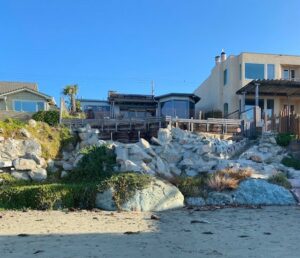
Warren and Henny Lent’s experience illustrates what the Commission’s enforcement process looks like for those who don’t simply capitulate.
The couple had stairs and a gate on their coastal property that had been approved by the local land use agency and in place for more than 20 years when the Commission ordered them removed in 2007. The Lents refused, arguing the structures were necessary to prevent people from falling down a 20-foot drop. As a gesture of good faith, they gave the Commission keys to the gate.
Seven years later, after the Commission received its new penalty authority, it issued a second cease-and-desist order, eventually fining the Lents $4,185,000 — more than four times the penalty the Commission’s own staff had recommended. The Commission partly justified the higher amount by noting that the Lents occasionally rented their property. They also highlighted that the Lents had disputed the alleged violations, characterizing their honest belief of their innocence as a particularly egregious aggravating factor.
The Lents sued, arguing the fines were excessive and the process denied them due process. They lost. The Supreme Court declined to hear their case, continuing to leave coastal property owners open to the Commission’s abuse.
The constitutional question
The Power of Punishment raises a structural concern that runs through all of the Commission’s enforcement hearings: the Commission serves simultaneously as prosecutor, judge, and often a direct recipient of the penalties it imposes. Legal experts cited in the report argue that this arrangement violates property owners’ rights to due process and protection against excessive fines.
Those arguments are now being tested in court. PLF is challenging the Commission’s enforcement power and process on behalf of Carlsbad property owner John Levy, who was fined $2.4 million in 2025 for alleged Coastal Act violations — including a gate the City of Carlsbad had approved years earlier.
The data in The Power of Punishment make clear that Levy’s case is not an anomaly. It is the system working as designed. The full report can be read here.