

California’s last nuclear power plant will remain open—for now
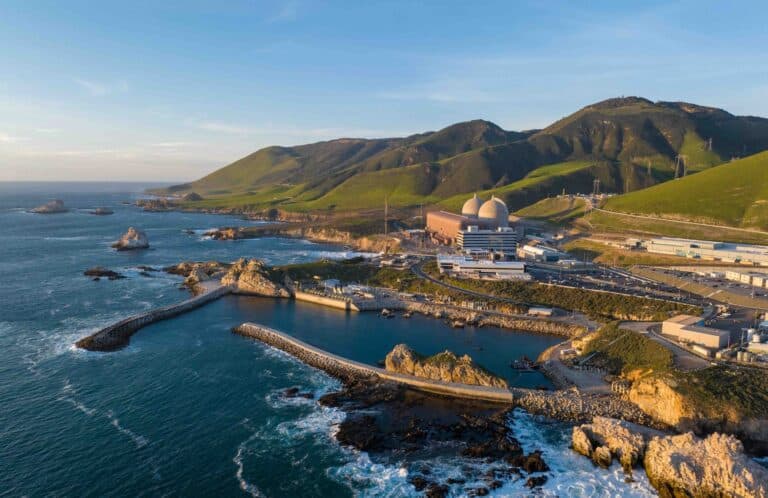
There’s only one nuclear power plant left in California: the Diablo Canyon plant, which sits near Avila Beach in San Luis Obispo County and provides almost 10% of California’s energy. The California Coastal Commission will allow the plant to remain open for five more years—but only because the plant’s owner, Pacific Gas & Electric (PG&E), made a series of concessions to the Commission.
PG&E agreed to set aside 4,500 acres of its land for “conservation,” establish a 25-mile-long public trail, and contribute $10 million for “trail development, maintenance, and stewardship.” In exchange, the Coastal Commission voted 9-3 on December 11 to approve the plant’s permit.
To outside observers across the country, the Diablo Canyon deal may look strange: How can a state agency extort money and land as a condition for approving a permit? Why is the future of California’s nuclear power—10% of energy in America’s most populous state, serving 40 million people—in the hands of 12 coastal bureaucrats?
The answer is a two-parter.
First, as regular Pacific Legal Foundation readers know, the California Coastal Commission is a powerful regulatory beast. The U.S. Supreme Court accused the Commission of “an out-and-out plan of extortion” back in 1987, after the Commission tried to force homeowner Patrick Nollan to give up a third of his property as a condition for a permit. PLF represented Nollan and won a landmark decision at the Supreme Court, one of many victories won against the Coastal Commission over the last 50 years. We just argued the case of homebuilder Tim Shea at the California Supreme Court and now await a decision. You can watch our new short documentary, The California Coastal Commission: A Story of Power, Extortion, and Ruin, to learn more about the Commission’s stranglehold on the California coast.
But there’s a broader problem. Across the country, regulatory complexity is slowing down nuclear growth. As Carter Johnson writes at the Competitive Enterprise Institute:
The fixed capital required to move nuclear energy development forward is being undercut by the current regulation issued at both the state and federal levels. For example, Minnesota has the longest-standing ban on nuclear energy plant construction in the US. The state government passed a nuclear moratorium in 1994 prohibiting the Public Utilities Commission from issuing a certificate of need for any new nuclear power plant in the state.
These kinds of regulations actively prevent any sort of nuclear expansion. […] The federal government has also placed onerous restrictions on nuclear energy development. While there is no law outright banning nuclear energy research or plant construction, there are still laws that hinder the nuclear energy sector. For example, the National Environmental Policy Act (NEPA) of 1969 requires federal agencies to prepare environmental impact statements for major projects, slowing the ability to build with its mandatory costly compliance and complexities.
Meanwhile, the majority of Americans say they want more nuclear power plants, according to a 2025 Pew Research Center survey. “Republicans and Democrats are less divided on nuclear power than on any other energy source,” Pew reports. That broad support is a good sign for the future of nuclear power in America—as long as state and federal agencies don’t block the way.
For more on the National Environmental Policy Act, read PLF’s recent policy explainer.