

Locked Away: Vast Resources and Missing Inventories on Federal Lands
July 23, 2026


This research report examines the natural resources that lie beneath federally owned land, which constitutes roughly 28 percent of the United States. Drawing on federal surveys, resource assessments, and inventory requirements in federal law, it estimates the scale of mineral, oil, and natural gas resources located on lands where development is prohibited or heavily restricted. It also documents the federal government’s failure to maintain comprehensive, recurring resource inventories and highlights the consequences for evaluating trade-offs between conservation and resource development.
Key Findings:
- Federal lands contain substantial deposits of economically significant resources—including nickel, copper, cobalt, iron, oil, and natural gas—many of which are located on lands where extraction is prohibited or heavily constrained.
- The only large-scale nationwide assessment of minerals on inaccessible federal lands identified 3,113 areas with probable or substantiated mineral-resource potential across wilderness and roadless areas.
- Individual wilderness-area deposits contain resources that dwarf current US production levels, including a nickel deposit equal to 56 times annual US production, an iron deposit equal to 12 times annual production, and a copper deposit equal to 5.5 times annual production.
- Estimated resource values are substantial, including approximately $13 billion in nickel at Glacier Bay National Monument, $47 billion in iron in Virginia’s Dolly Ann Roadless Area, and $56 billion in copper in Washington’s Glacier Peak Wilderness.
- A 2025 US Geological Survey inventory estimated that federal lands contain 29.4 billion barrels of oil and 391.6 trillion cubic feet of natural gas—enough to equal roughly 4 years of US oil consumption and 12 years of US gas consumption at current rates.
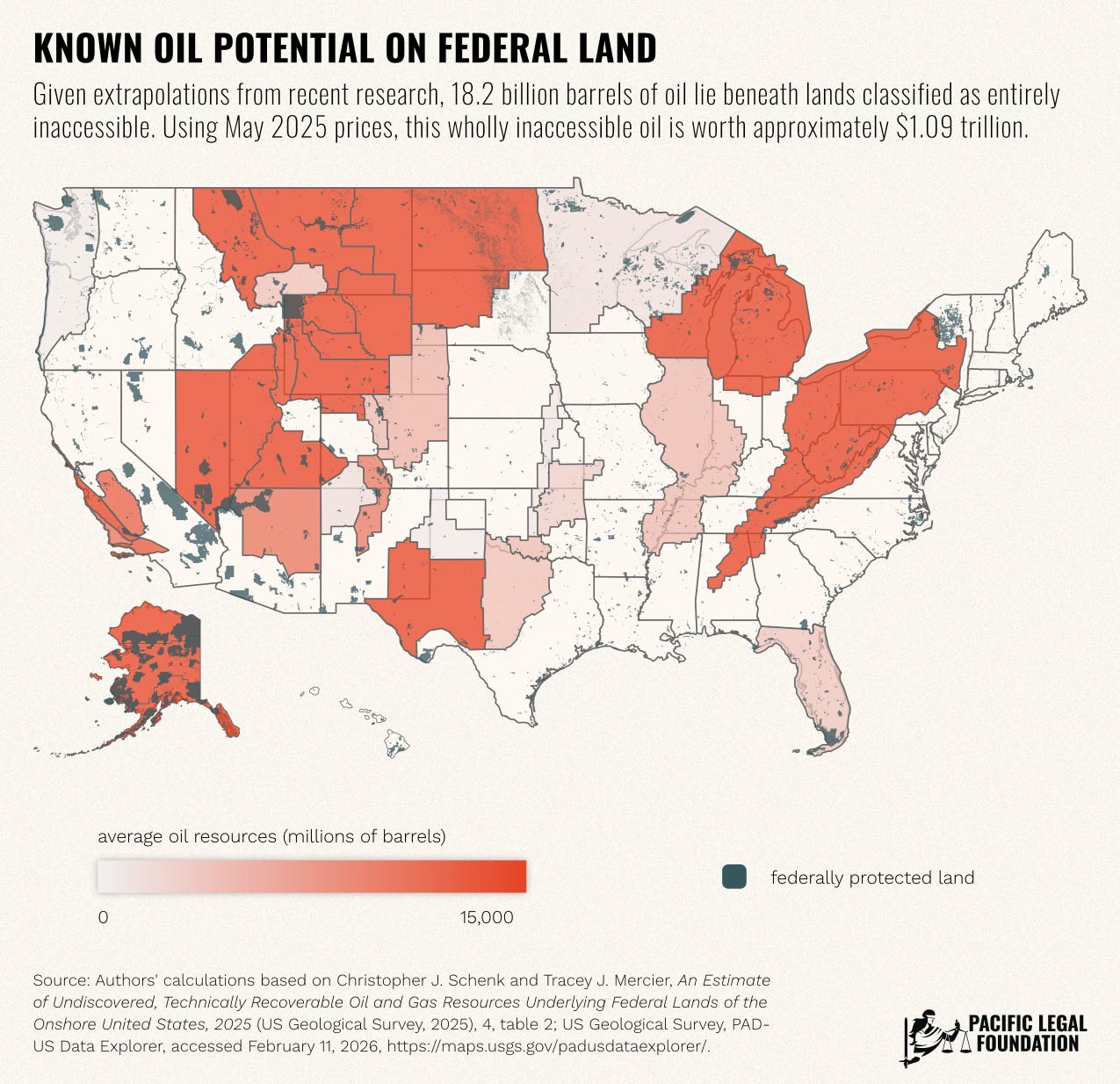
- Applying the most recent federal accessibility data suggests that approximately 18.2 billion barrels of oil and 160.6 trillion cubic feet of natural gas may underlie lands that are entirely inaccessible to development, representing more than $1.8 trillion in estimated resource value.
- Federal law requires recurring inventories of natural resources on public lands, but federal agencies have not consistently maintained comprehensive, up-to-date, publicly accessible inventories.
Policy Implications:
- Comprehensive, recurring, and publicly accessible federal resource inventories would provide policymakers and the public with better information about the location, quantity, and accessibility of natural resources on federal lands, improving long-term land-use and resource-management decisions.
Download the PDF here.
Locked Away: Vast Resources and Missing Inventories on Federal Lands
July 23, 2026