

The Mayflower Compact: America’s first great experiment
Four hundred and five years ago today, America launched its first experiment in self-government by using a written agreement—rather than a king—to dictate the rule of law.
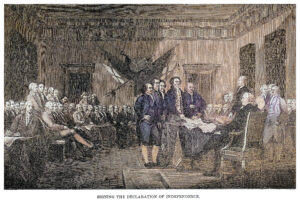
With the signing of the Mayflower Compact, the Plymouth settlers voluntarily agreed to live under laws equally applied to all, the same principles later echoed by the Founding Fathers in the Declaration of Independence and the U.S. Constitution.
Unplanned and uncharted territory
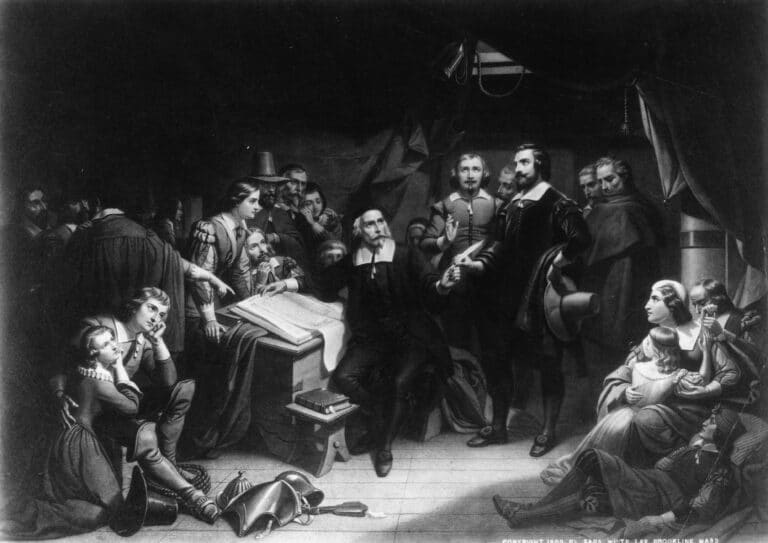
After two months at sea, on November 11, 1620, the Mayflower finally anchored in the new world. The ship carried 102 wary and hungry souls who had left their homes behind in search of a new life. A charter granted by King James I, through the Virginia Company of London, gave them permission to establish a settlement within Virginia’s claimed territory.
There was just one problem: They were nowhere near Virginia.
The ship had been blown off course somewhere along the way, eventually landing on Plymouth Rock, off the coast of Cape Cod. This was an interesting plot twist for the Mayflower’s passengers.
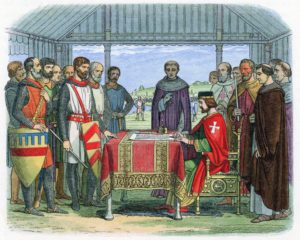
Under the original charter from the King, the settlers were bound to adhere to certain rules. While they were free to establish a new colony, they must do so with the understanding that they were still British subjects who were required to remain loyal to the King and govern their new settlements according to English law. This included sending goods and taxes back to England and paying the necessary fees to the Virginia Company.
However, the charter was applicable only within Virginia’s claimed territory—not at Plymouth where chance had carried them. Suddenly, the Mayflower passengers found themselves in uncharted territory, both physically and politically. Without a ruler and an established set of rules, anything was possible, a prospect that was both exhilarating and potentially problematic.
In the absence of formal laws, many feared their new colony would quickly devolve into chaos. But deciding what laws to adhere to was tricky.
Many of Plymouth’s new residents were religious separatists (Pilgrims) who had broken with the Church of England and come to the new world to freely practice their religious beliefs. For these English Protestants, God was their central authority, and they could have easily governed their new territory by religious covenant, but the other half of the Mayflower was comprised of passengers the separatists called “strangers.” These were tradesmen, servants, and adventure-seekers who had not left England for religious reasons.
For these separatists and strangers, the task at hand was to figure out how the two groups could live harmoniously together in the new world. Daunting as the task was, it offered an unprecedented chance to establish a self-governing community founded on consent and equality under the law.
The Mayflower’s passengers recognized what a great undertaking this political experiment would be and refused to leave the ship until an agreement had been reached, written, and signed. Thus, the Mayflower Compact was born.
Lockean government in a pre-Locke era
Interestingly, although the settlers were technically no longer bound to the King, the Mayflower Compact opens by affirming their loyalty to “our dread sovereign Lord King James, by the grace of God, of Great Britain, France, and Ireland King, Defender of the Faith.” This declaration served several purposes. Most importantly, it signaled that the passengers were not in open rebellion and reaffirmed their unity as British subjects—an essential safeguard against descending into anarchy.
But it is the next section that was truly ahead of its time and laid the groundwork for self-government.
It reads:
Do by these presents, solemnly and mutually, in the presence of God and one another, covenant and combine ourselves together into a civil body politic, for our better ordering and preservation, and furtherance of the ends aforesaid …
With these words, the Plymouth settlers proclaimed that, to preserve order and ensure survival, their new “civil body politic” would be established by the consent of the governed. This was unheard of in an era where the divine right of kings subjected every person to the whim of one ruler.
It then goes on to say, “and furtherance of the ends aforesaid; and by virtue hereof to enact, constitute, and frame such just and equal laws, ordinances, acts, constitutions, and offices …”
Here, they declared that laws would be just and equally applied to all, ending with a promise of “submission and obedience”—not to the King, but to the rule of law they had created themselves.
In fewer than 200 words, the Mayflower Compact achieved what John Locke would later articulate in his Second Treatise of Government—the very text that shaped America’s Founding Fathers. One might assume the Mayflower passengers were familiar with Locke’s ideas, except that the Treatise wouldn’t be written for another six decades—and the Declaration of Independence not for another 156 years.
This is what makes the Mayflower Compact so truly extraordinary. While Locke was well aware of the colonial experiments in America, there is no evidence that he knew about the Mayflower Compact—lending even great credibility to his claims that equality under the law, consent, and self-government are rooted in human nature itself.
The Mayflower Compact stands as living proof that the principles Locke would later define were already embedded in the human pursuit of liberty.
More than four centuries later, the principles born aboard the Mayflower remain present in our U.S. Constitution.
The settlers’ insistence that legitimate government exists only by consent, that laws must apply equally to all, and that power must remain bound by the rule of law are the same principles Pacific Legal Foundation defends today. Whether challenging executive overreach or restoring equality under the law, PLF champions the same spirit of self-government that first took root in the cramped quarters of a ship off Cape Cod.