

When fines become weapons: A history of excessive fines
A fine not even a baron could pay
King John was cruel, of that there was no doubt. But when he turned on his closest friend and ally, the Marcher lord William de Braose, his brutality knew no bounds.
William had won great favor with the King by playing an integral role in helping him secure the throne in 1199. After Richard the Lionheart died, John and his nephew, Arthur of Brittany, had competing claims to the English crown, triggering a cold civil war over the legitimacy of succession. Thanks to military might and support from the Norman barons, John was the victor. But the cold war turned hot.
Arthur, who was just 15 at the time, was captured by John, never to be heard from again. Everyone knew that Arthur’s blood was on John’s hands, and many began to question the King’s political credibility.
John was now paranoid, strapped for cash, and growing evermore ruthless and erratic. In the Medieval era, it was not uncommon for kings to coerce loyalty from their barons by demanding hostages until trust could be established. John did just that when he sent his men to William’s castle to collect his sons as collateral.
William’s wife, Matilda, was a bold woman and refused to comply, saying, “I will not deliver my children to a king who has murdered his own nephew.” When word of this accusation got back to John, he was livid and retaliated by demanding 7,000 marks from William—an amount vastly greater than any reasonable feudal obligation. William’s annual salary was around 400-700 marks. Even though this made him one of the wealthiest barons, he still didn’t have enough money to pay the King’s impossible fine. John knew this and used the outstanding debt to justify seizing the de Braose estate.
William saw the writing on the wall and fled, first to Ireland, then Wales, and eventually France. Possessed with rage, John captured Matilda and the eldest de Braose son, who were both imprisoned and ultimately died of starvation.
For the other barons who had been watching the horrific ordeal unfold, this event brought them to the point of no return with the King. For years, John had weaponized fines against widows who refused royal marriages, merchants who crossed him, and ordinary villagers caught in petty offenses—ruining livelihoods through arbitrary amercements.
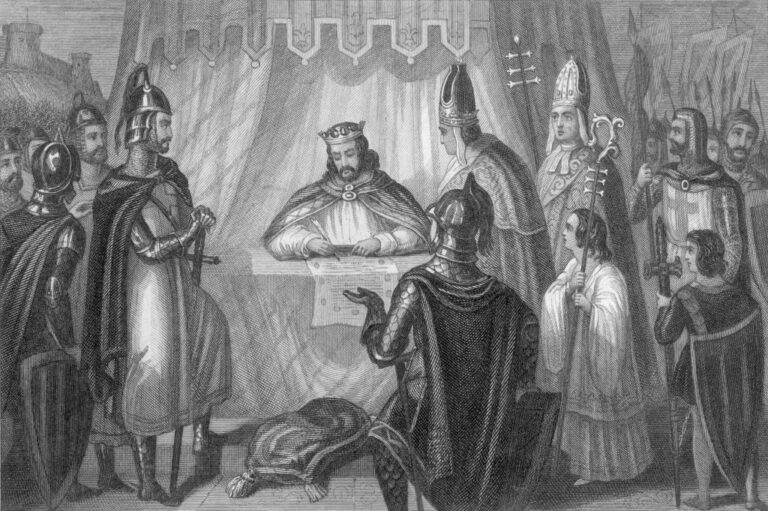
The time had come for the barons to take up arms against their King. After a series of escalating confrontations, John was ultimately cornered and forced to sign Magna Carta in 1215, limiting his power.
Magna Carta was the first document that bound a king by a rule of law. Among its many revolutionary safeguards, Magna Carta proclaimed that any fees imposed by a king must be “proportional to the offense” committed. No longer would the King be allowed to destroy a person’s life or property with impossible fines, nor would he be allowed to use arbitrary financial penalties to fund his wars.
From that point on, this principle of proportional punishment became a cornerstone of English constitutionalism, although it would not be properly solidified until over 400 years later in the English Bill of Rights, which plainly stated that “excessive fines ought not to be imposed.”
The intellectual inheritance of the Eighth Amendment
While the proportionality principle was revolutionary to the people of the 1200s, it had already been well-established elsewhere throughout history.
Under Charlemagne, Carolingian codes protected against excessive fines. Athens had maximum penalties for their government fines, and public accountability for magistrates who abused their fining power. The Romans also set maximum penalties and even gave the people the right to appeal. The Romans considered it corrupt and downright tyrannical for a government to confiscate property without due process. Ancient Hebrew law famously declared it just to take “an eye for an eye,” and while some mistook that to justify retaliation, it was meant to refer to the doctrine of proportional punishment.
The barons of 1215 were guided to the proportionality doctrine entirely by their own experience and were likely unaware of the centuries of precedent—but their constitutional heirs in the American colonies most certainly were aware.
Oddly enough, while many Brits viewed the colonists as culturally inferior yokels, in the mid-1700s, Americans were among the most literate societies in the world, and it showed in their knowledge of history and ancient law.
John Adams was extremely knowledgeable in Roman law and even wrote about Roman proportionality in his A Defence of the Constitutions of Government of the United States. James Madison studied Polybius, Tacitus, and Cicero diligently. And Thomas Jefferson was fascinated with classical legal models.
The colonists were also Englishmen before they were American revolutionaries and were well-versed in English constitutionalism. This was precisely why they were outraged: King George was violating England’s rule of law.
In the years leading up to the Revolution, ruinous fines, property seizures, and retaliatory economic sanctions were regularly used by the Crown as tools of oppression and control against the colonists. The Stamp Act imposed steep fines and property forfeitures for the slightest violations. The Townshend Acts allowed the government to seize property without a trial or criminal conviction. And anyone thought to be criticizing the government could be charged with seditious libel—a crime that came with heavy fines and a low burden of proof.
To the colonists, these offenses mirrored those committed against the barons by King John.
When the Revolutionary War was won, it came time to establish the new American government. The Constitution’s Framers were heavily influenced by the wisdom of history and political philosophers past—especially those who championed proportional punishment.
When the Constitution was put to the states for ratification, Anti-Federalists like Patrick Henry, George Mason, and Abraham Holmes were worried that, as written, the document did not protect against cruel and unusual punishments—including excessive fines, although that exact term was never used. Without the incorporation of a bill of rights explicitly protecting certain rights—like proportional punishment—the Anti-Federalists feared that government could not be properly contained by the Constitution.
James Madison, often called the Father of the Constitution, was initially hesitant to adopt a bill of rights. To him, including one might imply that the government possessed powers it had not been explicitly granted. But after the ratification debates, he changed his mind. He then drafted most of the Bill of Rights himself.
While James Madison drafted the Eighth Amendment, he turned to history, using nearly identical language as the English Bill of Rights. In its adopted form, the Eighth Amendment states that “Excessive bail shall not be required, nor excessive fines imposed, nor cruel and unusual punishments inflicted.” With its official inclusion, the Framers were hopeful that the government would be restrained from using excesses fines and punishments against its people.
From Magna Carta to modern America
Proportionality had finally been written into American law, but writing a protection and upholding it are different things. In the decades that followed, governments found new ways to levy ruinous fines, seize property, and sidestep the Constitution’s clear command.
More than eight centuries after Magna Carta, and more than two centuries after the Constitution and repeated Supreme Court affirmations, the fight over excessive fines is still not over.
Today, governments continue to impose crushing financial penalties under the guise of “civil” enforcement—punishments that function exactly like the excessive fines the Eighth Amendment was meant to prevent. One modern example is Pacific Legal Foundation client Tim Eyman.
After years of political activism and sponsoring ballot initiatives, in 2017, Washington State sued Tim for campaign finance reporting violations. Tim spent years wrapped up in costly litigation, and eventually a trial court imposed $2.6 million in fines plus $2.8 million in attorney fees. With 12 percent interest, the judgment now exceeds $8 million and grows by $700,000 annually. He cannot pay even one month’s interest.
The judgment destroyed Tim’s livelihood. The court ruled Tim was personally a continuing political committee, then barred him from any financial role in political committees—effectively ending his career. When Tim sought treasurers to help him continue his work, every qualified professional refused, explaining that they could not comply with both the injunction and state law.
Courts have long understood the danger of using financial sanctions as weapons of control. The Supreme Court has acknowledged this problem, as Justice Ruth Bader Ginsburg explained in Timbs v. Indiana, a case involving civil asset forfeiture: “Protection against excessive punitive economic sanctions has been a constant shield throughout Anglo-American history, distilling the principle that the punishment should be proportioned to the offense.”
Pacific Legal Foundation carries that shield into our legal battles today, defending the same principle that inspired the barons of 1215, the Founders of 1787, and generations of Americans who have stood against the abuse of government power.