

When the police break and enter, who do you call for help?
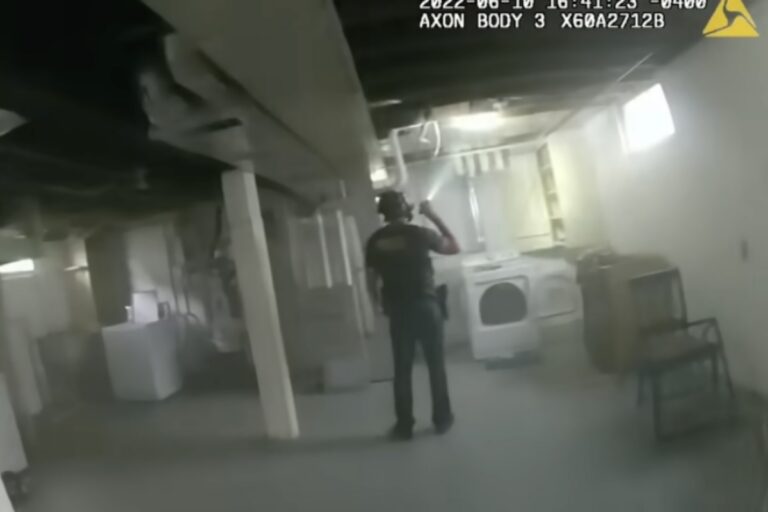
In June 2022, a mistaken IP address led the South Bend, Indiana, police department to destroy an innocent family’s home. Based on an officer’s belief that a murder suspect had accessed his social media account at Amy Hadley’s address, police acquired a warrant and stormed the building.
Officers handcuffed Hadley’s 15-year-old son and hauled him to the police station without allowing him to contact his family. They lobbed 30 canisters of tear gas into the empty house. Then they ransacked it, punching holes in the walls, tearing through panels, and destroying irreplaceable family photos and mementos—all in pursuit of a man who had never been inside.
Hadley protested. She knew the man they were looking for had never entered her home, and she even had security camera footage to back up her assurances. But the police continued the destruction.
When they finally left, they’d done over $16,000 in damage—and were no nearer to the murder suspect than before. They refused to compensate Hadley for the destructive raid, leaving the family to shoulder the costs and sleep in their car while tear gas slowly dissipated from their own beds.
Hadley filed a lawsuit seeking compensation. She argued that the government is constitutionally required to pay for the damage the police did to her property in pursuit of public safety. The court dismissed her lawsuit.
A Los Angeles print shop
Just a few months later, in August 2022, a similar horror story played out in a Los Angeles print shop. An armed fugitive evaded the police, threw out the store’s owner, and barricaded himself inside for a 13-hour standoff involving the fugitive, the LAPD, U.S. marshals, and a SWAT team.
The standoff culminated in officers launching dozens of tear gas canisters through the store’s windows and walls. By the time the smoke cleared and law enforcement got inside, the fugitive was long gone. Over $60,000 in damage was done to the store and the specialized printing equipment inside it, with nothing to show for the destruction.
The City left the shop’s owner, Carlos Pena, to foot the bill.
Like Hadley, Pena filed a federal lawsuit asking the courts to hold the government accountable for destroying his property without paying for the damage. And just like Hadley, his case was dismissed.
Now, these property owners are asking the United States Supreme Court to take up their petitions.
Attorneys at Pacific Legal Foundation filed amicus briefs on behalf of Hadley and Pena, arguing that the lower courts’ dismissals misapplied the Fifth Amendment and urging the Supreme Court to overturn the rulings.
What does the Fifth Amendment require?
When the police themselves are the ones breaking and entering, who do you go to for justice? The answer is the courts.
The law on this point is straightforward. The Fifth Amendment states that no one can “be deprived of life, liberty, or property, without due process of law; nor shall private property be taken for public use, without just compensation.” This means that if the government takes or breaks your property for the public good, it must pay you for it. And if it tries to evade that constitutional obligation, you have the right to file a lawsuit asking the court to hold the government accountable for its actions.
How is damage a ‘taking’?
Since 1922, the Supreme Court has held that the government “takes” your property—and owes you compensation for that taking—if it eradicates your ability to use that property. It doesn’t matter if that happens through overbearing legislation or physical damage. It’s a taking all the same.
For Hadley and Pena, this Supreme Court precedent means that the government has to cover the cost of the damage it did by punching holes in their walls and sending tear gas canisters through their windows in the name of public safety.
What if there was a good reason for the damage?
The government’s motive for the taking also doesn’t matter under the Fifth Amendment. The Takings Clause applies in any instance where private property is taken “for public use.” As PLF’s amicus brief on behalf of Hadley argues,
“The fact that the government had a compelling reason to enter and search Hadley’s property does not diminish its constitutional obligation to pay for what it intentionally destroyed. A good reason for taking someone’s property is not an exemption from the Takings Clause; it is a requirement.”
Is the ‘police power’ an exception to the Fifth Amendment?
The courts hearing Hadley’s and Pena’s cases attempted to draw a distinction between damage from “police power” and other instances of a government taking. But the Constitution doesn’t list any exceptions to the Takings Clause—for the police or for any other arm of the government.
PLF’s amicus brief on behalf of Pena puts it simply:
“The government destroyed an innocent person’s business in service of a public end [public safety]. The Constitution says plainly what happens next… [A]nd no amount of relabeling the police action as something other than a taking can change that.”
Does invoking ‘public necessity’ get the government off the hook?
PLF’s amicus briefs also address the government’s claim that the Takings Clause has a “public necessity” exception that can justify the damage to Hadley and Pena’s property. Decades of Supreme Court precedent show that this exception does not apply to routine law enforcement. In fact, it applies only to two equally rare and unapplicable situations: uncontained urban fires and wartime demolition.
These exceptions are a far cry from what the police saw at Hadley’s quiet home and at Pena’s print shop. As PLF’s amicus brief argues,
“Hadley’s home was not subject to inevitable destruction. No fire was raging. No enemy army was bearing down on Indiana. A murder suspect was thought to be inside, based on IP address data that turned out to be wrong.”
To preserve Americans’ rights, the “public necessity” exception must be kept to just those rare circumstances.
“Extending the necessity exception from wartime destruction to routine search warrants would gut the Takings Clause for the people who need it most: innocent bystanders caught in the crossfire of law enforcement operations they had nothing to do with.”
What comes next?
Hadley and Pena shouldn’t have had to file lawsuits to pursue justice, much less to appeal their cases to the Supreme Court to find relief. They deserve compensation for what they’ve lost and suffered. The Court should take up one or both cases and use its ruling as an opportunity to strengthen the Fifth Amendment’s protections for everyone else whose constitutional rights could otherwise be violated by a capricious government with impunity.