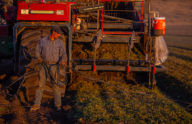


This retired general fought for his country. Now he’s fighting for his property.
After an impressive military career protecting the United States against foreign threats, Brigadier General Bill Don Farris is now fighting his own government for the right to exclude dangerous hunting dogs from his property.
Billy Don Farris grew up in a military family in Northeast Texas. His father served, his two brothers served, and there was never any doubt in his mind that he would carry on the family tradition of military service. “From a very early age, I always wanted to be a soldier,” he says.
After graduating from West Point in 1983, Billy Don began a more-than-30-year Army career that took him from the 101st Airborne Division to combat tours in Panama, Iraq, and Afghanistan. He spent much of his career as a paratrooper with the 82nd Airborne Division, including parachuting into Panama during the invasion to oust Manuel Noriega. In Iraq, he commanded a brigade during intense sectarian fighting in and around Sadr City and Adhamiyah, earning a Purple Heart.
His final combat tour came in Afghanistan, where he served as a one-star general and senior U.S. operational planner before retiring.
Earlier in his career, when he was a lieutenant, Billy Don had the opportunity to work for a man whom he greatly admired and who became something of a mentor to him. When he learned of his passing sometime later, Bill Don reconnected with the man’s family, including his daughter. The pair eventually fell in love and were married at Fort Campbell. They subsequently had three children, two of whom grew up to have careers in the military.
After years of moving their family from post to post, the couple looked forward to spending time in one place after Billy Don retired from the military. In 2017, they bought their dream 80-acre farm just off Mobjack Bay in Gloucester County, Virginia, in a place called Ware Neck.
“It’s a coastal area and so it’s got that personality and flavor to it,” Billy Don says. “My wife loves the seasons and wanted to be next to the water, can’t quite do that in Texas,” he added.
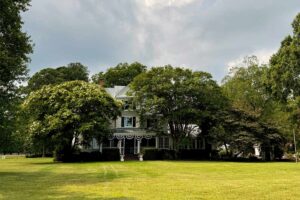
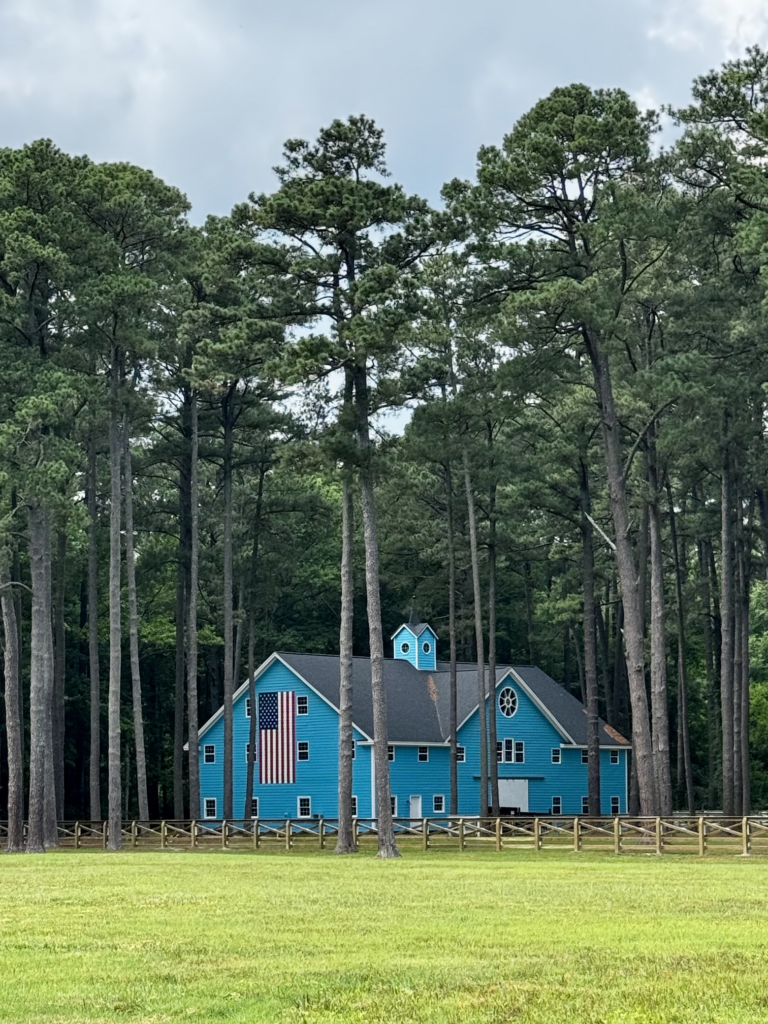
The family’s farmhouse is a living portrait of Americana, so perfectly rendered you might think yourself staring at a postcard from a bygone era. The white clapboard farmhouse is tucked between towering trees, with red-white-and-blue bunting greeting visitors at the front door. A robin’s-egg-blue barn adds a splash of color to the property, with a large American flag mural displayed across its side. Elsewhere, a picturesque dock and boathouse complete the storybook quality of coastal Virginia. “It’s very peaceful and beautiful out here,” Billy Don says. “And after 30 plus years of service, four and a half years in combat, all I wanted was to find peace and reconnect with hearth and home.”
But Billy Don’s farmhouse oasis is under threat from local hunting hounds that are continually disrupting the family’s property and tranquility. And thanks to the local sheriff’s unconstitutional policy, there is nothing Billy Don can do to remove the dogs, even when they threaten his family.
The dispute
Billy Don has always had a deep respect for private property, which he attributes partially to his Texas upbringing. He had no idea when he relocated to Virginia that the locals did not share this sentiment.
Ware Neck is a small peninsula no more than two miles wide, with a logging company and a wide-open forested area right in the center, which has helped make it a magnet for hound hunting clubs.
“It’s too small for hound hunting,” Billy Don says. “Hounds in a typical hunt will travel more than two miles. There’s no place you could release hounds in Ware Neck where you aren’t going to immediately encroach on private property.”
Every hunting season, the Farris family endures packs of hounds running amok on their property.
“We’ve had them on our dock; we’ve had them around the barns. I was keeping horses for a neighbor and I was deathly afraid they were going to spook them and cause an injury, which makes me liable.”
There is also a psychological component to these four-legged intruders.
“When you’re in a flat coastal area and you hear noise, it echoes for a long way. When they’re up close, it is thunderous. It’s an enormous annoyance and it changes your pattern of life.”
When Billy Don first encountered the hounds, one of his first reactions was to have a chat with the hunters to explain his concerns and request that they keep their dogs away from his property. Unfortunately, his request was not received well. “I would say the response was less than cordial to very flippant,” Billy Don recalls.
The problem only worsened.
“Over and over we’d go out there and challenge them. I caught hunters on our property in their vehicles. I’d run them off, I’d catch dogs, I’d give them back and go, ‘Hey, I don’t want you hunting on my property.’”
During the COVID-19 pandemic in 2020, the problem got so bad, Billy Don’s wife claims she sometimes saw multiple packs of hounds on their property in a day. This concerned Billy Don, who spent his days at work, leaving his wife alone on the property. At one point, one of the hunters even accosted Mrs. Farris on their dirt road, which did not sit well with Billy Don. “There is no honor in an armed man challenging someone’s spouse.”
When the local law enforcement finally got involved, Billy Don hoped that his problems would soon be over. He could not have been more wrong.
In December 2023, Billy Don physically caught one of the hounds on his property. Prompting the hunters to call law enforcement. When law enforcement showed up, they escorted the hunter onto Billy Don’s property, making it immediately clear to Billy Don that he—not the hunter—was in the wrong.
It must have felt like something out of the twilight zone for Billy Don, who had spent his life fighting to secure American principles, like the right to enjoy one’s own property undisturbed.
Just a few days later, Billy Don decided to go meet with Sheriff Darrell Warren to get a better understanding of this right-to-retrieve law that was disturbing his family’s peace.
“The meeting was immediately adversarial,” Billy Don recalls.
According to Billy Don, the sheriff walked by him and said, “You’re the problem here.” Sheriff Warren made it clear that his priority was to protect the interests of the hound owners. He then proceeded to tell Billy Don that his actions were either a misdemeanor or even a felony, depending on the value of the dog, and warned him to stay away from the dogs.
With no help from local law enforcement, the Farrises have been forced to sit back as hunting hounds continue to wreak havoc on their property, whether that is getting into his wife’s rose and flower gardens or urinating on a pile of jackets the family had taken off as they enjoyed a warm afternoon in their own yard.
To many of the locals, Billy Don is an outsider trying to disrupt their way of life. But just because Virginia’s right-to-retrieve laws have been around for a while does not mean that they are constitutional.
Right-to-retrieve laws
While Virginia has a long history of protecting property rights, the right-to-retrieve language was not written into law until 1938. Originally, the law allowed fox and deer hunters to “go upon prohibited lands to retrieve their dogs” but reassured Virginians that “[n]othing in this act . . . shall be construed to affect in any way the civil rights of a landowner as against trespassers against his property.”
In 1986, the reassurance was removed from the statute, but that did not necessarily reverse the rule the sentence expressed. The sheriff and his deputies’ interpretation ignores what Virginia’s courts, Attorney General, and Department of Wildlife Resources have all stated plainly: The “right-to-retrieve” law may decriminalize certain types of trespass, but it also intentionally preserves the landowner’s right to pursue all civil remedies.
Property rights are fundamental to our United States Constitution, and individuals have a right not only to enjoy their property, but also to exclude whomever they choose from entering their property.
But the sheriff’s interpretation of the law has stripped this protection away from the Farris family, forcing them to live among hunting dogs that pose a threat to both their property and personal safety.
After Billy Don realized that neither the sheriff nor the hunters were willing to come to a resolution, he decided to take the matter to the courts.
Billy Don has teamed up with Pacific Legal Foundation, and together they have filed a federal lawsuit to vindicate a property owner’s right to exclude trespassers from his home and restore the rights of all Virginia property owners.
“When property owners say they don’t want someone on their property, no should mean no. Under our constitutional framework, we have protected that value for as long as anyone can remember … except in Virginia,” says Billy Don.
While his days of protecting American ideals on foreign battlefields are over, Billy Don is now engaging in a different kind of fight, this time protecting property rights not against a foreign government, but against his very own.