

A can of spray paint is not an argument
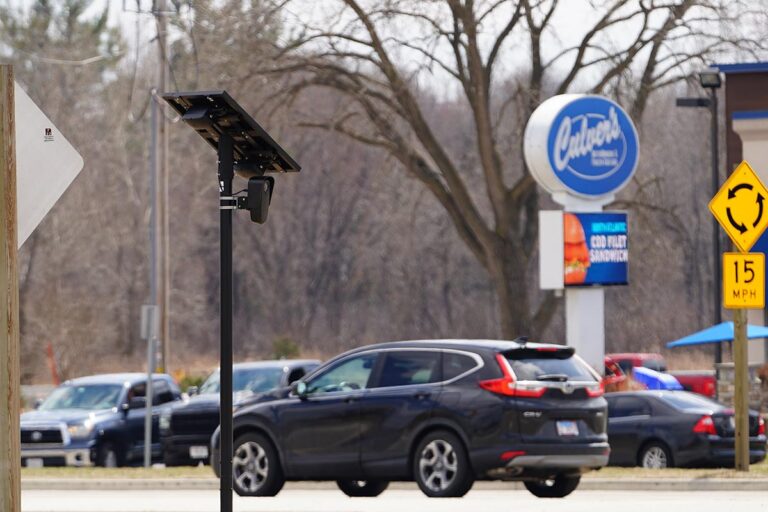
Someone in upstate New York took an electric saw to them. In California, they’ve been knocked down and vandalized. In Idaho, a man rammed a truck into two of them. This summer, a 19-year-old worked his way down Florida’s First Coast with cans of silver and gold spray paint, hitting cameras along the way; he told police he doesn’t trust license-plate readers.
Left and right—pun intended—Flock Safety’s automated license-plate readers have inspired a leaderless revolt. Anti-Flock sentiment is a rare cause capable of uniting a constitutional conservative in Texas with a progressive in Massachusetts. Cities from Eugene to Knoxville to Los Angeles have canceled or suspended their contracts with Flock.
The outrage is understandable. A private company has, with governments’ blessings and your tax dollars, blanketed American roads with roughly 120,000 cameras that log every passing plate into a nationwide, searchable database accumulating billions of records every month. All dystopian clichés—Orwell’s 1984, Rand’s Anthem, Bentham’s Panopticon—are apt.
But sawing down a camera is double-plus ungood. And for Pacific Legal Foundation, an organization that upholds property rights, it’s worth saying plainly: Physically damaging Flock cameras answers a claimed rights violation with an established one. A man with a spray can facing vandalism charges could have instead been a plaintiff vindicating our Fourth Amendment rights.
A better kind of protest
Carl Gunn leveled up. When a Flock camera appeared near his St. Petersburg neighborhood, he taped a sign to his pool skimmer, set up a lawn chair, and spent hours blocking its lens with his sign.
Others have gone digital. DeFlock is a crowdsourced map of license-plate readers, and FlockHopper will route you around them.
These forms of do-it-yourself Fourth Amendment protection are better than vandalism—peaceful, legal, and clever. But they’re just workarounds. The data-hoovering resumes the moment you fold up your lawn chair. To restore constitutional protections, we need to make use of two unrivaled tools: litigation and legislation.
Why the courts are newly promising
When cities contract with Flock to run their camera networks and grant police database access, the company acts as the government’s agent. What Flock searches and collects, the government searches and collects.
And now the government has a problem. In June, in Chatrie v. United States, the Supreme Court held that when police obtained a suspect’s location data through a “geofence” warrant—a dragnet search of millions of accounts to find everyone near a crime scene—that violated Chatrie’s “reasonable expectation of privacy” and therefore was a Fourth Amendment search.
Crucially, the Court rejected the government’s position that grabbing only a narrow, time-limited slice of a larger data trove was acceptable. Once the Fourth Amendment applies, the Court held, it doesn’t matter how small a bite investigators took.
For anyone challenging a government’s use of Flock cameras, that finding is a gift: “We collected it all, but we looked at only a little” is now likely a dead end.
Whose property was searched?
Justice Neil Gorsuch’s concurrence presents an even-more-promising path toward enduring Fourth Amendment protection. Rather than ask whether society deems an expectation of privacy “reasonable”—a test that shifts with every new gadget or data type—he asked whose property was searched. Ownership’s implications carry across technologies; expectations do not.
In the Flock scenario, Justice Gorsuch might say the government requires you to bolt a plate onto your car. Then a camera network converts that compelled affixed identifier into a 24/7 location tracker. Functionally, it’s the same tracking device the Court condemned in United States v. Jones. You agreed to display an identifier, not to carry a tracking device everywhere. And yet the next step is already for sale: Defense contractor Leonardo offers an accessory that captures Bluetooth, WiFi, and RFID signals leaking from your phone and other devices—and ties them to your plate. Soon every plate read may include a virtual, contactless, suspicion-less patdown.
Standard uses of Flock cameras are dystopian; misuses are the stuff of horror movies. Officers in a dozen states have used Flock to stalk ex-partners and others. We criminalize stalking because trailing another person’s every movement is a recognized harm. The Fourth Amendment simply imposes the same limits on government. Journalists have reported wrongful stops, like the car reviewer swarmed by squad cars over a misread dealer plate. Some have searched the system for an item of clothing, a tattoo, even a person’s race. What enables such abuses is retention: the fact that an extended record of your movements is kept, sitting in a database, waiting to be searched.
The principled legislative fix
Cities increasingly see their options as all-or-nothing: keep the surveillance dragnet, or rip the cameras out. The correct legislative answer is neither of these. License-plate readers have located missing children, recovered stolen cars, and placed a suspect’s vehicle at a crime scene. But a camera on a public road recording what a police officer standing there could see is doing plenty—and is doing nothing the Constitution forbids. The rights violation lies in keeping location records—on everyone, for extended periods, absent particularized suspicion. That is the modern general warrant our Fourth Amendment was written to prevent.
Allow cameras on public thoroughfares, but limit data retention. Keep a plate read long enough to check whether there’s a particularized basis for retaining it—a hotlist hit or a tie to an open, reported incident—and purge everything else automatically in a day. And create an audit log for every last query. Yes, a short retention window means a crime reported weeks later won’t be solved by a plate read waiting in the system. That’s a cost, but it’s one the Fourth Amendment’s drafters intended—a cost of freedom.
Channel the energy
If Flock cameras have you reaching for a spray can, pause before you paint. If your town turns your license plate into a 24/7/365 tracking device without your consent, that isn’t a nuisance to be sawed off a pole—it’s an opportunity to stand up for your Fourth Amendment rights. Contact PLF’s property rights attorneys through our case intake form, and let’s answer a rights violation the way the Constitution invites: in court.