

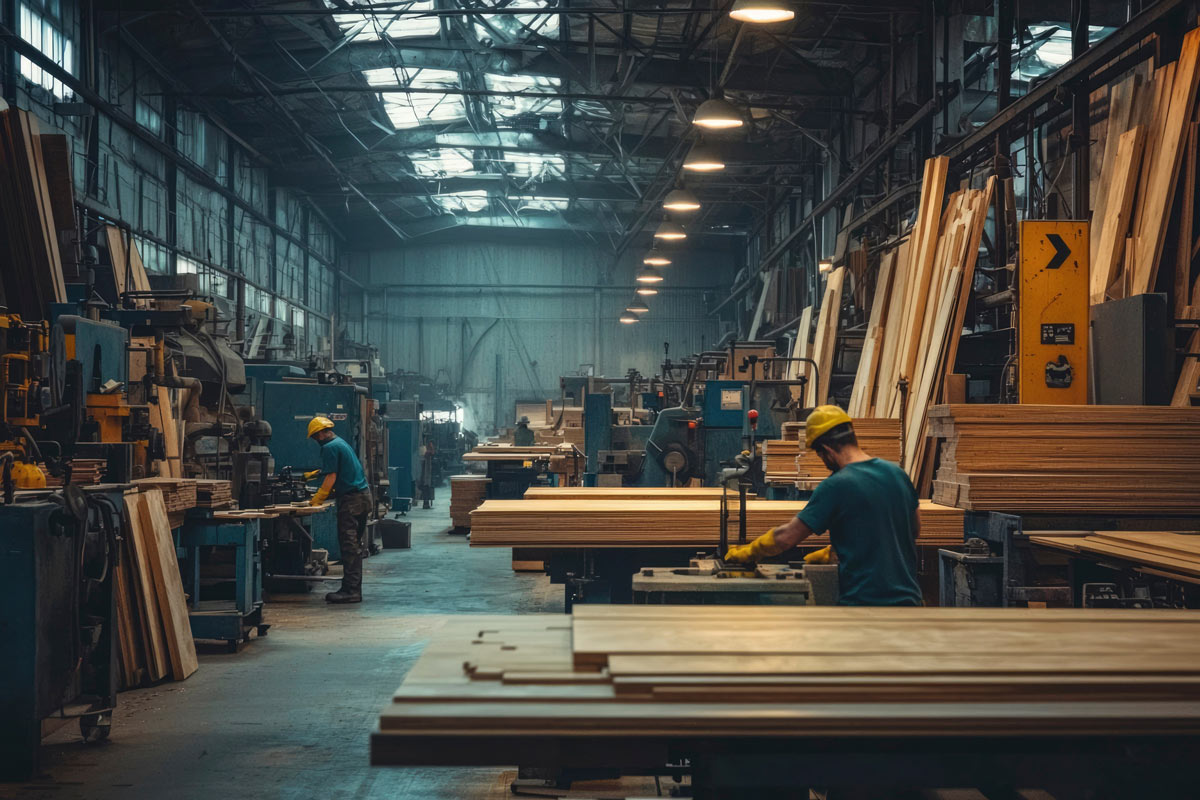
Willmore Lumber Company is a small lumber business in Eastern Idaho run by Jim Willmore and his three sons. In the fall of 2024, an Occupational Safety and Health Administration (OSHA) compliance officer arrived to inspect the lumber yard and claimed to see Willmore employees driving forklifts without wearing seatbelts. The officer’s complaints didn’t stop there; he scrutinized the company’s preference for hands-on instruction over formalized, written training as well as the ostensibly illegible condition of the “dataplate” on one forklift.
These infractions were enough for him to issue three citations and a penalty of $2,765.
When Willmore contested the citations, the case was sent to the Occupational Safety and Health Review Commission (OSHRC) for a hearing before an OSHRC-appointed administrative law judge.
But the Seventh Amendment affirms that anyone accused of violating a federal regulation and facing a monetary penalty has the right to a neutral judge and a jury of their peers—not a proceeding run entirely inside the executive branch. The Constitution similarly requires that judicial power stay in the hands of independent courts, not executive-branch officials deciding cases brought by other executive-branch officials.
For decades, agencies have been able to sidestep this rule because of a 1977 Supreme Court case, Atlas Roofing v. OSHRC. That case held OSHA penalties counted as “public rights”—a special category that didn’t require a jury, even though it looked and worked like an ordinary lawsuit. In 2024, the Supreme Court’s decision in SEC v. Jarkesy criticized that reasoning but stopped short of overturning it.
Unwilling to give up their right to a fair trial, Willmore filed a federal lawsuit arguing that OSHA’s in-house adjudication process is unconstitutional. The case also challenges the law Willmore was cited under: Congress gave the Department of Labor open-ended authority to write safety rules without meaningful limits, and the specific rule at issue is so vague that an ordinary person can’t tell what it requires.
Willmore Lumber is represented at no cost by Pacific Legal Foundation. A win would mean that anyone accused of violating a federal regulation and facing a monetary penalty gets what the Constitution promises: a neutral judge and a jury of their peers—not a proceeding run entirely inside the executive branch.
What’s At Stake?
- The Seventh Amendment guarantees the right to a jury trial when the government seeks civil penalties. That right belongs in a real court—before a neutral judge and a jury of peers—not in an administrative tribunal where the same agency investigates, prosecutes, and decides.
- Only Congress can make federal law. When Congress hands that power to an agency without clear limits, it lets unelected officials write the rules that govern Americans’ lives—with no accountability to voters.