

Equality before the law: The cornerstone of every individual right
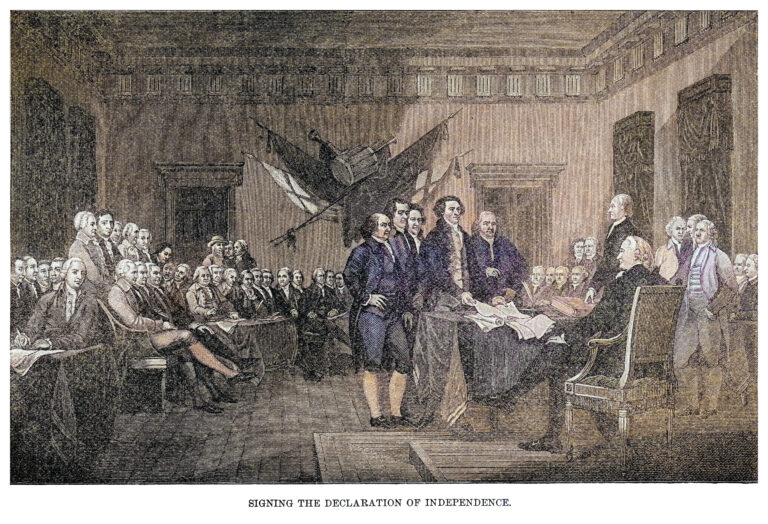
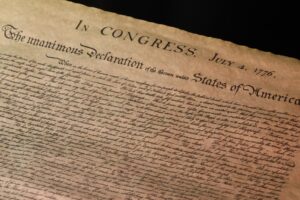
“We hold these truths to be self-evident, that all men are created equal” is arguably one of the most powerful phrases ever written. Before those words were immortalized in the Declaration of Independence in 1776, equality was a subject for philosophers to debate and despots to fear—but it had never served as the moral foundation of government itself.
With the signing of the Declaration, the Founding Fathers transformed the principle of equality from a philosophical ideal into a political first principle, from which all other individual rights flow.
To understand why the Founders placed equality at the heart of the Declaration—and why it still matters so much today—we must look to the philosopher who first defined it as the premise of natural law.
The origins of America’s self-evident truths
Equality is the first of four “self-evident” truths named in the preamble of the Declaration, the order of which was no accident. To the Founders, equality was not just one self-evident truth, but the self-evident truth from which the other three—unalienable rights, consent of the governed, and the right to revolution—must reasonably follow.
This idea, while revolutionary, was not one born in their own minds, but borrowed from the 17th-century English philosopher, John Locke.
Locke’s natural law theory starts with the simple premise that every person is born “equal and independent.” Because of that equality, everyone has the same inherent rights to life, liberty, and property. The purpose of government, then, is to protect those rights for all. But its authority exists only so long as it operates with the consent of the governed. When a government abandons that purpose by repeatedly violating the people’s natural rights, it loses its legitimacy, and the people have what Locke called the “right to revolution.”
Locke was beloved by the founding generation, who wholeheartedly subscribed to his philosophy of natural law. In fact, as C. Bradley Thompson notes in his brilliantly written book, America’s Revolutionary Mind: A Moral History of the American Revolution and the Declaration That Defined It, Locke’s body of work was so widely read that he was often quoted in colonial newspapers without citation, as it was assumed everyone would recognize his ideas.
Indeed, it is no exaggeration to say that his Second Treatise of Government and An Essay Concerning Human Understanding were the single-most influential works shaping the Founders’ conception of government and rights. And nowhere is Locke’s influence more apparent than in the Declaration of Independence. While Jefferson’s words mirror Locke’s to a T, what the former called “self-evident truths” the latter referred to as “intuitive knowledge.”
According to Locke, there exist objective truths that are so “infallibly true,” they require neither proof nor advanced intellect. So long as a person possesses the capacity to know that “white is not black, that a circle is not a triangle, that three are more than two and equal to one and two,” they could see these truths with “bare intuition.” Thompson puts it more plainly, describing a self-evident truth as an idea that “strikes the mind as immediately and perceptually true given the correspondence of the terms invoked.”
By Locke’s reasoning, mankind being born equal is not just infallibly true, it is also the moral starting point for all claims to natural rights—a theme which was a “central component of the American mind,” as Thompson highlights.
But declaring equality for all was one thing; convincing the world of its meaning was another.
What does it mean to be born equal?
For a group of rag-tag Americans to cut ties with the King of England because he did not regard his subjects as equally deserving of natural rights was a bold move, to say the least. And while some admired the profundity of the Declaration’s assertations, others weren’t so impressed.
In his book, Thompson writes that “…several English Pundits had a field day with the Declaration’s first self-evident truths, which they treated with contempt.”
In the October 1776 edition of The Scots Magazine, an anonymous “Englishman” mocked the claim that “all men are created equal,” arguing that “some are tall, some short; some wise, some foolish; some strong, some weak.”
English pamphleteer John Lind went so far as to compare the Founders’ belief of equality to the absurdity of those who believe in witchcraft. In his Answer to the Declaration of the American Congress, he snickered at the “supposed right of men to be all equal,” calling it contrary to “reason and experience” and “as absurd as the levelling system of the wildest fanatics, or the witchcraft of the most ignorant savages.”
These criticisms are somewhat excusable if we view them from the lens of 18th-century Englishmen. To them, the idea that a peasant’s rights were equal to a king’s was outlandish. True, Magna Carta and the English Bill of Rights had introduced the rule of law, but rights were still very much tied to social rank. The Founders’ proclamation that rights were universal was a hard pill to swallow and completely shattered centuries of social order.
These critics also fundamentally misunderstood what the Founders meant when they declared “all men are created equal.”
For Locke and the Founders, equality did not mean sameness of condition of ability, but of moral status and rights.
As Locke explained in the Second Treatise of Government,
“A state also of equality, wherein all the power and jurisdiction is reciprocal, no one having more than another; there being nothing more evident than that creatures of the same species and rank, promiscuously born to all the same advantages of nature, and the use of the same faculties, should also be equal one amongst another without subordination or subjection.”
By Locke’s reasoning, because we are all of equal moral standing, legitimate governments must protect our natural rights equally—none being afforded more or fewer rights than others. This Lockean view of equality closely echoes what the classical Romans called jus aequum, literally “just law” or “equal law.”
Speaking to this in his Lectures on Law, James Wilson, who was one of only six men to sign both the Declaration and the U.S. Constitution, and later served as one of the first associate justices of the U.S. Supreme Court, wrote:
“With regard to all, there is an equality in rights and in obligations; there is that jus aequum, that equal law, in which the Romans placed true freedom. By these laws, rights, natural or acquired, are confirmed, in the same manner, to all; and by them, duties are prescribed to all.”
Wilson’s insight, that true freedom lies in equal law, became the moral foundation for America’s promise of equality before the law.
Equality before the law
The Founders’ vision of equality was carried into the framing of the Constitution. And while the word “equality” is not found within the original text of the Constitution itself, its spirit is unmistakable.
When the Fifth Amendment’s Due Process Clause guaranteed that “No person shall… be deprived of life, liberty, or property, without due process of law,” it put into practice the natural law of reciprocity. It represents the simple but profound truth that government must apply the law equally and cannot take from one person what it would not also take from another under the same rule of law. To punish, confiscate, or command without equal application is to place those in power above those they govern—precisely what Locke warned against when he wrote that “all the power and jurisdiction is reciprocal, no one having more than another.”
Although the Fifth Amendment applied only to the federal government, the Fourteenth Amendment’s Equal Protection Clause later strengthened these safeguards, expanding them to state and local governments alike.
These principles are not relics of the past; they are tested every day in Pacific Legal Foundation’s fight to ensure that equality before the law is secured for each of our clients.
To uphold the Equal Protection Clause, a social worker in Louisiana should be free to open her small business and serve her community without first seeking permission from a government board tied to her competitors. No one’s right to earn a living should depend on political favor.
A student in Virginia who studied and worked tirelessly should not have to worry that race—not merit—will determine whether he is admitted to one of the best public schools in the country. Government cannot elevate some races over others.
A qualified nurse practitioner in Missouri should be free to provide vital care to her patients without being forced to pay unnecessary and burdensome payments to physicians.
Equality before the law demands that government play no favorites, grant no privileges, and impose no burdens that it would not justly apply to every individual. By defending this principle, Pacific Legal Foundation helps ensure our government remains faithful to the Founders’ vision of equality—the cornerstone of every individual right we defend.