Just one more justice…
Three justices wanted to hear our case involving California telling doctors what to say about hot-button political issues in their continuing medical education courses. But it takes four. More on that heartbreak in a minute. First, two small scoops on recent Supreme Court arguments about religious freedom and judicial remedies for Eighth Amendment violations.
First Scoop: What’s the catch in free preschool?
Colorado helps families pay for preschool through its universal pre-K program subject to a nondiscrimination requirement. The Catholic preschools in St. Mary Catholic Parish v. Roy, however, ask families to abide by their religious mission—meaning some families will not be able to attend. Colorado says the schools’ faith-based admissions practices make them ineligible for public funding. The schools say Colorado is excluding them based on their religious practice and treating them differently than secular schools who are, in fact, allowed to preference certain students. The Supreme Court recently heard oral argument on what level of judicial scrutiny should apply.
The schools make two main arguments. First, they cite Carson v. Makin, which governs discrimination against religious entities in the context of government subsidies. There, the Court applied strict scrutiny to a law that excluded schools from a Maine tuition program because they provided religious instruction. The schools now argue that the same demanding review should apply any time a program makes eligibility dependent on giving up an otherwise lawful religious exercise, even if the rule never mentions religion. Second, they say that although Employment Division v. Smith requires very little judicial scrutiny of generally applicable laws that burden religious exercise, here Colorado offers secular exceptions that render its law unequal and subject to strict scrutiny. The question is whether Colorado’s secular exemptions are enough like its religious prohibitions to render the law discriminatory.
Although I assume a majority will rule for the schools, Justices Sotomayor, Kagan, and Jackson pressed hard about the extent to which the schools’ argument will allow religious entities to become a “law unto themselves,” or whether this case would lead to churches discriminating on other prohibited bases (Justice Jackson asked about race; Justice Kagan asked if religious parents in public schools could say they didn’t want their children educated alongside children of same-sex couples). Arguing for the Solicitor General’s office in support of the schools, Sarah Harris said that the experience of the Religious Freedom Restoration Act, which already requires strict scrutiny in some cases, hasn’t borne that prediction out, and that the requirement that a law “substantially burden” religious exercise would limit how often people challenged government laws. Justice Kagan responded that she found it highly unlikely the Court would ever seriously question whether a law substantially burdened someone’s sincere religious belief.
Justice Kavanaugh spotted an oddity in the broader argument: Denying a subsidy could get tougher constitutional review under Carson than banning the very same conduct outright under Smith. Counsel for the schools explained the disparity by pointing to the state’s especially strong interest in enforcing prohibitions as opposed to subsidies.
I’m watching to see whether the Court takes the narrower route through Colorado’s exceptions or says something bigger about how the Court will treat public benefit programs that burden religious freedom.
Second Scoop: The one-way ratchet against individual rights
“It’s time to end the Bivens experiment,” argued Lucas Walker, the lawyer for federal prison nurse Francis Nielsen. What’s Bivens? Oh, just the case that let a man sue federal narcotics agents for damages after they allegedly searched his apartment without a warrant. The Supreme Court held that he could sue the agents personally for violating the Fourth Amendment, even though Congress hadn’t created a cause of action—because rights require remedies.
In 1980, the Court applied that reasoning in Carlson v. Green and allowed an Eighth Amendment damages suit against federal prison officials for deliberate indifference to a prisoner’s serious medical needs. In the decades since, the Court has made it increasingly difficult to bring a claim under either, effectively narrowing them to their facts. Now Nielsen wants the Court to overrule both cases entirely. The Justice Department took a narrower position, urging the Court to hold that Carlson is obsolete, overrule it, or distinguish it—but to leave Bivens alone for now. And federal inmate Kekai Watanabe? He just wants damages from the nurse he says left him in needless pain.
Watanabe says he was beaten during a fight in federal custody, reported excruciating back pain, but was refused a trip to the hospital. Months later, an X-ray showed a fractured tailbone with bone fragments in the surrounding tissue. He brought an Eighth Amendment claim under Carlson, where a prisoner died after officials failed to provide adequate care for an asthma attack. Nielsen’s lawyer argued that a death and a more common, nonfatal injury mean the case is distinguishable; Justice Sotomayor asked why the pain and suffering Watanabe says he endured should count for less because he lived.
Justice Kagan, who had already asked whether just about any factual difference short of the color of the nurse’s uniform would be enough to distinguish the case, later pressed Watanabe’s lawyer on more substantial differences, including what the officials knew. His answer was that those differences can matter to whether the prisoner actually proves deliberate indifference, or whether qualified immunity applies, but they shouldn’t be enough to distinguish Carlson entirely.
Then came the exchange I keep thinking about. The government’s lawyers argue that other remedial schemes, like the Federal Tort Claims Act, not only mean that Carlson is now categorically distinguishable in every case and a nullity, but also mean that prisoners no longer need a Carlson claim. If that’s true, then why do prisoners keep bringing them?
Assistant to the Solicitor General Vivek Suri suggested that some prisoners just bring Carlson claims to harass individual officials. Justice Gorsuch floated the possibility that prisoners filing on their own might be confused. But Justice Sotomayor and Watanabe’s attorney came in with a better response. If you prove malpractice under the FTCA, you can recover compensation from the United States. If you prove a Carlson claim, you can hold the official personally liable for violating the Constitution. And that means something. What’s more, your claim will rest on a uniform federal standard, whereas under the FTCA, you need an actionable tort under local law, which can bring its own defenses and limits on recovery. Those differences can determine whether a prisoner gets anything at all.
But the bigger take away, from this bird’s eye view, is the continuous one-way ratchet against judicial remedies for violations of constitutional rights. This exchange reminded me of what the government too often argues in constitutional cases.
JUSTICE THOMAS: Well, before you do that, could you give me an example of a viable Carlson claim now? MR. SURI: No, Justice Thomas. In our view, there are no viable Carlson claims anymore. From the oral argument transcript in Nielsen v. Watanabe
I can’t help but feel the Constitution was not written so that rights would become dependent on Congress gracing us with a remedy.
It seems as if the Court is likely to leave Bivens alone, and at least some of the justices seemed interested in distinguishing Carlson rather than rendering it dead, or overturning it completely.
Third Scoop: One vote short in Khatibi
On November 16, the Court denied review in Khatibi v. Yip. Justice Thomas dissented, joined by Justice Alito. Justice Gorsuch separately said he would have granted it. Three votes. We really couldn’t get one more?
California requires all continuing medical education courses, even highly technical ones covering retinal tumors, to cover implicit bias. Our client, Dr. Azadeh Khatibi, is an ophthalmologist who develops and teaches her own courses. She challenged the state’s power to make her use her class time to deliver its preferred message. But the Ninth Circuit held that continuing medical education is government speech immune from First Amendment scrutiny, even though the government doesn’t write, subsidize, review, or deliver the courses. To all of the lawyers reading, think about the last continuing legal education course you attended. Mine was one delivered via the Federalist Society. Does California really want to claim credit for everything that was said there? At least when it’s convenient in a First Amendment lawsuit, it does.
Justice Thomas not only took issue with the way the Ninth Circuit applied the government speech doctrine, he also would’ve used the case to reconsider the test as a whole. Critiquing the way the Ninth Circuit looked at the scope of regulation rather than whether the government was using CMEs, he warned that “A State cannot regulate its way out of First Amendment scrutiny.” Thomas also warned of the danger: could California make a bar conference keynote speaker oppose racial preferences in law-firm hiring?
On the Ninth Circuit’s view of government speech, could California require a CME instructor to communicate the State’s preferred message on the availability of abortion? Cf. National Institute of Family and Life Advocates v. Becerra, 585 U.S. 755, 766 (2018). Could the State require a CME instructor to inform participants that for certain patients, gender-transition surgery is ethically required? Cf. Chiles v. Salazar, 607 U.S. 627, 636, 639–640 (2026). What of other professions whose members California licenses and regulates? At the next statewide legal conference at which lectures are offered for continuing legal education, could California require a keynote speaker to oppose racial preferences in law firm hiring? Applying the Ninth Circuit’s logic, enough government regulation of the field would convert the private speaker’s message in each of these hypotheticals into government speech unprotected by the First Amendment. That result does not follow from this Court’s precedents, and it certainly does not follow from the Constitution. Justice Thomas, dissenting from the denial of certiorari in Khatibi v. Yip
We had a three-judge dissent from denial of rehearing en banc, excellent amici, and a cert petition I was proud to help write. I came away from this case continually impressed by my colleagues’ lawyering (looking at you, Joshua and Caleb) and grateful to Dr. Khatibi and Do No Harm for their bravery in bringing the challenge. I’d have crawled over broken glass to get this case heard, and I know I’m lucky to work for an organization that makes me feel so strongly about my job. But being one vote away hurts.
The cherry on top: At least I made it back home from DC after all flights were grounded!
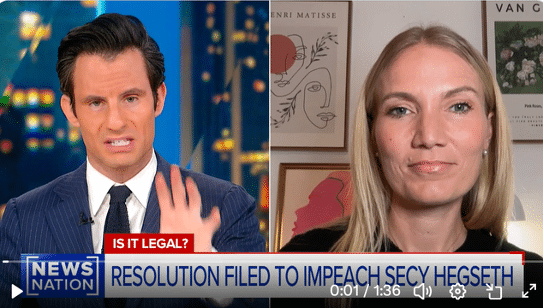
I joined Jesse Weber on NewsNation to talk about the War Powers Resolution and Rep. Thomas Massie’s push to impeach Defense Secretary Pete Hegseth based on the Iran War. A good primer (I hope) on the WPR and what the Constitution says about Impeachment.
At George Mason, I moderated three prolific Supreme Court litigators, Willy Jay, Roman Martinez, and Jeff Wall about tales from the Solicitor General’s office at Beyond the Holding, a symposium PLF co-hosted with the Journal of Law, Economics & Policy. I also spoke about PLF’s Montgomery County magnet-school admissions case, through which I will have to live vicariously now that Khatibi was denied.
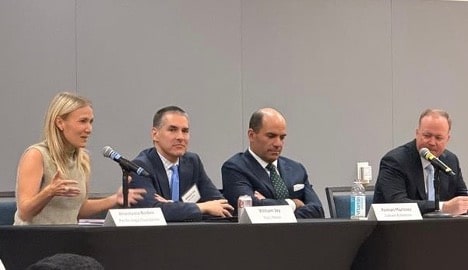
I swear Roman was very interested in what I had to say.
Just got back from a travel nightmare, ie. that time all flights across the country were suddenly grounded just as I was about to board my plane. It was worth the trip to see Justice Alito speak Thursday night.
With gratitude…