Scalia’s least favorite monster
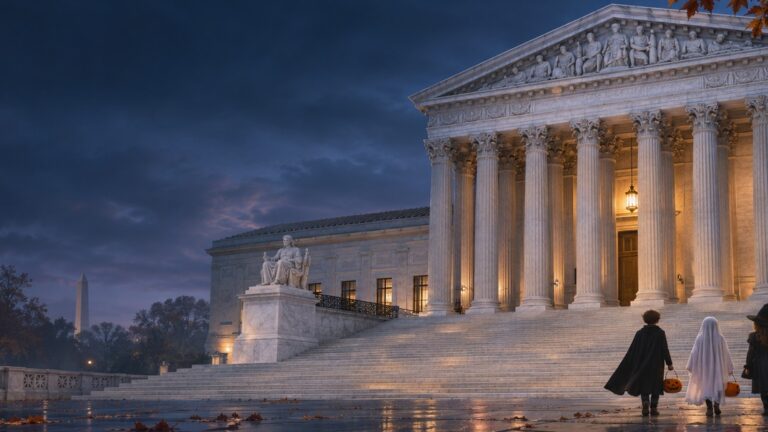
First Scoop: In honor of Halloween, our favorite spooky Supreme Court quote
Like some ghoul in a late-night horror movie that repeatedly sits up in its grave and shuffles abroad, after being repeatedly killed and buried, Lemon stalks our Establishment Clause jurisprudence once again, frightening the little children and school attorneys of Center Moriches Union Free School District. Its most recent burial, only last Term, was, to be sure, not fully six feet under: Our decision in Lee v. Weisman conspicuously avoided using the supposed test but also declined the invitation to repudiate it. Over the years, however, no fewer than five of the currently sitting Justices have, in their own opinions, personally driven pencils through the creature’s heart (the author of today’s opinion repeatedly), and a sixth has joined an opinion doing so. The secret of the Lemon test’s survival, I think, is that it is so easy to kill. It is there to scare us (and our audience) when we wish it to do so, but we can command it to return to the tomb at will. Such a docile and useful monster is worth keeping around, at least in a somnolent state; one never knows when one might need him. Justice Antonin Scalia on the Supreme Court’s 1971 decision in Lemon v. Kurtzman in Lamb’s Chapel v. Center Moriches Union Free School District, 508 U.S. 384, 398–99 (1993).
Second Scoop: Back to the bench
The Court’s been quiet for the past two weeks—at least on the argument and conference fronts—but oral arguments resume today. Let’s look at a couple of cases on tap for November.
On November 3, the Court will hear St. Mary Catholic Parish v. Roy, which asks whether Colorado can offer “universal” preschool funding but exclude schools whose admissions policies reflect their religious beliefs.
Colorado allows families to use preschool assistance at public, private, and religious schools, so long as participating schools comply with its nondiscrimination requirements. Catholic schools argue that those conditions prevent them from operating consistently with their beliefs about marriage, sex, and gender. They also point to exceptions allowing other preschools to serve particular communities—for example allowing preschools to admit only “children of color,” “gender-nonconforming children,” “the LGBTQ community,” low-income families, and children with disabilities.
The Court has repeatedly held that government cannot disqualify schools from generally available benefits simply because they are religious or provide religious instruction. This case asks how that principle applies when the government conditions participation on compliance with rules that burden religious exercise. The schools say Colorado is excluding them based on their religious exercise, while the state says it hasn’t singled religious exercise out for disfavored treatment.
There’s also a question about how to apply Employment Division v. Smith, which ruled that generally applicable laws that burden religious exercise only trigger rational basis scrutiny. The schools say Smith doesn’t apply because Colorado favors some secular activity. The Tenth Circuit, however, ruled that a law only fails to be generally applicable if officials have unfettered discretion to grant exemptions or if there are categorical exemptions for identical secular conduct.
On November 10, the Court will hear Department of Labor v. Sun Valley Orchards. There, a New Jersey family farm was ordered to pay more than half a million dollars in back wages and penalties for allegedly violating employment obligations under the H-2A agricultural guestworker program. The prosecutors, agency witnesses, and administrative judge all worked for the Department of Labor. Sun Valley argues that the Constitution entitles it to have the dispute decided in an independent federal court. The Third Circuit agreed and the Supreme Court agreed to hear the case.
Following SEC v. Jarkesy, this case tests another limit on agencies’ power to adjudicate disputes in-house. The questions are whether Article III requires these proceedings to take place in federal court—and whether Congress authorized the Department’s adjudication in the first place. The stakes extend well beyond agriculture, and will help determine how much power agencies can exercise over Americans’ property without going before an independent judge.
Third Scoop: Can you sue federal officials for damages if they violate your rights?
The most important argument of the month, to my mind, is Nielsen v. Watanabe, scheduled for November 9. It concerns a basic question of government accountability: When a federal official violates the Constitution, can the injured person recover damages from the official responsible?
If a state or local official violates your rights, Congress created a cause of action for damages under a law called Section 1983. Even if you sue under Section 1983, there is an endless host of obstacles to actually getting relief, but at least you can try.
Section 1983, however, doesn’t apply to federal officials. So in 1971, the Supreme Court decided Bivens v. Six Unknown Named Agents, involving federal narcotics agents who allegedly entered a man’s home without a warrant, searched the place, and handcuffed him in front of his family. There the Court allowed Bivens to sue the agents personally for violating the Fourth Amendment—even though Congress had never expressly created a cause of action for a Fourth Amendment violation, reasoning that there are no rights without remedies for those rights, and so there must be an implied right of action.
The Court later recognized Bivens-type claims in two other circumstances, including in Carlson v. Green, where it allowed a lawsuit based on deliberate indifference to a federal prisoner’s serious medical needs under the Eighth Amendment. Then the Court spent the next forty years sort of regretting the whole thing and limiting those cases to their facts.
Today, unless your case is nearly identical to one of the original recognized cases, the Court will say it presents a “new context.” And if it is new, the case is essentially over.
That brings us to Kekai Watanabe. He was attacked during a gang riot in a federal detention center in Hawaii and says he repeatedly sought medical treatment, but prison nurse Francis Nielsen refused to send him to a hospital. Seven months later, doctors discovered that Watanabe had a fractured tailbone, with bone fragments in the surrounding tissue.
He sued the staff nurse Francis Nielsen for money damages, alleging deliberate indifference to serious medical needs in violation of the Eighth Amendment. The Ninth Circuit held that this was effectively a Carlson claim—deliberate indifference to serious medical needs. But Nielsen argues that the context was different because the injury was different, the mistreatment was lesser, and there are alternative remedial structures. Now, the Court will determine whether Bivens and its progeny will have any lasting significance, or whether they are essentially limited to their facts.
The cherry on top: the Anastasia docket, of course!
I was on with Jesse Weber at NewsNation to discuss recent election-related litigation.
This month marks the 100th anniversary of Euclid v. Ambler Realty, the Supreme Court case that blessed zoning. Here’s my SCOTUSblog column on the case, and why it deserved a dissent. An excerpt:
James Metzenbaum was stuck on a train from Washington—slowed by a snowstorm—convincing himself that his opponent had successfully persuaded the Supreme Court against his position within the last few minutes of oral argument. He had just argued in Village of Euclid v. Ambler Realty in defense of the city’s zoning plan. The poor weather meant he might not get back to his office in time to send a telegram asking Chief Justice William Howard Taft for more briefing before the weekend. So he improvised—opening the train car door, making eye contact with a man shoveling snow near the tracks, and tossing him a telegram wrapped in cash. The shoveler seems to have understood what was intended. He sent off the telegram, and a few days later the court granted Metzenbaum permission to file another brief. Not long after that, the court granted a full rehearing, which was followed by a dramatic reversal in several justices’ positions. In a 6-3 decision, the court sided with Metzenbaum and in favor of Euclid’s power to pass comprehensive zoning, and against a local developer who had argued the town’s plan exceeded the city’s police power and destroyed the property’s value. Three justices dissented, though they never said why. It was an odd start to the birth of modern zoning, and it happened almost exactly 100 years ago. —From my SCOTUSblog column
I recently flew to Ohio to see Euclid myself! The ultimate irony is that despite the city planners, the property at issue did in fact end up going to industrial use. I also saw the farmhouse at the center of Wickard v. Filburn (justice for Roscoe!). Stay tuned for a few videos visiting Supreme Court places…

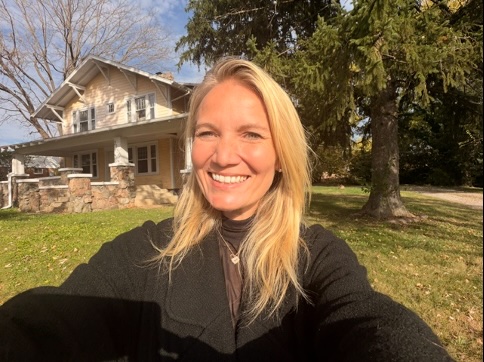
Stop doomscrolling and start learning about the Supreme Court instead! I’ve been posting mini-explainers of strange or interesting Supreme Court cases and facts on my Instagram page.
Last, I was on Armstrong & Getty to talk about PLF’s latest Supreme Court case, while the guys tried to cajole me into telling them whether I think my law school classmates are good lawyers.