

Let the big cases begin!
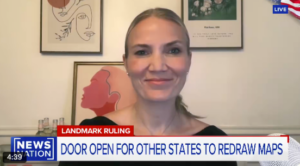
Last night I talked with Jesse Weber of NewsNation about the Supreme Court’s decision in Louisiana v. Callais, which significantly shifted how courts will consider certain claims under the Voting Rights Act. Watch it here.
The last oral argument of the term!
The Court heard the last oral argument of the term yesterday in Mullin v. Doe, a challenge to the government’s decision to terminate Temporary Protected Status (TPS) for hundreds of thousands of migrants. The fight isn’t really about immigration policy—it’s about who gets the final say. I broke it down for NTD TV right after argument here.
Facts: Temporary Protected Status is a program that allows non-citizens to temporarily live and work in the United States when it’s unsafe to return home—because of war, natural disaster, or similar extraordinary conditions. The Secretary of Homeland Security designates a country for TPS for periods of 6, 12, or 18 months and can extend as long as conditions warrant. Syria was designated in 2012 because of Assad’s dictatorship. Haiti was designated in 2010 after its catastrophic earthquake.
The Trump administration, through then-Secretary Kristi Noem, determined conditions had improved enough and terminated TPS for Syrians and Haitians—roughly 10,000 and hundreds of thousands, respectively. Lower courts disagreed, found the process inadequate, and blocked the terminations. The Supreme Court declined to lift those blocks but fast-tracked the case and heard argument today.
Issues: Two things are actually being argued, and it’s worth keeping them separate. The first is the scope of judicial review: Can courts review TPS termination decisions at all, and if so, how much? The second is the merits: Was Noem’s determination legal? The challengers say she didn’t follow proper procedure and was motivated by animus rather than facts on the ground. The government says it’s a political decision that courts shouldn’t be second-guessing.
What happened at argument? Challengers concede they can’t challenge the Secretary’s ultimate conclusion about whether a country is safe. What they say they can challenge is the procedure—whether Noem followed the statutory requirements—and whether the whole exercise was a constitutional violation driven by racial animus rather than an honest assessment of conditions. Their evidence: The State Department simultaneously maintains Level 4 travel advisories for both Syria and Haiti, warning Americans not to go there. If it’s too dangerous for Americans to travel there, the argument goes, sending TPS holders back is pretextual.
The government’s primary argument isn’t really about Haiti or Syria at all. It’s that courts shouldn’t be in the business of reviewing these decisions—a position the administration has taken across a lot of executive action this term. Putting judges in the business of evaluating country conditions, they say, turns justices into DHS mini-secretaries.
Interesting bit: There was a notable moment around the animus argument. Challengers frame the terminations as reflecting the administration’s generalized hostility toward “non-white” immigrants—but as a legal matter, that framing raises real questions. What does “non-white” even mean as a legal category? Justice Alito probed the challengers’ attorney: Do you consider Syrians white? How about Turks? How about Southern Italians (a joke because Alito is Italian)? How about Spaniards? He summed it up by saying he doesn’t like dividing up the people of the world this way.
Louisiana v. Callais: Unequal Outcomes Aren’t the Same Thing as Discrimination
Quick takes: 6–3 along ideological lines. Alito wrote it. Thomas offered a characteristically singular concurrence. Kagan read her dissent aloud (and lost her voice). Key takeaway: Unequal outcomes aren’t illegal—discrimination is. That’s the animating idea behind today’s decision, and it’s not a radical one.
Facts: Louisiana redrew its congressional maps in 2022. A federal judge found the new map likely violated Section 2 of the Voting Rights Act—which prohibits voting practices that provide less opportunity based on race—because it had only one majority-black district despite black residents making up roughly a third of the state’s population. So Louisiana drew a new map, SB8, creating a second majority-black district. Then a group challenged that map as an unconstitutional racial gerrymander.
Issue: The Court was resolving the tension between preventing discrimination and perpetuating new discrimination through a race-based remedy. Specifically: Can you justify drawing a race-conscious map by pointing to a Section 2 violation? Only if you can actually prove the original map was drawn because of racial discrimination rather than plain old politics.
Majority opinion: The majority did not go as far as some hoped—or as others feared. It did not declare Section 2 unconstitutional. What it did was tighten the test for proving a Section 2 violation to bring it in line with the Constitution.
The majority’s view: Courts had let the Gingles framework get too loose, blessing race-based redistricting even when the government might have been sorting people based on politics, not race. Now, before anyone gets a race-based remedy, plaintiffs have to do three things the old test didn’t meaningfully require: (1) draw an illustrative map without using race as a factor—you can’t use the thing you’re accusing the state of doing; (2) disentangle racial bloc voting from party-line voting—if black and white voters split differently because of party, that’s not automatically a Section 2 violation; and (3) show present-day discrimination, not just the lingering residue of historical discrimination. Higher bar, but a principled one aimed at restoring Section 2 to a ban on discrimination rather than unequal outcomes.

Applied here: Louisiana’s remedial map failed because the VRA didn’t actually require a new map in the first place. The Robinson plaintiffs never showed the original map was driven by racial discrimination—instead they showed black and white voters chose different parties’ candidates, which could easily reflect political preferences. That’s not enough anymore.
Justice Thomas, joined by Justice Gorsuch, concurred and went further: In his view, Section 2 doesn’t apply to redistricting at all.
The interesting bits: Alito alludes that the Court took the case to bring clarity before elections—partisan redistricting fights are increasingly being repackaged as racial discrimination claims, and computers have made it easier to generate alternative maps that look like proof of a violation without actually establishing one. The decision acknowledges both problems: Computers helped create the mess, but they should also help states disentangle race from politics going forward.
The deeper philosophical divide is this: Justice Kagan and the dissenters see the world in terms of racial groups. To Justice Kagan, if a racial group has less political power, that is treated as a harm requiring a remedy. The majority draws a different line: The Constitution protects individuals from discrimination—not groups from losing elections. That distinction matters enormously, because ensuring equal outcomes for racial groups almost always requires intentional racial sorting to get there.
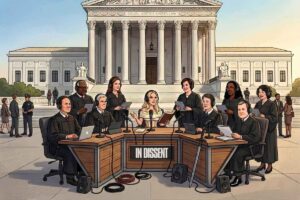
And of course, the dissent: Justice Kagan, joined by Justices Sotomayor and Jackson, was not pleased—and made sure everyone knew it. She read the dissent from the bench, which is not standard practice, but instead a choice. She read at such length that by the time oral argument began in the next case, she remarked she had lost her voice.
In Kagan’s framing, the majority claims to be reconfiguring the test but is actually setting the bar so high that no one will ever clear it. She believes the VRA was never intended to capture only intentional discrimination—it was doing something more, protecting against vote dilution. She delivered what amounted to a eulogy for Section 2, invoking the blood of the Civil War. She closed with a triple: “I dissent… I dissent… I dissent.” (and not “respectfully”).
Dissents are often hyperbolic. They’re not the law, and justices are writing for themselves. But typically, the sky does not fall.
Implications: Louisiana must redraw. Nationally, fewer Section 2 redistricting challenges succeed, and the ones that do require harder evidence. Political gerrymandering claims that were being smuggled through the racial discrimination door get sent back to the political process—where, some would argue, they belong.
What’s left this term?
We’re heading into the final stretch of October Term 2025, and the biggest opinions are still coming.
Watch for separation of powers and laws that limit the president from removing executive officers, birthright citizenship, policies on transgender athletes, and of course, PLF’s case involving home equity theft.
In other Anastasia news
On the Jesse Weber show: Broke down the birthright citizenship argument—where the Court seemed deeply skeptical of the government’s attempt to rewrite the longstanding rule. It’s a weird time when both the president and Robert DeNiro show up at the Supreme Court.
In WaPo: I wrote an op-ed for The Washington Post on Trump’s temporary pause on the Jones Act. My take? End it, don’t suspend it.
Always talking about dissents: I wrote columns at SCOTUSblog about Justice Sotomayor’s skeptical dissent in SEC v. Jarkesy on the right to a jury trial and the time NASA made Justice Scalia turn against judicial restraint.
Want to know why I do what I do?

Dispatch piece: Told the story of Ruby Bridges for The Dispatch’s project celebrating the 250th anniversary of the Declaration of Independence. It’s a narrative about civil rights through the lens of individual courage rather than abstraction.
She still litigates: Remember how we sued when Napa called a small family winery a “nuisance” for offering tastings and then fined them millions for it? We secured an injunction in the Napa County v. Hoopes Family Winery litigation—pushing back on excessive fines and regulatory overreach. I also sued Louisiana, because I’ve got unfinished business.
Well, readers, the Supreme Court is heating up. The quiet part of the term is over and the part that shapes doctrine (and headlines) is just beginning.
Until next time,