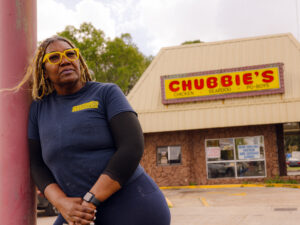



Ursula Newell-Davis has built her career around one goal: helping the vulnerable in Louisiana.
After 20 years as a social worker, she saw firsthand that many families couldn’t access care for their children with special needs, leaving parents with no choice but to leave them unsupervised. Some kids would fail to complete basic tasks, like preparing meals or maintaining personal hygiene; others turned to the streets, falling into crime.
Ursula, not one to watch from the sidelines, knew exactly how to help. By offering short-term respite care in her clients’ own homes, she could empower children by teaching them the basic life skills they needed to flourish. Their parents were then free to go to work or take a few hours of much-needed rest—comforted that their children were in good hands.
“People like her only come around once in your life,” said one mother, whose daughter was counseled by Ursula while the mother battled addiction.
Her credentials are impressive, too. Ursula holds bachelor’s and master’s degrees, plus a license, in social work. Her resume includes working in hospice care, managing a behavioral health center, and launching a consulting business for organizations that work with special needs populations. By all accounts, Ursula is the ideal candidate to provide respite care in New Orleans.
But Louisiana requires aspiring providers to first obtain Facility Need Review (FNR) approval, wherein the government demands that a provider essentially come crawling on their hands and knees to plead their case. The process places the entire burden on applicants of proving “need” and the “probability” of “serious, adverse consequences” to a committee of bureaucrats. Those terms have no definition, leaving the standard a provider must meet to be whipped about by the whims of those bureaucrats, who substitute their own judgment for the basic economics of supply and demand. This process reduces supply of critical services, drives up costs, and protects incumbents from competition.
State health officials chose to deny Ursula’s FNR application despite rising juvenile crime rates, calls from city officials for early intervention, and studies showing respite care improves outcomes for children.
Disappointed but resolute, Ursula sprang quickly into action. She filed a federal lawsuit to defend her constitutional right to earn a living free of irrational and arbitrary government restrictions.
Unfortunately, the courts upheld Louisiana’s FNR program, applying the notoriously deferential rational basis test, which asks if a law is at all related to a legitimate government interest and almost always favors the government. Ursula petitioned the Supreme Court, but her petition was denied, thereby closing her case—at least at the federal level.
But while Ursula was fighting in court, Louisiana passed the Right to Earn a Living Act, which requires that occupational regulations be “necessary and narrowly tailored to fulfill legitimate” government interests. The FNR process is in clear violation.
Reinvigorated by a second chance, Ursula filed another FNR application in January 2025, which included substantial evidence establishing a need for her services: At least one mother had to relinquish custody of a special needs child because she could not receive the needed respite care Ursula would have provided. Half of Louisiana families in need of respite care were unable to obtain it. Thirty-six percent of providers could not be reached by phone, and of the ones that did answer, 44% weren’t accepting clients from the population Ursula would serve.
Despite all this, the committee told Ursula her services were “not needed,” and her application was denied—again.
Ursula deployed one more effort before turning to the courts again. She sent a letter to Louisiana Department of Health Secretary Bruce Greenstein, requesting an exemption from the process—one that he is authorized to give. She never heard back.
With nowhere else to turn, Ursula is filing another complaint, this time in state court. In it, she alleges that Louisiana’s FNR regulations violate the right vindicated by the recently passed Right to Earn a Living Act.
But Ursula’s case is about far more than one woman’s fight to open a small business. It asks whether government should be able to bar a qualified, dedicated professional from entering a field simply to protect established players from competition.
Certificate-of-need and facility need review laws exist in dozens of states, and wherever they operate, the consequences are the same: higher costs, reduced access, and vulnerable communities left without the services they need. For children with special needs in New Orleans, Ursula’s success in court could mean the difference between having a safe place to develop life skills and being left to fend for themselves.
What’s At Stake?
- Louisiana law protects the right to earn an honest living—and a bureaucratic permission requirement violates that right and blocks qualified providers from offering care.
- State law requires occupational regulations to be “necessary and narrowly tailored”; blocking a licensed social worker from serving vulnerable children and their families is neither.