


National Review: Speaker Johnson Proves the Necessity of Reviving the Nondelegation Doctrine
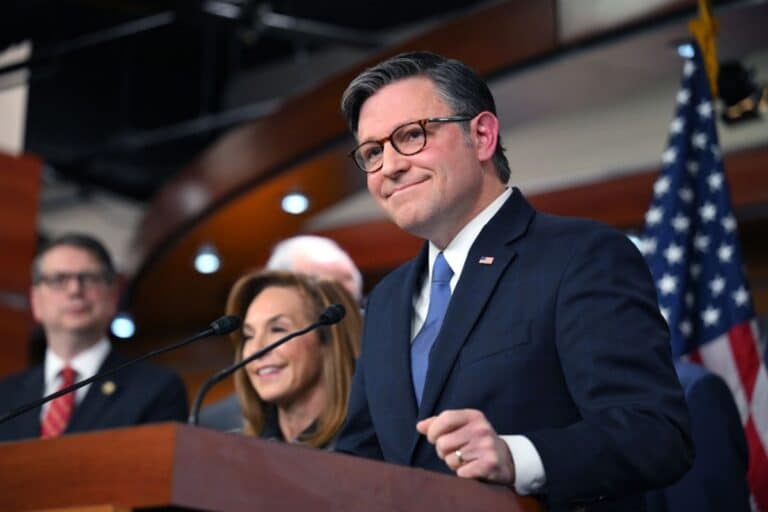
During a press conference earlier this month, House Speaker Mike Johnson was asked about Justice Neil Gorsuch’s concerns, raised during Supreme Court oral arguments over the legality of the president’s tariffs, that Congress had violated the long-dormant “nondelegation doctrine” by delegating too much of its tariff power to the president.
Johnson rebuffed Justice Gorsuch’s concerns, declaring himself a “jealous guardian of Article I.” He explained that if he “felt like the executive branch had overstepped its bounds on trade or on the tariffs or something, I would have stepped in.”
With this answer, however, Speaker Johnson demonstrated that his “jealous guardianship” of Congress’s prerogatives is insufficiently jealous.
Article I of the Constitution explicitly grants the power to impose tariffs to Congress, not the president. In fact, the Constitution gives the president no power at all to dictate the nation’s trade laws. To be sure, the president has many foreign policy powers under Article II — he is the commander in chief of the armed forces, he can receive foreign ministers, and, with the Senate’s advice and consent, he can make treaties and appoint ambassadors. But none of these powers authorize the president to impose taxes on imports. In fact, during the November 5 oral arguments before the Supreme Court on the delegation of tariff authority, Solicitor General John Sauer conceded this point.
With no inherent tariff power, therefore, President Trump claims that the International Emergency Economic Powers Act (IEEPA) of 1977 gives him broad power to impose tariffs, so long as they “deal with” a presidentially declared emergency. Suppose, for the sake of argument, that Trump is correct about IEEPA (he is not). If so, Congress has effectively surrendered its tariff power to the president.
Under Trump’s interpretation of IEEPA, the issue becomes not whether the president has “overstepped” his statutory boundaries, as Johnson framed it, but whether Congress has unconstitutionally handed its powers to the president. The Constitution prohibits Congress’s wholesale abdication of its constitutional responsibility over tariffs and, more generally, Congress’s unlimited transfer of its lawmaking power to the executive branch. Yet, in Trump’s own formulation, that is exactly what has occurred here.
The president’s boundless tariff policy is a good example of why the Founders’ careful separation of powers was prudent. By exploiting IEEPA, President Trump has imposed tariffs on virtually every country in the world, and the rates of the tariffs are frequently changing — sometimes as a result of negotiations, sometimes in reaction to political events. Indeed, the tariffs could change for any reason Trump pleases, as Congress left the decision of whether to invoke IEEPA to the president.
Nevertheless, Congress could still reclaim its authority to set tariffs if it wanted to. It could repeal or amend IEEPA to make clear it does not authorize tariffs. That would be a tall order, given the president’s inevitable veto and the two-thirds majority in both chambers required to override it. But that is the sort of thing a Congress that jealously guards its power would do.
Instead, it has done the opposite. This past spring, the House manipulated its own oversight rules to prevent its members from taking any votes that could potentially rescind the emergency declaration underlying most of Trump’s IEEPA tariffs.
It now falls to the Supreme Court in the tariff case to enforce the Constitution’s limits on Congress delegating legislative power to the president. In an amicus brief, Pacific Legal Foundation has advocated for the Court to revive the nondelegation doctrine on behalf of our clients in a parallel challenge to the IEEPA tariffs.
Unfortunately, even a Supreme Court ruling that IEEPA unconstitutionally delegated the Article I tariff power seems unlikely to rekindle Congress’s jealousy — the real solution to lawmaking by the executive branch. The president will likely fall back on some other capacious statutes to implement his tariff plans, and Congress will probably let him. At the very least, however, this case provides the Court with an opportunity to clarify that Congress must do more than simply commission the president to perform its core legislative duties for it.
This op-ed was originally published in National Review on Regulation on November 18, 2025.