


New year, new SCOTUS opinions

The Supreme Court has issued its first handful (or scoop, if you will) of opinions. And it heard oral arguments in one of the most closely watched cases of the term.
But first, the bad news. On Monday, the Court rejected six PLF petitions for review: Hierholzer (challenging racial preferences in federal contracting), Lincinio (asking the Court to revisit its judge-made and unwieldy 3-part test for determining whether there’s been discrimination in the workplace under the Civil Rights Act), McGee (due process when trying to recover what you’re owed after the government seizes your house over a small debt and sells it), Koetter (same), Howard (same), and Beeman (same).
In brighter news, over the holiday break I filed two new SCOTUS petitions. We’re asking the Court to get rid of the terrible, no good, unconstitutional rational basis test. That test is one of the most commonly used judicial tests in constitutional law, and yet it provides almost no protection for our rights.
In the first case, a jet engine mechanic is building his own home in rural Massachusetts but can’t finish it because the state prohibits people from performing their own plumbing. It’s one of the only places in the nation to do so, and it looks an awful lot like a handout to the plumbing industry. The lower courts dismissed our client’s case using just two sentences: the law is rational because the legislature says it is. And the right to repair your own home isn’t fundamental because the Supreme Court has never deemed it so. Our brief is here.
In the second petition, we’re representing a certified nurse midwife (CNM) who is prohibited from assisting at home births. This means that mothers can give birth at home, just without the help they may want or need. CNMs can only help out if they pay a physician to grant them the privilege, even though they may never even meet the physician in person or receive meaningful oversight. I believe the technical term for such a scheme is a “racket.” The lower court dismissed our case while totally ignoring all of the allegations in our complaint showing the law does nothing to protect mothers and is instead pure economic protectionism. That’s the “rational basis” test folks. Read our brief explaining just how silly the rational basis test is.
Last, the Court scheduled oral argument in our Pung case, involving a City that seized a family’s home over a contested tax debt and then sold it under suspect processes for more than $100,000 less than what it was worth—meaning the family will get back $100,000 less than what they are owed in proceeds from the sale. The Court will hear the case on February 25, so stay tuned!
First decisions issued!
The Court issued a slew of opinions this week, but one is worth lingering on.
In Bost v. Illinois Board of Elections, the Court ruled that a political candidate had standing (or in non-legalese, he was injured enough) to challenge an Illinois law that allows mail-in ballots to be counted within two weeks of being received so long as they are mailed by Election Day. He alleges that Illinois’s rule violates the federal law that sets Election Day, since it allows ballots to be counted even if received after election day. And he says the law harms him because 1) it forces him to expend extra resources to monitor the election, and 2) even if the allegedly improper votes would not make the difference between winning or losing, margins still matter in politics.
The lower courts said he wasn’t injured because any resources he spends monitoring the election are self-inflicted wounds and that any injury to his margins was speculative.
In an opinion written by the Chief, a majority of the Court reversed and said he did have standing to sue. Using an analogy to the 100-meter dash, it ruled that candidates suffer even if the votes don’t end up making or breaking the election. Being subject to an unfair election process was enough:
Each runner in a 100-meter dash… would suffer if the race were unexpectedly extended to 105 meters. Whether a particular runner expects to finish strong or fall off the pace in the final five meters, all would be deprived of the chance to compete for the prize that the rules define.
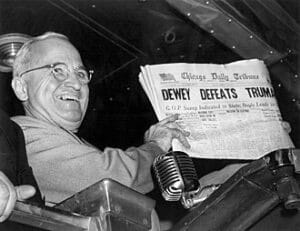
The Chief also reasoned that forcing candidates to wait until the eve of or after an election to challenge election rules would force judges to get involved in politics at the worst possible time and to make guesses at who’s winning or losing. As Thomas Dewey could attest to, predicting election outcomes is no easy feat.
It was particularly interesting that the Chief felt compelled to call out and disagree with Justice Barrett’s concurrence, which said that Bost’s monetary injuries were what caused him to suffer an injury. In his view, that reasoning would have the unfair result of conferring standing to the politician who expends a penny while withholding standing from a politician that relies on volunteers. And in any event, all candidates have a stake in the rules governing elections because those rules provide democratic legitimacy itself.
According to Justice Barrett, joined by Justice Kagan, the money Bost has to expend monitoring the election is a much more concrete harm, so they could not join “the Court’s creation of a bespoke standing rule for candidates. Elections are important, but so are many things in life.” (I agree, but I think that means that more people should have standing in more cases, not fewer.)
Justice Jackson wrote a dissent, joined by Justice Sotomayor, warning that the decision would “open the floodgates to exactly the type of troubling election-related litigation the Court purportedly wants to avoid.” I, for one, have become immune to such hyperbole, and of course welcome more civil rights lawsuits in federal courts.
Bonus: Justice Barrett’s concurrence has a passing reference to a PLF case, Tyler v. Hennepin County. Always fun to see.
Can we revisit that wild oral argument?
Over the break I listened to oral argument in First Choice Women’s Resource Centers v. Platkin and it blew. my. mind. The lawsuit arose after the Attorney General of New Jersey issued First Choice a subpoena asking for the names and addresses of its donors (!!!!!) and then claimed that the group wasn’t injured enough to challenge the subpoena in federal court.
According to the AG, the subpoena was not “self-executing,” meaning that the AG would have to go to state court to enforce it if the group chose to comply. It thus claimed First Choice wasn’t really injured. (Justice Alito pointed out that the first time the AG had adopted this position about subpoenas being non self-executing was… this case.)
The AG also quibbled with the way First Choice framed its injury: rather than saying donors weren’t likely to donate in the future, they had submitted a declaration from donors who said they wouldn’t have donated in the past if they knew the subpoena was coming. The AG therefore argued they had not pleaded any risk of future injury. (Justice Gorsuch wasn’t buying this argument, saying this was too pedantic and said that the risk of future injury “just follow[s] night from day.”)
In response, First Choice argued that the subpoena sure seemed menacing and mandatory on its face since it contained a threat about the group’s “failure to comply.” And any donor would be reasonably chilled from donating.
But some justices seemed skeptical. Justice Jackson, for example, asked what the harm was if it was possible that a state court might throw out the subpoena (after you’ve litigated it in a forum that you don’t want to be in).
What makes this all even crazier is the state is the government claims you have to go to state court first, but after you do, you might be precluded from going to federal court!!!
In sum: standing doctrine has become a deeply unfair game. When the government threatens to violate your constitutional rights, you should be able to go to federal court immediately.
Bonus: at oral argument, the justices brought up a PLF case, Knick v. Township of Scott. Good to see our cases influencing the trajectory of constitutional law.
What you’ve been waiting for: blockbuster argument alert
This week the Court heard arguments over two states’ bans on trans-athletes in women’s sports.
Twenty-seven states have passed laws limiting sports by biological sex. Idaho and WV were among the first. On Wednesday, the Court heard arguments over whether the bans violate the Equal Protection Clause or Title IX of the Civil Rights Act.
The plaintiffs were two trans-athletes. Though the states are defending the laws, a group of female athletes intervened to help defend the law. According to their brief:
Madison Kenyon and Mary Marshall ran on the women’s track and cross-country teams at Idaho State University. In 2019, they both lost—by a significant margin—to June Eastwood, a male athlete who identified as female. Eastwood competed on the men’s team the year before and recorded times that would have broken national women’s records.
Both the Ninth and Fourth Circuit struck down the state laws. The Supreme Court seems poised to reverse, but the question is how.
One case involves a plaintiff who attempted to mitigate their physical advantage over women by suppressing testosterone for over a year. Rather than debating the empirical question of whether that mitigation worked, the argument turned on something much broader: whether as-applied challenges should meaningfully exist at all.
The state’s advocate suggested that recognizing as-applied challenges would force states to perfectly tailor their laws to every edge case. I don’t think that’s right. Sometimes laws are unconstitutional in a ton of cases, but there’s something special about the plaintiff that means the law no longer makes sense. That person should not be deprived of their rights just because everyone else can be constitutionally limited.
(To be clear, the law here may still be constitutional even as applied. I’m making a structural point: please don’t abolish as-applied challenges.)
The justices also explored the consequences of each side’s argument. If states have to exempt trans athletes who are biological males but who have mitigated their physical advantage, does that mean teams must also open the door to any male who lacks a physical advantage for whatever reason?
Meanwhile, the states want a strict line based on differences between the sex. Does that mean states can create sex-segregated programs for chess, since men perform better? And must states separate sports by sex, or can they merely choose to?
What’s next?
Next week the Court will hear arguments in Trump v. Cook, regarding whether Congress may limit the President’s ability to fire people in the executive branch (here, the chair of the federal reserve). For a primer, read my SCOTUSblog column, a love letter to one of the greatest dissents of all time…
About that New Year’s Resolution…
Over the holidays I filed briefs on behalf of a charity whose member was arrested for handing a homeless man a burrito and a virtual real estate brokerage that is stifled by a useless in-state office requirement. I also filed a brief in response to the government’s attempt to kick us out of court in a case defending a man who teaches dogs to avoid deadly rattlesnakes.
I also wrote this SCOTUSblog column on the most unorthodox dissent you’ve never read. It concerns President Nixon, the bombing in Cambodia, Justice Wild Bill O. Douglas, and presidential war powers.
Or maybe you prefer to read this piece on Justice Scalia’s powerful concurrence… which was really kind of a dissent.
What’s your New Year’s resolution? Mine is to convince you to follow me on Instagram…