

On the anniversary of the Bill of Rights, we have the Anti-Federalists to thank
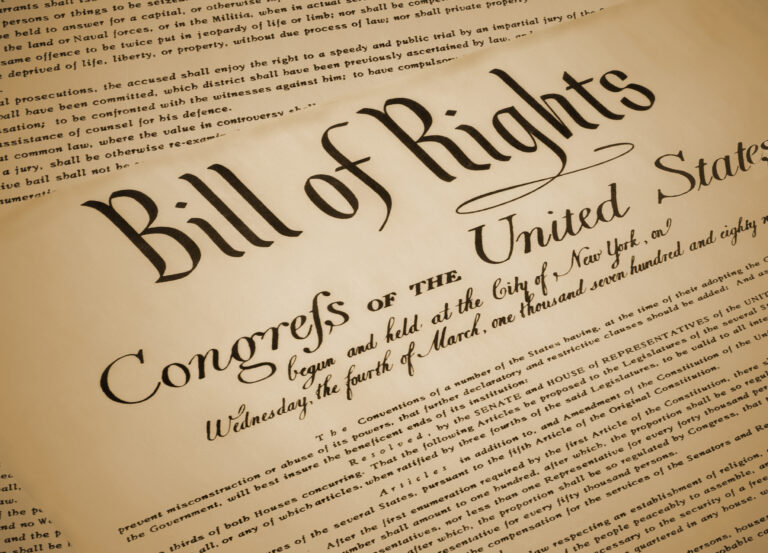
On this day 234 years ago, the Bill of Rights was officially ratified. With two centuries of examples showing us how willing governments are to ignore even these enumerated rights, it’s astonishing that those first ten amendments almost didn’t make it into the Constitution at all.
If not for a small group of determined Anti-Federalists—and their insistence on explicit protections like jury trials, property rights, and due process—the Bill of Rights would not exist.
Powers granted, powers reserved
When the Revolutionary War ended, a civil war of ideas began. The Framers agreed that government must be limited to preserve liberty—but they could not agree on the extent of those limits.
Disillusioned by the loose union created under the Articles of Confederation, which gave the national government virtually no power to enforce the laws, the Federalists called for a stronger central authority. Others saw the Articles’ decentralized structure as a feature, not a flaw. These “Anti-Federalists” were skeptical that individual liberty could survive centralized power and pushed back. The debate grew so fierce that the Constitution’s ratification nearly collapsed over one issue: the absence of a Bill of Rights.
This dispute spilled into print—the Federalist Papers on one side and Anti-Federalist essays like Brutus and Federal Farmer on the other. The Anti-Federalists feared that unless rights were explicitly listed, the new government would behave as though those rights did not exist at all. In Brutus II, whose anonymous author is thought to be New York judge Robert Yates, the warning was clear: “A bill of rights is essential to guard against the abuse of the powers of the general government.”
Federalists like Alexander Hamilton and James Madison disagreed. Hamilton went so far as to denounce a bill of rights as dangerous. In Federalist 84, he warned that listing prohibitions would “afford a colorable pretext to claim more than were granted.” “Why declare that things shall not be done,” he asked, “which there is no power to do?”
By Hamilton’s reasoning, declaring that Congress “shall not” restrict something like free speech would imply that Congress might otherwise have possessed that power. But the Revolutionary War had already made clear that individual liberty does not suffer because governments have too many limitations, but because they have too few.
Hamilton also insisted that “bills of rights… have no application to constitutions founded upon the power of the people,” arguing that a government created by the people would have no reason to oppress them. Brutus II rejected that premise outright, warning that even a well-intentioned federal government was susceptible to abuse. As he wrote, “The powers, rights, and authority granted to the general government by this Constitution, are as complete in many instances to the purpose of tyranny as those possessed by any government in the world.”
Brutus further challenged Hamilton’s claim that enumerated powers made a bill of rights unnecessary. If everything not granted was truly reserved, he asked, why did the Constitution include explicit prohibitions at all—bans on suspending habeas corpus, passing ex post facto laws or bills of attainder, or granting titles of nobility? “It certainly does not,” he noted, “in express terms.”
Explicit declarations of rights had already become standard practice among the states. Given that reality, Brutus found it astonishing that the federal Constitution omitted what Americans widely understood to be a basic safeguard of liberty.
James Madison opposed a bill of rights for different reasons. Unlike Hamilton, he did not consider it dangerous, but unnecessary. Madison believed the Constitution’s separation of powers and federalism were sufficient protections, and above all, he feared that reopening debate could derail ratification altogether.
As Federalists and Anti-Federalists continued their debate, the fate of the Constitution rested with the states and their ratifying conventions.
Massachusetts Compromise
The Virginia convention had a strong contingent of Anti-Federalists, including the revolutionary favorite Patrick Henry, who was vocal in his skepticism of adopting the Constitution without a bill of rights. “There will be no checks, no real balances, in this government,” he warned. He also stressed the importance of addressing the issue now and not waiting for Congress to consider the matter down the road. “If, sir, amendments are left to the twentieth, or tenth part of the people of America, your liberty is gone forever.”
Like Virginia, Anti-Federalists also had a strong presence in the Massachusetts, New York, North Carolina, and Rhode Island ratifying conventions, which made the Federalists nervous. These five states were among the largest, most politically influential, and economically significant. If they refused to adopt the Constitution, others might follow suit and the new government would collapse.
Massachusetts was particularly important, because it was a major battleground state sharply divided right down the middle. If the Constitution could succeed here, there would be hope.
Anti-Federalists John Hancock and Sam Adams became the key players in Massachusetts, and the pair brokered a deal with the Federalists that would become known as the Massachusetts Compromise. Massachusetts would agree to ratify the Constitution immediately, but with one condition: Adding a bill of rights must be the first order of business for the new American Congress.
After Massachusetts signed on, Virginia and New York weren’t far behind. North Carolina and Rhode Island held out a bit longer, but eventually they also voted to ratify.
The debate was finally over, and the new Constitution would have its Bill of Rights. But who would write it?
The only man for the job
When the time came to draft the Bill of Rights, James Madison volunteered. Unlikely as it seemed for a Federalist and Bill of Rights skeptic to volunteer, he was truly the only man for the job. For starters, no one else wanted to do it. None of the Federalists had any interest in writing it and the Anti-Federalists were keenly aware of their minority status in Congress. They had managed to secure a Bill of Rights, but they weren’t going to push their luck by demanding they also become its authors.
Madison was willing and, most importantly, he had the trust of both sides. The Anti-Federalists may have found his faith in a self-restrained government naïve, but unlike Hamilton, whom they didn’t trust as far as they could throw, they knew Madison’s concern for liberty was genuine.
Madison had his work cut out for him as he determined which rights would be included. He worked deliberately and pulled from existing state constitutions, the English Bill of Rights, Magna Carta, Anti-Federalist essays, and his own opinions. He also asked the states for their input.
Madison received over 200 suggestions. Virginia, New York, North Carolina, Rhode Island, and Massachusetts alone were responsible for 170. Madison carefully considered each one. He also set some parameters. The new amendments would not alter the structure of the new government, and they must be compatible with its general design and focus on protecting core liberties—conscience, expression, property, due process, and meaningful limits on federal power.
Eventually, he presented Congress with 19 amendments to consider. The House of Representatives reduced the amendments to 17. The Senate then cut that list down to 12. The states ultimately ratified 10 of those amendments and the Bill of Rights was officially added to the U.S. Constitution.
A victory for the Anti-Federalists
The Federalists are often remembered as the winners of the great debate over the Constitution. And in one sense, they were—the Constitution was ratified. But on the question that mattered most, history has vindicated the Anti-Federalists. Their refusal to accept a Constitution that relied on good intentions instead of clear limits forced the adoption of the Bill of Rights.
Two centuries later, those first ten amendments remain the most powerful protections ordinary Americans have against government overreach. But the fact that those rights had to be written down—and are still so frequently tested—proves the Anti-Federalists’ point.
Every day, Pacific Legal Foundation fights to protect our clients from governments’ attempts to skirt our Bill of Rights’ protections, like the right to a jury trial and the right to just compensation, among others. Imagine how much harder our fight would be if we didn’t have these explicit protections to point to when the government steps out of line.
As we celebrate the Bill of Rights today, we owe a debt of gratitude to the Anti-Federalists, who understood this long before the rest of the nation.