

PLF’s Supreme Court Show: Home equity theft is back at the Supreme Court

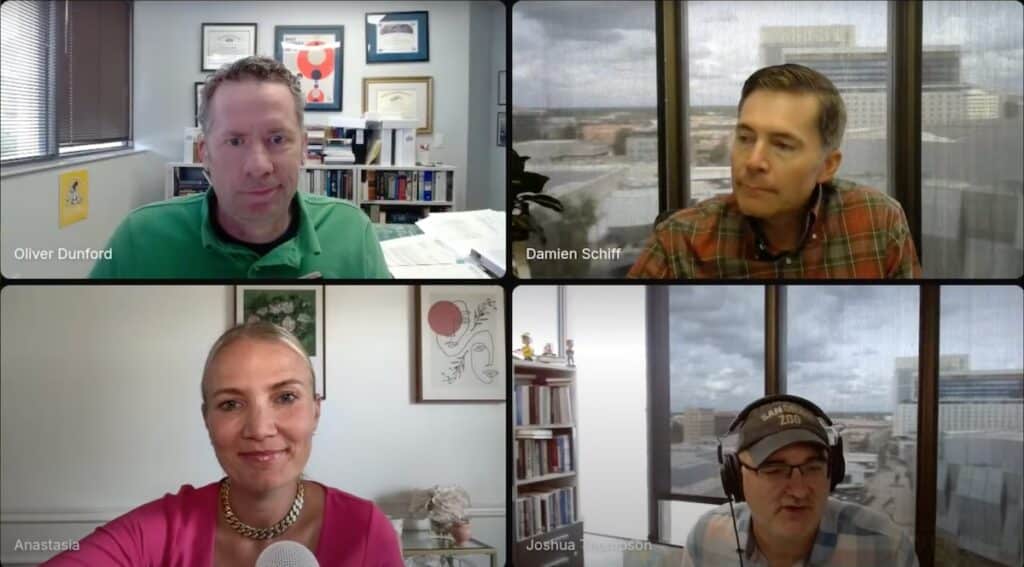
Last Monday the Supreme Court held its “long conference,” which is exactly what it sounds like: a longer-than-usual meeting in which justices review cert petitions that have piled up over the summer. Pacific Legal Foundation attorneys gathered for our new Supreme Court livestream, “PLF’s Supreme Court Show,” in which attorneys discuss oral arguments and make predictions about which cases will be granted.
The results of the long conference came in yesterday (and attorneys reacted on another livestream). Here’s a recap with commentary and predictions (right and wrong) from PLF attorneys.
Home equity theft is back at the Supreme Court
Anastasia Boden correctly predicted the Court would grant Pung v. Isabella County. The case is a follow-up to PLF’s 2023 case Tyler v. Hennepin County, in which justices unanimously ruled that home equity theft is an unconstitutional taking. With Pung, the justices have an opportunity to “do some cleanup” after Tyler, Boden said. The case asks whether the government has failed to justly compensate property owners when it artificially depresses home prices at auctions—a common practice “which is just ridiculous,” Anastasia noted.
“This case is a really interesting one,” Joshua Thompson added in yesterday’s livestream.
One of the questions that this case asks is: What is the just compensation required by the Fifth Amendment? What Michigan says, and the courts say, is, ‘Since we sold this at auction for $70,000, you’re entitled to the difference between $70,000 and whatever you owed in taxes—let’s call it $10,000. So your just compensation is $60,000.’ The petitioner is like, ‘Well, that’s bullshit, because the guy who bought it at auction turned around and sold it for $200,000 a couple days later. So the difference is actually $200,000 [minus] the $10,000’— which seems right to me.
A Cuban confiscation crisis?
The Court also granted Exxon Mobil Corp v. Corporacion Cimex and Havana Docks Corp v. Royal Caribbean Cruises, two cases “that kind of go together,” Oliver Dunford said in yesterday’s livestream. “They both involve property that has allegedly been confiscated by the Cuban government and how owners may pursue those claims.” The question in the Exxon case, Dunford explained, is “whether someone who has a claim for property stolen by the Cuban government has to get over sovereign immunity of foreign governments.” In Havana Docks, “the question is whether the person bringing a challenge actually owns a claim to the property, which is what the statute requires, or if it’s enough that the defendant who trafficked the property prevented the would-be current owner from still owning the property.”
A Second Amendment case from Hawaii
The case of Jason Wolford, a Hawaii gun owner with a concealed carry license, will also be heard at the Court this term. The question in Wolford v. Lopez is “whether Hawaii may preclude [concealed carry license holders] from carrying their guns onto private property that is open to the public,” Dunford explained. Justices must decide “whether the Ninth Circuit erred by relying solely on post-Reconstruction Era cases and not cases from before the Civil War to determine how far the Second Amendment right extends here.”
Scheduled oral arguments
Which upcoming arguments are PLF attorneys excited about? Anastasia Boden highlighted Bost v. Illinois State Board of Electors, “a case brought by Judicial Watch that involves the Election Clause.” Oral arguments are scheduled for October 8. The trial court never reached the merits of the case: It held the plaintiffs didn’t have standing to sue. That’s part of what makes the case interesting, Boden explained.
It just brings up the question: Who can ever sue? If you are a person running for office under these election rules that you contend are preempted and unconstitutional, and you don’t have standing to sue, who can sue? What the court’s effectively saying is: You have to wait for the election to see if all of those votes that were cast illegally do affect you, but by then it’s too late.
Boden also discussed Landor v. Louisiana Department of Corrections and Public Safety, scheduled for oral arguments on November 10. The plaintiff “hadn’t cut his hair for 20 years in accordance with his Rastafarian beliefs,” Boden explained. “They strap him down, restrain him and forcibly shave his head… The question is whether you have a right to sue government officials for money damages under the Religious Land Use and Institutionalized Persons Act of 2000.”
Oliver Dunford’s top pick was the consolidated tariff case Learning Resources Inc. v. Trump and Trump v. V.O.S. Selections, scheduled for oral argument on November 5. “The issue before the court is whether the president is allowed to impose tariffs basically on anything coming into the country,” Dunford said. The International Emergency Economic Powers Act “is supposed to apply only in emergencies. And the emergency that the president has cited is longstanding trade deficits, which are economically meaningless.” (Pacific Legal Foundation filed our own tariff case.)
Damien Schiff highlighted United States Postal Service v. Konan, a case about whether “the words ‘loss’ and ‘miscarriage’ in the context of the delivery of mail necessarily imply mere unintentional negligence or whether one can deliberately miscarry or deliberately lose the mail.” It’s a classic textualist case, Schiff explained. Oral arguments are scheduled for October 8.
Joshua Thompson brought up Chiles v. Salazar, which had oral arguments this morning (and which Ethan Blevins also wrote about in National Review ). “At the petition stage, the issue was whether conversion therapy is conduct or speech,” Thompson said. But leading up to oral arguments, Thompson noted,
it seems like Colorado has largely abandoned that defense to it and has instead said, ‘Well, this meets strict scrutiny or even intermediate scrutiny because we’re just banning a particular procedure that we think has offensive or bad medical basis.’ But they’re sort of conceding that there is a First Amendment issue here. So that’s interesting.
PLF is litigating several telehealth cases in which we argue doctors have a First Amendment right to engage in telehealth across state lines. The outcome of Chiles will speak to those cases, Thompson said.
Denials
Not all PLF predictions came true. Here’s a few cases that attorneys thought would be granted but were denied yesterday:
Mumford v. Iowa: Oliver Dunford was optimistic about Mumford, “which asks whether a dog sniff of the interior of a lawfully stopped vehicle violates the Fourth Amendment without consent or probable cause to think that drugs are present.” Cert denied.
Project Veritas, et al. v. Vasquez: Project Veritas “goes around getting people to say ridiculous things and catches them on tape,” Joshua Thompson explained. “Oregon criminalizes that behavior and has made it illegal. They brought suit saying that that prohibition violates the First Amendment. The Ninth Circuit says it does not.” Cert denied.
RunItOneTime LLC v. United States: Both Damien Schiff and Oliver Dunford were hopeful about this administrative law case. “The question,” Schiff explained,
is if you’re suing the federal government under the Administrative Procedure Act and an Indian tribe that otherwise has sovereign immunity is sort of tangentially interested in the issue, whether it can then intervene, assert sovereign immunity and then preclude you from getting any review under the APA under Rule 19 as a necessary but not joinable party… I think it’s an excellent issue and I think the court’s going to take it.
Cert denied.
Watch the two livestreams below. Next week attorneys will reconvene to recap the term’s first oral arguments and look at what’s ahead.