


Home equity thieves still lurk in the shadows. Michigan is the biggest culprit.

Oakland County, Michigan, stole Uri Rafaeli’s financial assets in 2014. Three years earlier, Rafaeli had purchased a $60,000 rental property. He paid his taxes in 2012 and 2013, but he mistakenly had underpaid his taxes in 2011. When Rafaeli discovered the delinquent taxes, he paid the debt immediately. However, he miscalculated the accrued interest and fees, underpaying the debt by $8.41.
Rather than asking Rafaeli to pay the remaining debt—which, in today’s market, is equivalent to a specialty coffee—the County foreclosed on Rafaeli’s home, sold it for $24,500, and confiscated the remaining proceeds, leaving Rafaeli with nothing.
Rafaeli petitioned the Michigan Supreme Court in 2019, seeking restitution for his stolen property. Michigan’s Supreme Court ruled in favor of Rafaeli, prohibiting the government from taking more than what is owed—also known as home equity theft.
Although the Michigan Supreme Court declared the state’s actions unconstitutional under the state constitution’s takings clause, Michigan’s legislature swiftly enacted a complex claims process, creating a new scheme of property theft that makes it almost impossible for homeowners to recover their surplus home equity. The new scheme—which imposed burdensome requirements before the government would return property to its owners—is also known as shadow equity theft.
Three years later, the U.S. Supreme Court declared home equity theft unconstitutional, and some states enacted legislation to ban the practice.
Since 2019, 19 states have passed laws limiting home equity theft to specific circumstances or outlawed it completely, while other states have evaded the Supreme Court’s directive by using a sneaky tactic—shadow equity theft—that allows governments to unconstitutionally auction and confiscate property, leaving homeowners with nothing in their pockets. A new research report reveals how five states—Alabama, Arizona, Michigan, New Jersey, and New York—are stealing property in the shadows.
Equity theft in the shadows
In Shadow Equity Theft: Confusing Claims Processes Allow Wholesale Home Equity Theft to Continue, authors Kyle Sweetland and Deborah J. La Fetra analyze how arbitrary state claims processes make it extremely difficult for homeowners to claim their excess home equity. Rather than following the Supreme Court’s decision in Tyler v. Hennepin County and the Michigan Supreme Court’s opinion in Rafaeli v. Oakland County and remitting just compensation to tax debtors after their homes are foreclosed, states like Michigan impose complicated, counterintuitive claims processes that most property owners cannot successfully navigate.
“While local governments may not be overtly stealing property owners’ equity, the state’s claims process enables them to confiscate much of it,” Sweetland and La Fetra wrote. In the state of Michigan, roughly 19,000 properties were foreclosed and over $125 million was confiscated from homeowners, while only $26 million was “returned to Michigan’s property owners from properties that were foreclosed on from 2020 to 2023.”
If Michigan property owners want to claim the excess value of their property, they must submit all proper documentation to the County by a strict deadline. The three-step process is not self-explanatory, leaving many property owners without access to their hard-earned money.
In their research, Kyle Sweetland and Deborah J. La Fetra summarize the claims process in the following manner:
- Rather than complying with the categorical constitutional obligation to pay just compensation for taken property, Michigan shifts the burden to property owners. Property owners are required to navigate a multi-step process and file their claim for excess proceeds with the local government.
- To be valid, surplus equity claims must be filed before the property sale occurs. However, most homeowners, who still reside in their foreclosed homes, aren’t aware that their homes will be auctioned and confiscated.
- Homeowners must file notarized claims on a strict, compressed timeline, with zero room for extensions. Claims must also be sent by personal service or certified mail, with a return receipt requested (no other tracking methods permitted).
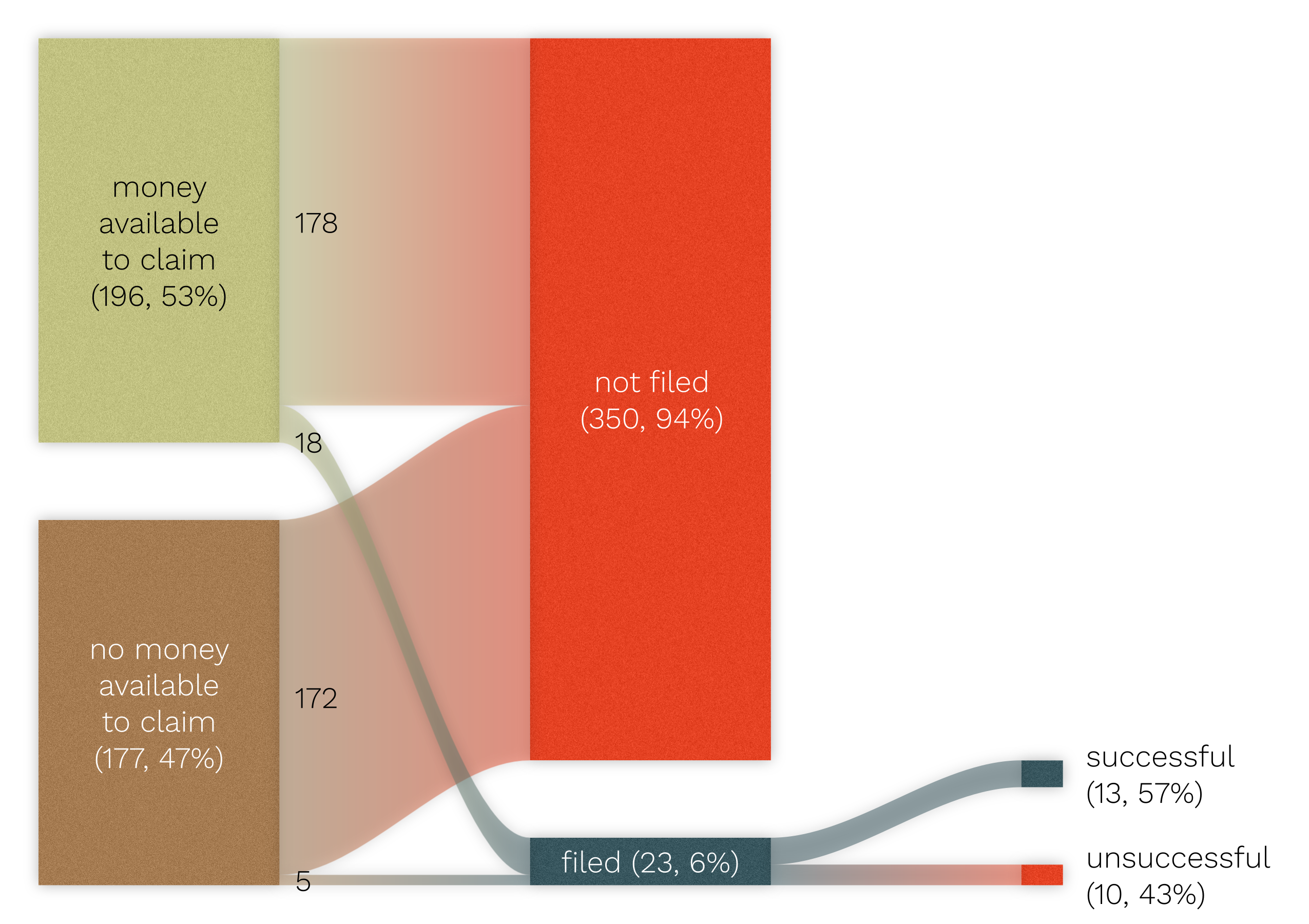
As the graphic describes, 6% of property owners successfully filed, while only 3% claimed their financial assets in Oakland County, Michigan. Of the 373 foreclosed homes in Oakland County, that means only 13 property owners successfully claimed the excess proceeds from their property’s auction. And even though their financial assets were claimed, it doesn’t mean the property owners received the full and perfect equivalent of the property taken by the government.
With Pung v. Isabella County scheduled for this term, the Supreme Court will decide what is owed when a taking occurs. When absolute title to property is taken to repay a debt, the government may retain only what is necessary to pay the debt—nothing more and nothing less. If anything is taken in excess, the full and perfect equivalent must be paid in return—and in some cases, like Pung v. Isabella County, that is equal to the fair market value.
States can avoid these pitfalls by removing the statutory schemes that burden homeowners. Pacific Legal Foundation’s model policy team created the Property Equity Protection Act, which several states have already adopted.
Several Americans, including the Pung family, are still being hurt by the unconstitutional practices of home equity and shadow equity theft. Pacific Legal Foundation will continue to advocate for the right to use and enjoy one’s property without government interference.