

The state wants to track lobstermen’s every move. One is asking the Supreme Court to end it.
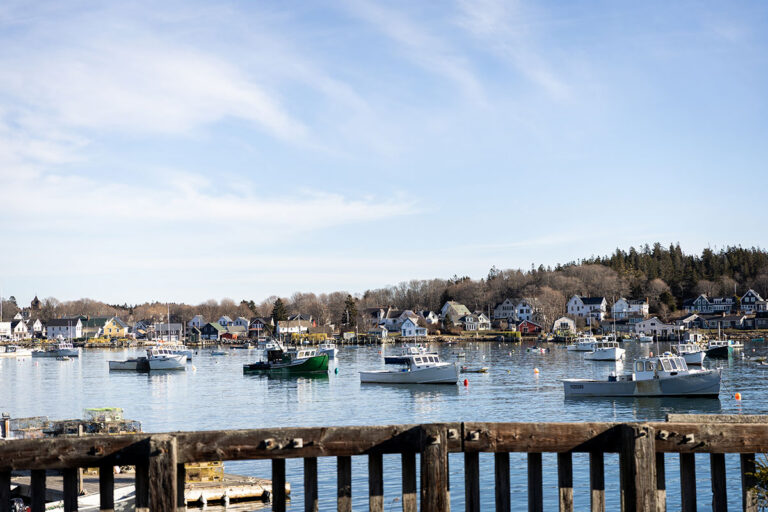
Everyone in Vinalhaven knows two things: the weather and the price of a lobster — $6.
Ten miles off the coast of Maine, this rugged outcropping of fewer than 1,300 people is one of the cradles of the New England lobster industry. Dark evergreens cling to the hillsides above its blue coves; granite cliffs take the full force of the North Atlantic. In summer, the sheltered inlets and bays are glassy and calm. In winter, near-hurricane-force winds whip over the waters and batter the island.
This is the place Frank Thompson calls home. It’s the only place he ever has.
Frank was two days old when he took his first boat ride. He was born at home on Vinalhaven, and two days later his parents put him on a boat to the mainland so he could meet his grandparents for the first time. He spent his boyhood sailing through the coves and inlets that ring the island, using the waterways the way other kids used sidewalks — for fishing, for recreation, for getting from one place to another.
That was more than 60 years ago. Frank, now a fifth-generation lobsterman, still hasn’t left.

Home base
“It’s something that’s born into you,” Frank says.
Walk into the Thompson home and you understand immediately what kind of life this is. The walls are covered with photographs and paintings of Frank and his sons’ fishing vessels. Model boats sit on shelves, on countertops, on top of the refrigerator. The kitchen and dining area offer a 270-degree view of the coves and waterways surrounding the house. You can watch the Captain E. Frank Thompson — the island’s ferry, named for Frank’s late father, a longtime ferry pilot here — chug past on its run between Vinalhaven and Rockland on the mainland. At least once a week, Frank pulls fresh lobster from a submerged crate in the cove out front, carries them up the hill, and drops them into a 10-gallon stock pot with a little salt water. There is no recipe, just good lobster, fresh as can be.
It’s the home that Frank built with Jean, his wife of 50 years. It’s where they celebrate holidays with their two boys, their daughters-in-law, and their five grandkids. And it’s where they run Fox Island Lobster Company. Frank is at the helm. These days Jean runs the books, but she’s put in her share of time on the water. When their boys were young, she was essential crew on their first boats. Maine law required a licensed adult on board if the engine was over 10 horsepower, and the boys wanted to fish as soon as they were big enough to reach the controls.
“They mostly just drove the boat and turned on the pot hauler,” Jean recalls. “That’s about what they did at that time. And I did everything else, but I enjoyed doing it with them.”
Frank laughs. “She did all the work.”
Frank’s sons earned their licenses the same way Frank did: by putting in the time, learning the water, and showing up. Now they fish alongside him.
“It’s nice seeing them on the horizon,” Frank says. “Both boats fishing alongside of me. It’s quite a comfort.”
A tracker on every boat
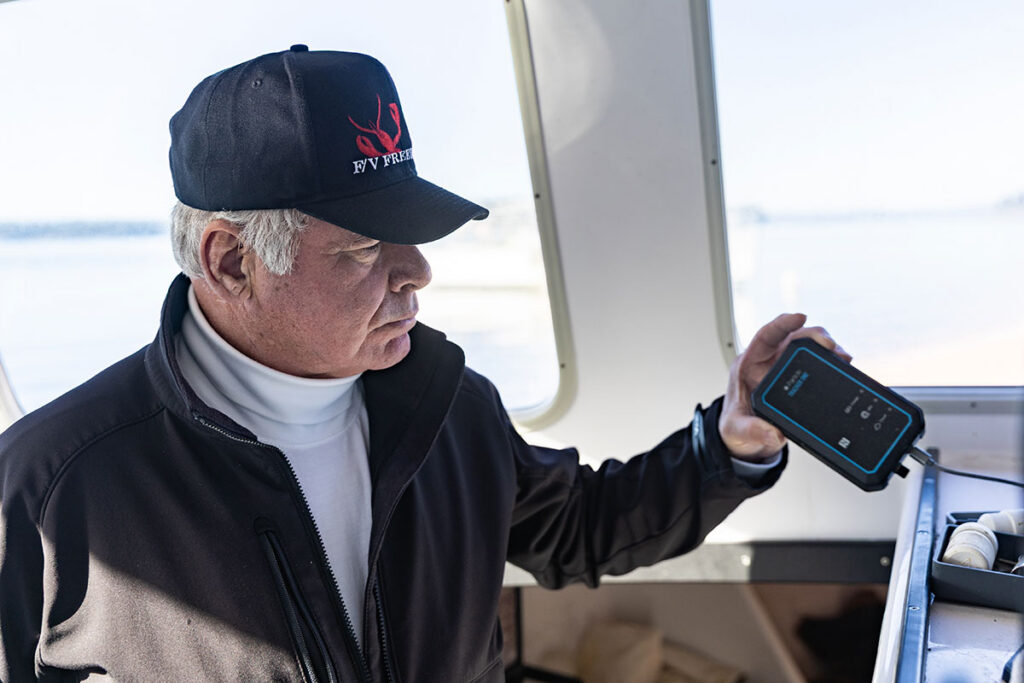
In December 2023, a new government rule changed something fundamental about life on the water for Frank and every other federally permitted lobsterman in Maine. Under a directive from the Maine Department of Marine Resources — itself responding to a mandate from a multi-state fisheries commission, backed by federal law — every lobsterman was required to install a GPS tracking device on their vessel and keep it there, permanently, as a condition of keeping their license.
Maine prohibits removing the device. It records the boat’s precise location every minute while moving, and every six hours when moored. The government tracks Frank around the clock — when he’s hauling traps, when he’s taking his family on a day trip, and when he takes islanders to the mainland when they need medical help.
Vinalhaven has a clinic, but no hospital or emergency department. When storms keep helicopters from reaching the island, Frank has often stepped in to race patients across the water for aid. It’s something he’s done for anyone in need since 1978, including members of his own family.
Five years ago, he whisked his daughter-in-law across the bay to deliver her baby. The whole family piled onto the boat, along with a small medical team. Frank pushed the vessel as fast as it would go. They made it to Rockland. His granddaughter was born minutes after they walked through the hospital door.
Under Maine’s law, all of these medical trips would be tracked, too.
Frank and his fellow lobstermen were already required to self-report their harvesting data — where and when they fished — under regulations that predate the GPS requirement. For years, Jean had been the one filing those reports, every time the boats moved. Maine’s own fishing commissioner once praised the lobster industry as “a model of conservation,” including two decades of participation in efforts to protect the fishery.
“I spent 60 years on the water,” Frank says.
I know where lobsters are — these young guys, they don’t steam as far as I do. They don’t know what I do. But if they put this black box together with the landings every day, they know where I’m fishing every second and every pound that I’m catching. And that’s going on tradition — taking my history, what I’ve learned, passed down to my kids.
What Frank knows about these waters took five generations to learn. The tracker exposes all of it.
“Where’s the freedom in this?”
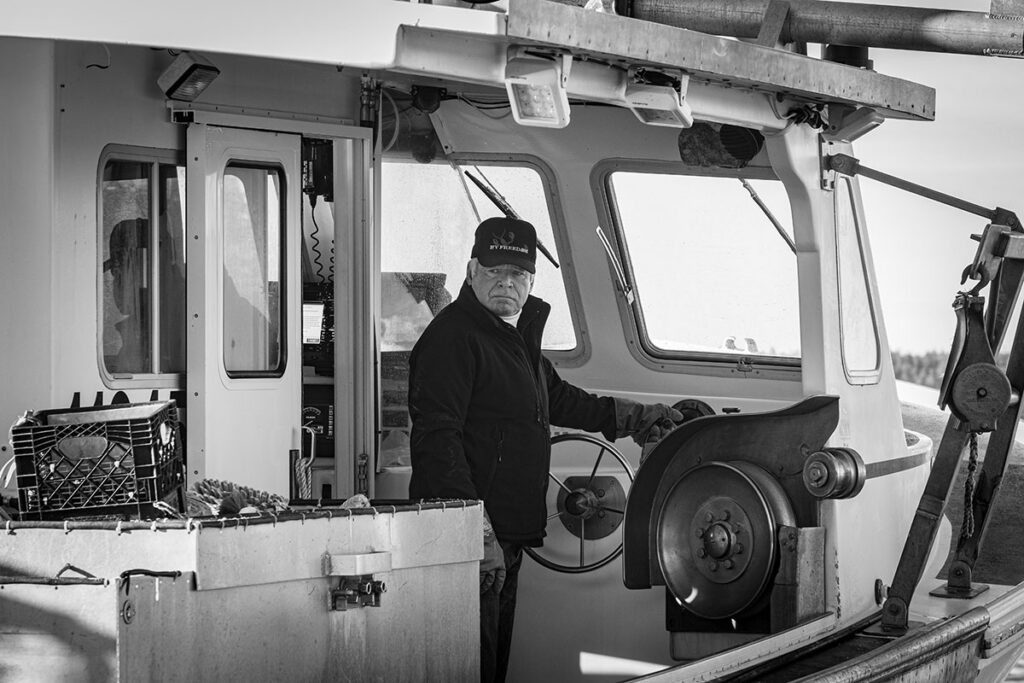
Frank named one of his boats Freedom. Another is Independence. A third is Obsession.
He has watched other fisheries regulated out of existence. Livelihoods and generations of fishing tradition, gone. He does not want that future for his sons.
“It’s just ridiculous how an industry that’s been around forever gets over-regulated until people are driven out of it,” he says. “It’s supposed to be a free country. But where’s the freedom in this? You throw the line off your boat in the morning, go to haul, and you’re looking over your shoulder wondering if the marine patrol officer is going to write you up.”
In January 2024, Frank sued the Maine Department of Marine Resources, arguing that requiring him to host a government GPS tracker on his private vessel — 24 hours a day, whether he’s working or not — violates the Fourth Amendment’s protection against unreasonable searches. The Fourth Amendment requires the government to obtain a warrant before searching private property.
Strapping a permanent surveillance device to his boat, without a warrant, is precisely the kind of government overreach the Framers had in mind when they wrote that guarantee. Unfortunately, lower courts have ruled that because lobstering is a “closely regulated industry,” normal Fourth Amendment protections give way to a government inspection exception.
PLF is asking the U.S. Supreme Court to review that decision — and to answer a question with consequences for business owners far beyond the fishing docks of Maine: does the government’s classification of your business as closely regulated give it the right to surveil your private property around the clock, without a warrant, even when you’re not working?
“I’d like to have a few years — what I’ve got left — not looking over my shoulder,” he says. “I’d like to have peace and quiet.”