

239 years later, the Constitution still depends on the people
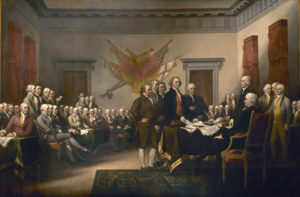
On September 17, 1787, delegates in Philadelphia signed the finalized U.S. Constitution. Two hundred thirty-nine years later, Constitution Day seems to hit a little harder than it has before. Perhaps it’s because we just celebrated America’s 250th birthday two months ago. Or maybe it’s because we lost constitutional scholar Gordon S. Wood a few weeks before Independence Day.
Wood spent his career examining what made the American Founding so revolutionary. This Constitution Day, his work also raises another question: What has allowed that revolution in government to endure for nearly two and a half centuries?
The American Founding and the Constitution it helped build turned the world upside-down and changed the relationship between government and the people, placing government under limits it had never answered to before.
A written Constitution can establish limits on government. But it cannot make government obey them. The gap between what the Founders wrote and what they could actually guarantee is the real story of the American experiment, and it’s the story Wood spent his career telling.
Across five decades of scholarship, Wood showed that the Constitution didn’t just create a government; it relocated sovereignty itself, taking ultimate authority out of the hands of government and placing it, permanently, with the people.
While the Framers debated what this new form of government might look like, the Anti-Federalists saw a problem: Classical political theory held that every state required one final, supreme, indivisible lawmaking authority, and if that authority rested with the new federal government, the states would inevitably be reduced to irrelevance.
Delegate James Wilson wasn’t content to let ultimate sovereignty reside with federal or state governments. As Wood explains in Power and Liberty, “The people retained ultimate sovereignty and doled out bits and pieces of their sovereign power to their different representatives and agents at both the state and national levels.”
Wood paraphrased Wilson’s thoughts during his appearance on the Harvard GSAS Colloquy Podcast just before his passing: “…we agree that there must be in every state one final lawmaking authority. It’s going to be in the people themselves.” (Emphasis added.)
But placing sovereignty with the people meant the success of the new constitutional experiment would ultimately depend on them too.
As the story goes, the day after the Constitution was signed, James McHenry wrote in his Convention journal that a woman—later identified as Elizabeth Willing Powel—asked Benjamin Franklin, “Well, Doctor, what have we got, a republic or a monarchy?” To which Franklin replied, “A republic, if you can keep it.”
Our constitutional republic was not designed for apathetic people.
Human history has a terrible track record when it comes to governments limiting themselves. Even those with the best of intentions can be tempted by the intoxication of power. As Wood wrote:
“What, in other words, would keep the new national government from succumbing to the same popular pressures, the same vices, that had afflicted the state governments?”
James Madison supplied the grim premise behind the answer to Wood’s question in a letter to Thomas Jefferson: “Wherever there is an interest and power to do wrong, wrong will generally be done.”
Limiting the government with words was one thing; enforcing through action was another. The Founders built safeguards into the Constitution, but keeping government within those limits would remain the responsibility of every generation that followed.
Madison understood the shortcomings of written limits too. In Federalist No. 48, he wondered whether written constraints would be enough to keep the government in line. He feared it might not be enough to simply trust those “parchment barriers against the encroaching spirit of power.”
If written boundaries weren’t enough to bind governments to the rule of law, then why bother with a written Constitution at all?
The Constitution’s “parchment barriers” provide the people with a measuring stick to which we can hold our governments accountable. Without them, we would have no way to know when governments step out of bounds.
What was missing, however, was what Madison referred to as a “practical security” measure to keep the three branches of government within their respective constitutional boundaries. And Federalist No. 51 identifies something even more fundamental: “A dependence on the people is, no doubt, the primary control on the government.” (Emphasis added.)
What does “dependence on the people” actually look like 239 years after the Constitution was adopted?
The people of the United States have the opportunity to vote politicians in and out of government; we can speak out, protest, petition, and challenge government action; and we can go to court when a government crosses a constitutional boundary.
That last mechanism is where organizations like Pacific Legal Foundation come in.
For over 50 years, PLF has been helping Americans fight back when governments step out of their constitutional bounds and violate property rights, deny equal treatment under the law, or exercise authority that belongs to another branch of government.
The Constitution gives us the measuring stick to keep government within its bounds, but it still requires people ready to use it—people like the countless PLF clients who are willing to stand up when their rights have been violated.
Perhaps that is what makes Constitution Day worth celebrating 239 years later. The Founders created an extraordinary system of constitutional government and entrusted ultimate sovereignty to the people. But they could not guarantee that future generations would preserve what they built.
As we celebrate this year, it is worth remembering not only the Founding generation and what they gave us but also what is required of each of us to ensure their experiment endures. Wood spent his career helping Americans understand the revolutionary system they inherited. But understanding that inheritance is only part of our responsibility. Keeping it is the other.
The Founders wrote the Constitution. They couldn’t make us keep it.