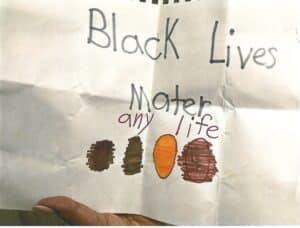


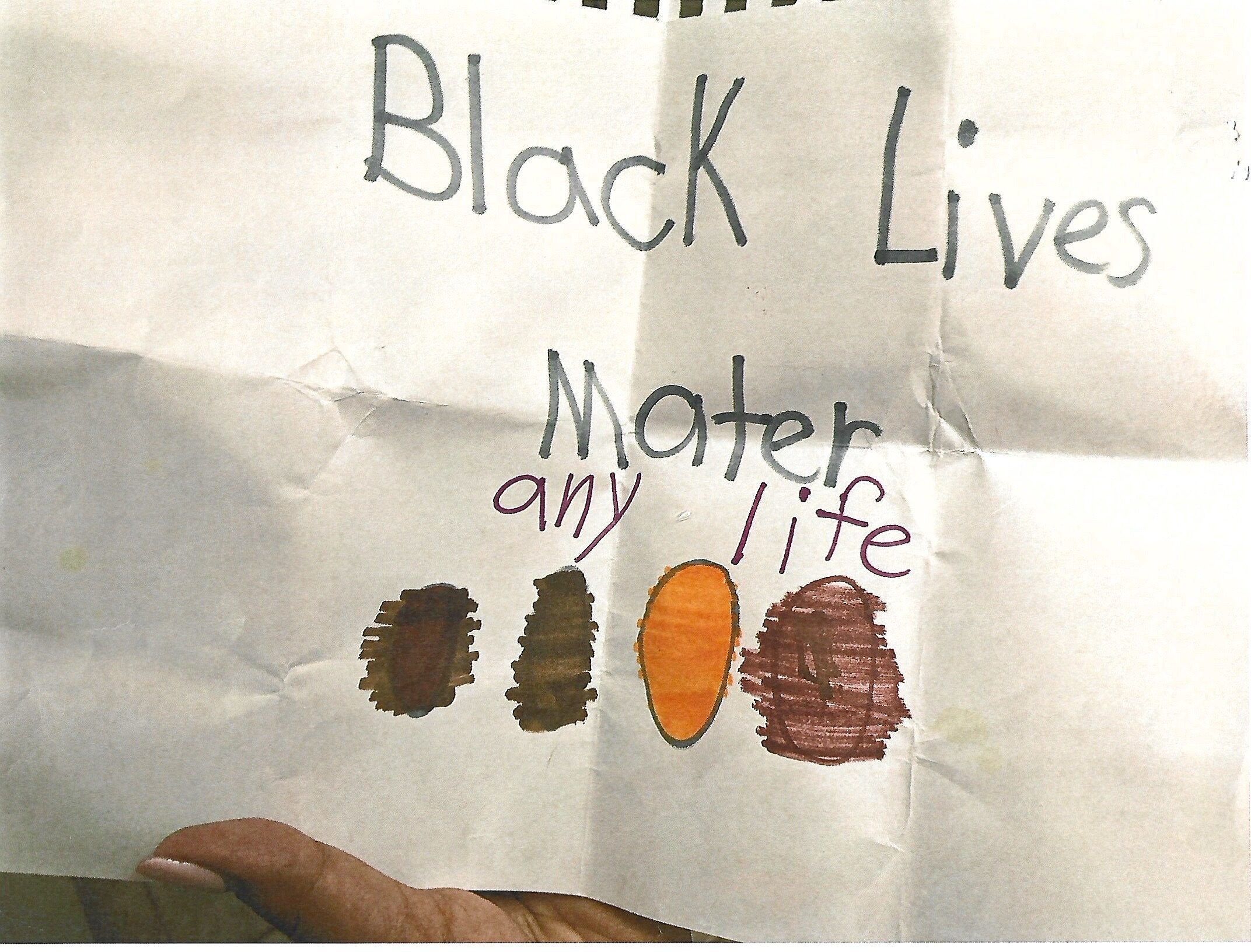
B.B.* was introduced to the phrase “Black Lives Matter” in her first-grade class in California, during a lesson about Martin Luther King, Jr. The lesson inspired her empathy and led her to draw a picture for her black classmate. B.B. drew a picture of them and two of the girls’ other friends and wrote “Black Lives Mater (sic)” across the top. Below, she added “any life” and handed the picture to her friend.
Little did she know her caring gesture would prompt a shocking overreaction from the school and a dangerous legal precedent that threatened to leave children completely stripped of their constitutional rights.
When B.B.’s classmate took the drawing home, her mother contacted the school, concerned that her daughter was being singled out for her race. In response, the school principal forced B.B. to apologize, denied her two weeks of recess, and banned her from drawing at school from that point on.
B.B. received no explanation of her supposed wrongdoing, and the friend for whom she drew the picture was equally puzzled by the apology. The school never even informed B.B.’s parents—the family only learned of the situation nearly a year later through another parent.
The school’s reaction to a child’s innocent drawing reflects a concerning trend of race obsession in public education—a fixation that runs contrary to fostering a truly inclusive school environment that values each student as an individual.
To the school, it didn’t matter that B.B.’s intentions were laudable—or that she was unaware of the controversy her innocent addendum sparked among the adults around her. Instead, school administrators punished her for saying something someone else might find offensive.
B.B.’s mother filed a federal lawsuit against the school district to vindicate her daughter’s First Amendment rights. Initially, a federal district court upheld the school’s actions, reasoning that elementary school students simply have no First Amendment rights in the classroom.
An elementary school is not a totalitarian environment in which students have no rights. The district court was wrong to claim otherwise and set a dangerous precedent that would have totally stripped away the First Amendment rights of elementary school students.
Luckily, the story didn’t end there.
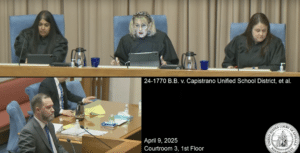
Represented by Pacific Legal Foundation at no charge, B.B. and her mother fought back, appealing the lower court’s ruling to the United States Court of Appeals for the Ninth Circuit.
In March 2026, the Ninth Circuit vacated the district court’s judgment and ruled that elementary school students have the same First Amendment rights in the classroom that they do everywhere else in the country. The Ninth Circuit’s ruling also held that schools bear the burden of proving any restriction on student speech is reasonably necessary, establishing precedent that will defend future students’ rights against injustices like the ones that B.B. faced and successfully overcame.
*PLF’s client is a minor using the pseudonym B.B. for privacy.
What’s At Stake?
- It is unconscionable for an elementary school to severely punish a first-grader based on an innocent drawing. And the district court was egregiously wrong to hold that elementary school students do not have First Amendment rights in school. First-graders have free speech rights like every American.
- The school’s massive overreaction to a young child’s innocent drawing reflects a worrying trend of race obsession in public education that’s contrary to fostering a truly inclusive school environment that values each student as an individual.