


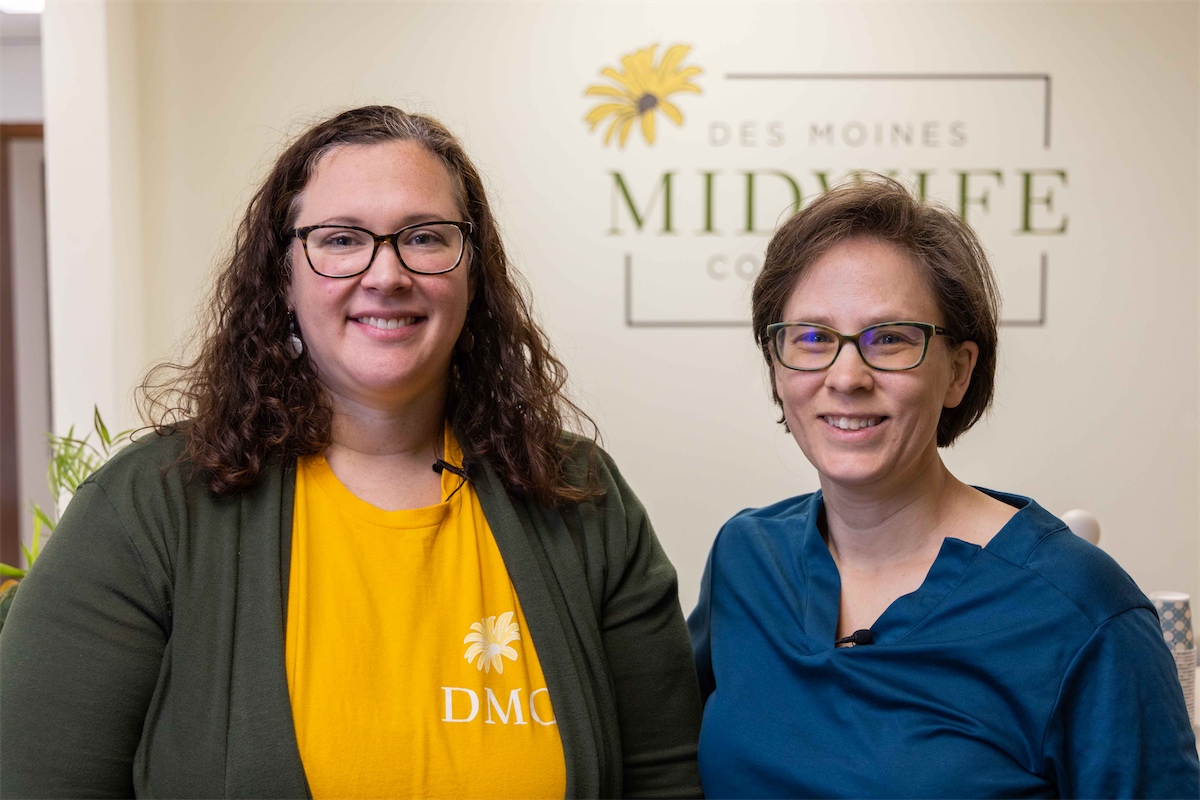
Emily Zambrano-Andrews always had a passion for helping expectant parents bring children into the world. But ten years as a registered nurse working in obstetrics only led to her frustration with Iowa’s hospital birth system.
Caitlin Hainley had similar frustrations. Caitlin was a registered nurse and lactation consultant who had attended childbirths and provided postpartum care to women for many years. The two women both came to view midwifery as a solution. Accordingly, they attended Frontier Nursing University, became Doctors of Nursing Practice, and attained full licensure as Certified Nurse Midwives.
They opened the Des Moines Midwife Collective, a homebirth practice that honors the wishes of women of all income levels to give birth safely and comfortably outside of a hospital setting. Because of the Iowa law, Caitlin and Emily were challenging why they could not have their own safe midwifery location. Instead, they had to use their clients’ own homes or other locations pre-arranged by clients, including hotel rooms, short-term rentals, or friends’ houses.
The Midwife Collective was also Des Moines’ only homebirth service that was insured and accepted insurance, including Medicaid, allowing them to charge out-of-pocket rates as low as $1,500. By contrast, the only physical birth center in the state charged upward of $10,000. It was no surprise that demand for their safe, effective, and affordable service surged.
Emily and Caitlin wanted to accommodate their growing clientele and broaden their range of childbirth options with the most logical solution: opening a freestanding birth center.
Lower costs, greater autonomy, a homey atmosphere, and compatibility with personal or religious values contributed to birth centers’ increasing popularity among women with low-risk pregnancies. Staffed generally by midwives, these birth centers provided pre-pregnancy, pregnancy, and postpartum care. And research had shown birth centers were a safe option for mother and child.
Home birth is legal in all 50 states. Iowa is no exception. Freestanding birth centers were also legal in Iowa, but anyone wishing to open one had to first endure a complex, lengthy, and expensive Certificate of Need (CON) process to prove it was needed. Worse, prospective birth centers also required permission from their direct competitors, the most important of which were hospitals—even for the modest two-to-five-bed center planned by Emily and Caitlin.
This “competitor’s veto” gave established businesses, rather than expectant mothers, the right to determine what options were available for giving birth. Nor did this process serve health or safety; it served only to insulate established businesses from competition.
By granting hospitals veto power over new birth centers, the state prevented people like Emily and Caitlin from offering Iowa’s expectant mothers a safe alternative. It was no surprise that Iowa has no other freestanding birth centers, despite a loss of 40 birthing units since 2001, and rural hospitals throughout the state continued to struggle and close.
It was bad enough that in the face of dwindling options for birth, Iowa’s entrenched interests were stymieing innovation through the burdensome CON process. But the state’s competitor’s veto law violated the rights of Caitlin and Emily to provide critical childbirth care and the fundamental right of Iowa mothers to decide the place and manner of giving birth.
Represented free of charge by Pacific Legal Foundation, they fought back with a challenge to Iowa’s CON law.
Joining PLF on this case is Alan Ostergren, president and chief counsel of the Iowa-based Kirkwood Institute.
In 2025, new legislation mooted the lawsuit.
What’s At Stake?
- The government shouldn’t shield established businesses from competition. Protecting industry insiders stops entrepreneurs from pursuing their calling and reduces access and choices for underserved consumers.