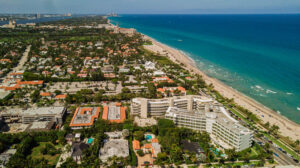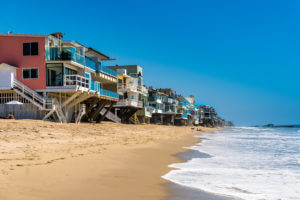


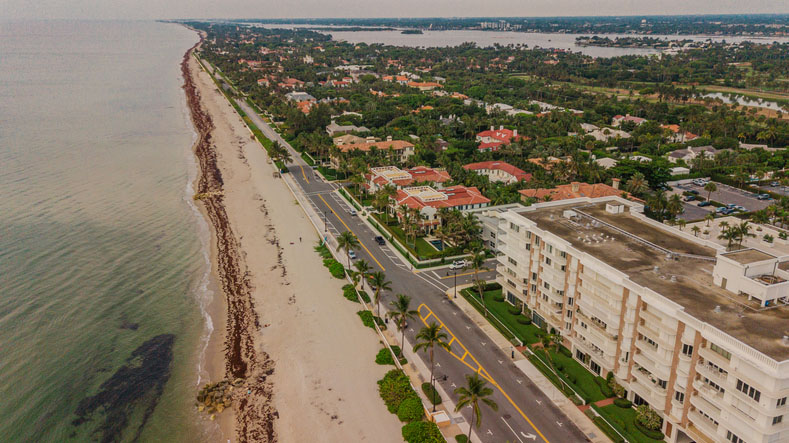
For two decades, Leslie Daniels has owned a beachfront home in Palm Beach, Florida. His property includes a sandy beach parcel that extends from a concrete seawall down to the state’s Erosion Control Line—land he holds title to, pays taxes on, and uses for personal enjoyment and family gatherings.
For most of that time, the Town of Palm Beach agreed the beach was his. Town maps labeled it private. Police responded to trespassing complaints and moved unwanted visitors off the property. When trespassing increased around 2020, town officials even instructed Daniels to install posts marking his property boundaries so officers could enforce the law.
Then the town reversed course.
In late 2021, Palm Beach officials announced a new policy: the public had an easement for “traditional beach use” on private sandy beaches where renourishment projects had added sand—including Daniels’ property. The town based this claim on a Florida statute that had been on the books for 60 years but had never been interpreted to impose a public easement on private land merely because sand was added. Police received orders to stop enforcing trespassing laws on Daniels’ land. When strangers settled on his beach and refused to leave, officers told Daniels they would not remove them. The town council president told him his beach was not private. The town manager testified that the public could use Daniels’ land and that he had no right to keep them off.
The town also forced Daniels to remove the very posts and “private property” signs it had told him to install, calling them prohibited “structures” under the town code. When Daniels switched to small plastic cones with private property messages, the town ordered those removed too.
Daniels filed a federal lawsuit challenging the town’s actions as an unconstitutional taking of his property and a violation of his First Amendment right to post signs on his own land. Now represented by Pacific Legal Foundation, Daniels is pressing his case in federal court.
What’s At Stake?
- Government cannot open private dry beach property to public use without paying just compensation for taking the property.
- Government cannot reclassify private beachfront property as a public beach simply because it added sand at one point with the owner's consent.