

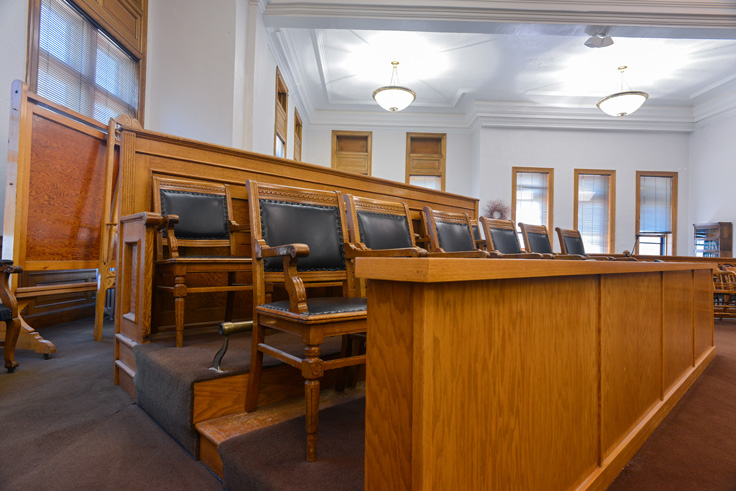
In an enforcement case involving punitive penalties and disputed facts, Americans would normally expect the government to have to prove its claims before a jury. The Seventh Amendment guarantees that right. They would also expect an independent judge, not the agency itself, to preside over that proceeding.
That’s not what happened to husband and wife Jammi and Scotty Wilson. The Wilsons, along with their company, Six Shooters Investment Group, LLC, operate an animal auction in Madison, Florida, where animals such as goats, zebras, and antelopes are sold from owners to zoos, pet stores, and individual buyers. Owners wishing to sell animals must send a health certificate signed by a licensed veterinarian, and the Wilsons employ a full-time attending veterinarian to conduct rounds daily to observe and monitor each animal.
The Wilsons were surprised when an inspector from the Animal and Plant Health Inspection Service (APHIS), an agency of the United States Department of Agriculture, alleged that they’d violated the Animal Welfare Act. The inspector initiated an enforcement action with fines of up to $14,575 per violation—enough to threaten their ability to stay in business. They denied every alleged violation.
Rather than proving its claims in a real court, the USDA forced the Wilsons through its in-house adjudication process. In this process, administrative law judges—who work for the very agency bringing the charges—hold a hearing and make an initial decision, which can be appealed to the USDA’s judicial officer.
The judicial officer who issues final rulings in these cases wields enormous power—but was never appointed by the president or confirmed by the Senate as the Constitution requires. Because the judicial officer lacks that proper appointment, the ALJs below him lack the oversight the Constitution demands. These ALJs also enjoy multiple layers of job protection that make them nearly impossible to remove, further insulating them from accountability to the American people.
When the Wilsons challenged that process from within the agency, the ALJ predictably ruled in the agency’s favor and denied their motion to dismiss. Represented free of charge by Pacific Legal Foundation, the Wilsons filed a federal lawsuit challenging the constitutionality of the USDA’s adjudication process.
This case is part of PLF’s broader work challenging whether federal agencies can continue bypassing neutral courts to adjudicate themselves the very citizens they are prosecuting. If a citizen has broken the law, a real court—not the agency itself—should be the one to say so.
What’s At Stake?
- The Constitution guarantees a neutral judge and jury when the government seeks to financially penalize you for alleged violations of the law. Government agencies cannot use in-house tribunals to circumvent this right.
- The Constitution requires that officials exercising significant government authority be appointed by the president and confirmed by the Senate. When that power is held by officials who were never subject to that process, there is no meaningful accountability to voters or to the law.