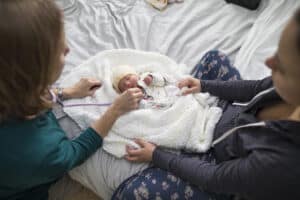


Increased access to Certified Nurse Midwives improves maternal and prenatal health

For Hope Lindstrom, the question of where and how to give birth is deeply personal.
As a devout Christian and licensed pastor, she views childbirth as a sacred experience—one that centers her as an active, empowered participant in her care. Her preference is also guided by stories from her mother and grandmother, both of whom endured traumatic hospital births. She wants to avoid unnecessary interventions and allow her body to labor naturally whenever possible.
Hope delivered her first child at a birth center in Oregon, where she worked closely with certified nurse midwives (CNMs) who focused on building trust and understanding her values before delivery. Care was personal rather than clinical. After her baby was born, the midwives even visited her at home for postpartum care.
When Hope began trying for a second baby, she knew she’d want to give birth at home with the support of CNMs. Unfortunately, her family had since moved to Nebraska, a state that prohibits CNMs from attending home births.
Distraught at the prospect of giving birth in a hospital, Hope believes her anxiety may have affected her ability to conceive. After learning about the state’s limited birth options, she struggled for six months to become pregnant. Once she connected with the midwife team leading the effort for birth freedom in Nebraska, Hope says her anxiety eased, and she soon conceived. She is now fighting in court for her right to birth freedom, not only for her own upcoming delivery but for every Nebraska mother who will follow.
New research corroborates Hope’s concerns, revealing that increased access to healthcare professionals, including nonphysicians such as CNMs, leads to better health outcomes for both mothers and infants.
Expanding Certified Nurse Midwife Practice Authority Enables Early and Regular Prenatal Care Visits analyzes how a delay in prenatal care of as little as three days can affect whether a child is born underweight or even survives birth. Although three days may seem insignificant, the data overwhelmingly demonstrates that access to qualified nonphysician clinicians can improve maternal and child health.
Although the United States is considered a high-income country, it has the highest infant mortality and maternal death rates in the developed world. Due to excessive healthcare bans, mothers have limited access to necessary prenatal and postnatal care. Even if birth facilities are nearby, there is no guarantee that each mother will have access to a provider.
Over half of Nebraska counties, for example, are designated as maternity care “deserts,” which may contribute to the state’s high maternal mortality rate. In the face of such a crisis, restrictions on access to qualified healthcare professionals are difficult to justify.
“The lack of physicians in primary care affects the availability of prenatal and postnatal care visits, especially in states that require collaborative practice agreements, where the shortage of physicians may indirectly prevent the practice of nonphysicians,” the reports’ authors wrote.
According to the new research, “a late first prenatal care visit is associated with low birthweight and marginally higher odds of birth defects.”
For Hope Lindstrom, access to high-quality, timely medical care is vital to her health and that of her new baby. Hope is expected to give birth soon, but Nebraska’s laws are restricting access to a CNM being present for her child’s birth—which could determine her health and the health of her new baby.
Yet these oppressive laws aren’t restricted to Nebraska. Many other states have burdensome regulations that harm mothers and their children, Caitlin Styrsky and Jaimie Cavanaugh wrote. Considering PLF’s new research, states ought to remove regulations that harm women and their children and pass laws that promote health instead.