

The UK is on track to restrict jury trials—and the U.S. could be next.
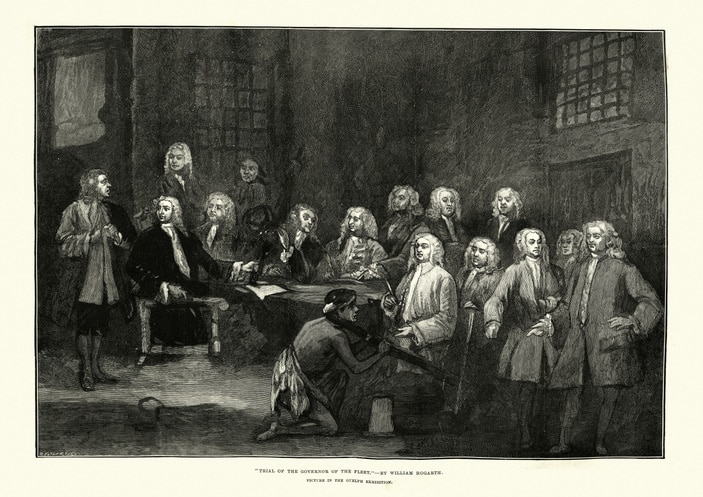
This week, British Deputy Prime Minister and Lord Chancellor (a position comparable to the U.S. Attorney General) David Lammy addressed the House of Commons, arguing that legal reform is desperately needed to clear up the backlog of criminal cases. The Crown Court faces an unprecedented number of backlogged cases, which could exceed 100,000 by 2028. Based on an independent research report published last year, Lammy proposed that unless defendants are accused of serious offenses—including rape, murder, aggravated burglary, blackmail, people trafficking, grievous bodily harm, and the most serious drug offences—they most likely won’t receive a jury trial.
Although English Common Law relies upon the ancient right of trial by jury rooted in Magna Carta, Lammy said that “we must never forget that [Magna Carta] implores us not to deny or delay justice.” In his eyes, because the backlog and prolonged trials delay justice, necessary legal protections, including jury trials, can be sacrificed. These alarming assertions from the House of Commons highlight a similar problem here in America: Federal agencies and state commissions have already restricted the right to jury trial in several instances.
Even though the Seventh Amendment provides for a jury trial in civil cases for the U.S., state and federal governments have established civil schemes to fine people for legal violations without an independent court or a jury. The Supreme Court has exacerbated the issue by creating carve-outs for agencies, allowing them to serve as judge, jury, and executioner. Thankfully, the U.S. is fighting to avoid the trap that the UK has fallen into.
The UK’s jury trial debacle
In December 2024, Sir Brian Leveson was appointed to conduct an independent review of the UK’s criminal justice crisis. Alongside three other experts, Leveson identified over 75,000 backlogged cases, and the number continues to rise. Leveson’s research indicates that this crisis signifies an unacceptable delay in justice, severely affecting victims, witnesses, and defendants and weakening public trust. Although the delayed justice is alarming, Leveson’s proposals are not the solution.
Some of the most concerning proposals include granting judges the authority to deny “a jury trial in the Crown Court for offences which carry a maximum sentence of two years or less.” Another proposal includes removing jury trials for complex fraud cases, focusing on expedience rather than justice.
Former Lord Chancellor Shabana Mahmood commented on these proposals last summer, saying that even though “[j]ury trials … remain a cornerstone of our justice system in the most serious cases, … we must ask whether there are cases being heard by juries today that need not be heard by juries in [the] future.”
While Mahmood addresses the problem, her solution is misinformed. She has forgotten that jury trials are intended to be a check on government abuses, which is why the barons approached King John in 1215 to sign Magna Carta, requesting the right to trial by jury.
Jury trials are designed to include the voice of the people and guard against unjust and unfair rulings, which makes the statements by the former and current lord chancellors even more alarming. Proposing to eliminate jury trials for cases less serious than the most severe crimes is neither fair nor just—and claiming that a right to trial by jury is nonexistent violates Magna Carta’s historical protections.
Several barristers implored Mr. Lammy, asking that he add “more court sitting days in existing courts, and judges and lawyers to staff them,” rather than removing the fundamental right to trial by jury. Although Lammy clarified in his address to the House of Commons that the UK is “proud of our justice system, rooted in the Magna Carta,” he justified his reforms with the following statement: “When victims are waiting for years, justice is effectively denied—and this is a betrayal of our legal heritage and is a betrayal of the victims themselves.” Even though Lammy offered millions of dollars to increase court sittings so that judges could hear more cases and provide swift legal decisions for victims, he reaffirmed his proposal to eliminate jury trials in most civil and criminal cases.
Although jury trials will not be effectively restricted until legislation passes Parliament, the current developments are concerning. The foundational question hinges on justice—one that Mr. Lammy has failed to answer correctly. While removing jury trials may ease the backlog, it will sacrifice justice in the long term.
This is why the colonists and anti-federalists advocated for structural protections for jury trials; without them, the flame of liberty would die.
Eerie similarities in the U.S.
Sadly, the Seventh Amendment’s guarantee of a civil trial has been hollowed out through congressional delegation and Supreme Court precedent. Instead of providing a jury trial, state and federal agencies and commissions responsible for enforcing the law also serve as judge and executioner, often imposing excessive fines. This leaves American citizens vulnerable to the same ills that afflict the British government, and it is why the U.S. declared its independence almost 250 years ago.
A new documentary highlights how the government’s arbitrary infringement of individual rights occurs through state-level agency adjudications. PLF reveals how Governor Gavin Newsom has aided and abetted the California Coastal Commission in its abuse of the Coastal Act. In 2016, Warren Lent was fined over $4 million for failing to comply with the Coastal Act, and in the end, the Lents had to sell their home to pay the fines. While the UK’s present actions are concerning, the U.S. has already implemented similar practices, as evidenced by the stories detailed above.
Before the American Revolution, the colonists viewed jury trials as “the most effective means available to secure the independence and integrity of the judicial branch of the colonial government.” Jury trials, in their mind, served as a check on tyrannical government, including the British government at the time. And in 1776, the colonies established themselves as independent states, emphasizing their right to trial by jury. In the Declaration of Independence, Thomas Jefferson wrote that the British Crown “depriv[ed] us in many cases, of the benefits of Trial by Jury.”
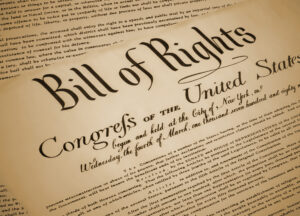
Therefore, when the Constitutional Convention of 1787 failed to add a provision protecting civil jury trials, the people protested. The Federal Farmer believed that the “trial by jury is…essential in every free country.” Thanks to the persuasive arguments proposed by the Anti-Federalists, the Bill of Rights ensured the right to a jury trial, one that James Madison eventually supported as well: “[t]rial by jury…is as essential to secure the liberty of the people as any one of the preexistent rights of nature.”
We have “improved on the British model, by rendering our public functionaries more responsible to the people,” Richard Bland Lee said during the first Congress. Mr. Lee also noted that we are indebted to the example of historical figures like Publius Cornelius Tacitus, who kept the flame of liberty alive, including the valuable trial by jury and popular sovereignty.
The Seventh Amendment provides structural protections that allow the people to participate actively in government. But agencies and state commissions are violating these structural protections, restricting the individual rights and voice of the American people. With the help of Pacific Legal Foundation, several groups and individuals are suing the Federal Trade Commission (FTC), the Horseracing Integrity and Safety Authority (HISA), the National Labor Relations Board (NLRB), the Financial Industrial Regulatory Authority (FINRA), the U.S. Department of Agriculture (USDA), and the Consumer Product Safety Commission (CPSC) for their unfair and abusive legal practices.
The Supreme Court has erroneously created exceptions that allow agencies to ignore the constitutional right to a jury trial, harming Americans like Frank Black, Barry Sturner, Bill Walmsley, and Jamie Leach. Although the Supreme Court has partially restored the right to trial by jury in civil cases, there is still more work to be done, and PLF continues to advocate for Seventh Amendment protections at the state and federal levels.
While our political scene may seem far off from the UK’s current debates, we are experiencing a silent legal revolution right before our eyes. Unless we act swiftly to protect and preserve the structure of our Constitution, we could be in the same deep waters as the UK.